
Data centers are being fast-tracked at the federal level despite documented human health and environmental effects. Data centers bring together nearly every type of pollution, from air, water, and land pollution to harmful noise, EMF, and fire risk. Yet the regulatory frameworks in place to allow development lack the holistic oversight needed to address these compounding, multi-system impacts. Communities are blindsided by well-financed corporate pushes, while existing policies evaluate only a few hazards in isolation, creating massive loopholes that fail to protect public health and the environment.
Hyperscale data centers are enormous industrial- facilities that can span hundreds of acres and contain hundreds of thousands to millions of servers. They require massive amounts of electricity, water, cooling infrastructure, transmission lines, diesel generators, and industrial equipment.
This page summarizes critical health and environmental issues along with key recommendations to protect communities.
Jumplinks:
- Key Environmental and Health Risks of Data Centers
- Air Pollution
- Energy Demand
- Forever Chemicals and PFAS
- Noise Pollution
- Water Impacts
- EMF Exposure
- Thermal (Heat) Pollution
- Fire Risk
- Herbicide Spraying
- Light Pollution
- Supply Chain Human Rights Abuses and Critical Mineral Exploitation
- E-Waste
- Nuclear Power Health Risk
- Flooding Risk
- Data Center Infrastructure Can Contribute to Endocrine Disruption
- The Federal Push to Fast-Track Data Centers
- What You Can Do
- Key Information on High Voltage Transmission Lines and EMF Exposure
- Key Resources
The Key Environmental and Health Risks of Data Centers
Data Centers Increase Air Pollution
The American Lung Association’s “State of the Air” 2026 report identified data centers as an increasing source of air pollution concern due to both their electricity demand and diesel backup generators. Data centers rely on dozens of diesel generators that emit particulate matter, nitrogen oxides (NOₓ), and other pollutants linked to asthma, heart disease, and premature death.
- MIT News states 60% of the increased electricity demands from data centers will be met by burning fossil fuels, with a Goldman Sachs report estimating increased global carbon emissions of about 220 million tons.
- A report by Caltech and University of California Riverside estimates data center air pollution will contribute to 1,300 premature deaths every year in the U.S. by 2030, disproportionately affecting certain low-income communities.
- Research by Virginia Commonwealth University found data center air pollution in Northern Virginia has risen sharply as the number of facilities has grown.
Data Centers Increase Energy Demand and Strain the Grid
AI data centers require enormous amounts of electricity, driving electrical grid expansion (new substations and transmission lines) that’s often paid for by residents, not the data center companies. To satisfy these massive power needs, utility providers are increasingly firing up fossil-fuel plants and delaying the retirement of legacy coal facilities. This prolonged reliance on dirty energy floods the atmosphere with greenhouse gases and intensifies regional air pollution.
Data Centers Increase Forever Chemical PFAS Contamination
Data centers host tens of thousands of servers that run 24/7 and they require semiconductors, cooling systems, water treatment chemicals, and fire suppressants – all sources of PFAS forever chemicals. Many projects are using two-phase immersion cooling, which uses PFAS.
PFAS are persistent environmental pollutants linked to cancer, immune dysfunction, reproductive harm, and other serious health effects. The Environmental and Energy Study Institute reports that data centers are driving expanded PFAS material manufacturing that has already been linked to widespread drinking water contamination.
Chemours, one of the largest global producers of PFAS and one of the biggest suppliers of PFAS materials for data center coolants and semiconductor production (semiconductors are used to make data center microchips) stated in its 2026 Report, “The company aims to expand production of its PFAS materials, in particular resin for semiconductor manufacturing, to accommodate the growth of data centers across the country.” In 2026, the company reached a $450 million settlement for poisoning the Cape Fear, Delaware, and Ohio rivers with PFAS.
Data Centers Create Harmful Noise Pollution
The industrial machines of data centers produce continuous 24/7 noise spanning multiple frequencies. Research has found that anthropogenic noise can increase stress, disrupt sleep, and impact sleep, mental health, and cognitive performance, which can lead to poor school or work performance. These frequencies can propagate long distances, and while many are inaudible to humans, many animal species such as cows, have wider hearing ranges. Noise generated by data center operations can contribute to chronic stress in livestock and wildlife, as scientific studies have shown that prolonged exposure to elevated noise levels can increase stress hormone concentrations (e.g., cortisol and corticosterone), elevate heart and respiratory rates, disrupt feeding, breeding, and communication behaviors, impair immune function, and reduce overall productivity.
- Infrasound (<20 Hz) and ultrasonic noise (>20,000 Hz) is the extremely high frequencies hat sit above the threshold of human hearing.
- Tonal and low-frequency noise consists of continuous, often low-frequency hums between 50 Hz and 200 Hz, that are perceived as a distinct pitch, whine, or drone. It can be detected for several miles.
- Vibration from cooling equipment, generators, pumps, and other mechanical systems can travel through the ground and nearby structures, affecting people and wildlife. Because it is not routinely measured in conventional noise assessments, vibration impacts may be overlooked during project review.
Data center noise is inadequately measured and monitored. Traditional noise ordinances typically rely on A-weighted decibel (dBA) measurements and may not adequately assess the low-frequency, tonal, infrasonic, impulsive, and continuous noise generated by hyperscale data centers. In addition, standard noise monitoring equipment does not capture the full range of these emissions, meaning facilities can comply with conventional noise limits while still causing significant community impacts.
Data Centers Impact Water Availability and Quality Increasing Toxic Contaminants
Large data centers consume millions of gallons of water for cooling, placing strain on local water supplies while discharging heated wastewater back into rivers and waterways. This wastewater, also called blowdown, may contain salts and minerals, corrosion/scaling inhibitors, biocides, heavy metals from piping systems, refrigerants, and PFAS chemicals. In addition, the elevated temperatures may further concentrate existing contaminants and worsen water contamination issues already affecting communities. Warmer discharge water can reduce dissolved oxygen levels, stress fish and aquatic organisms, promote algal blooms, and cause long-term changes to aquatic ecosystems.
For example, an Amazon Data center in Oregon agreed to a $20.5 million class-action settlement following allegations that its server-cooling process concentrated nitrate-laden wastewater, contaminating local wells and causing health issues, including miscarriages, kidney failures, and cancers.
Hyperscale data centers often permanently extract millions of gallons of water daily. Instead of returning to the local watershed via treatment plants, this water is evaporated into the atmosphere, directly starving local aquifers, lowering the water table, and driving regional water scarcity.
Water demand associated with data centers is projected to rise dramatically, with some estimates projecting annual increases of up to 400% for electricity-related water use and more than 870% for direct cooling operations. In some areas, intensive groundwater extraction may also lower water tables and degrade the quality of local wells by increasing sediment and contaminant concentrations.
Data Centers and Their High Voltage Transmission Lines Increase EMF Exposure
Data centers can increase environmental electromagnetic field (EMF) levels through the power lines, substations, transformers, and electrical distribution systems that supply them, as well as through internal equipment that generates extremely low frequency (ELF) fields, power quality distortion and harmonics (“dirty electricity”), electromagnetic interference. EMFs are linked to cancer, miscarriage, Alzheimer’s and other health impacts.
A Bloomberg report of over 770,000 sensors documented more than three-quarters of highly distorted power readings in the U.S. occur within 50 miles of large data center activity. More than half of the households experiencing the worst distortions were located within 20 miles. The issue of power quality, known as “harmonics”, happens when the normal flow of electricity in steady waves is disrupted, causing erratic spikes and dips in voltage. Unaddressed, this can lead to sparks, damage to appliances and even home fires. Harmonic distortion can also alter the electrical environment inside homes, affecting health, as the currents can travel along interior household wiring and increase EMF exposure within living spaces. Further, cellular tower antennas can be added to infrastructure (data center campuses and powerlines) once they are built, adding overlapping sources of non-ionizing EMF exposures.
Data Centers Create Thermal Pollution
Data centers generate enormous amounts of heat from continuously operating servers and cooling systems. This heat can warm surrounding neighborhoods and increase energy demand for nearby residents as they need more air conditioning. Reports estimate land surface temperature increases by 2°C on average after the start of operations of an AI data centre, inducing local microclimate zones, called the data “heat island” effect.
Facilities that discharge heated water can also harm aquatic ecosystems by reducing oxygen levels and stressing fish and wildlife.
Dara Centers are a Fire Risk
Data center fires are increasingly reported, with recent fires linked to battery failures, electrical faults, and equipment malfunctions. A collaborative engineering study by researchers at George Washington University and the University of California, Berkeley, analyzed the common causes of data center fires, highlighting the fire risks associated with large-scale battery systems in data centers. In particular, fires can be triggered by “thermal runaway,” a process in which chemical reactions within batteries generate excessive heat. The researchers also identified key strategies to mitigate these risks, including to closely follow the NFPA and IFC fire safety standards and implementing fire-safe designs, advanced sensors, alarms, suppression systems, and comprehensive fire safety plans.
The International Association of Firefighters recommends finding out if lithium-ion batteries are being used as a back-up power source, because, if those malfunction, they can become explosive.
“Due to the size of these data centers, some may have thousands, or even millions, of these batteries on-site,” Jasen Dodson, a Loudoun Career Fire Fighters Local 3756 member, stated. “Fire safety standards, building codes, and the safety of lithium-ion batteries are improving, but fire department responses to data center battery incidents are likely to increase in frequency until the hazards can be engineered out.”
Data Centers Include Herbicide Spraying
Utilities commonly use herbicides, including glyphosate, to maintain access for trucks and heavy equipment. Yet there is limited public reporting, transparency, or oversight regarding the amount sprayed, frequency of application, and assessment of the contamination of nearby streams, wetlands, forests, wildlife habitat.
Data Centers Create Light Pollution
Hyperscale data centers require all-night lighting that disrupts the natural (circadian) rhythms of the body, including melatonin, which regulates sleep-wake cycles. This impacts humans as well as animals, putting wildlife at risk. Light pollution can disrupt migration patterns, reproduction, and feeding habits as well as confuse and disorient a wide array of species.
Data Centers Drive Supply Chain Human Rights Abuses and Critical Mineral Exploitation
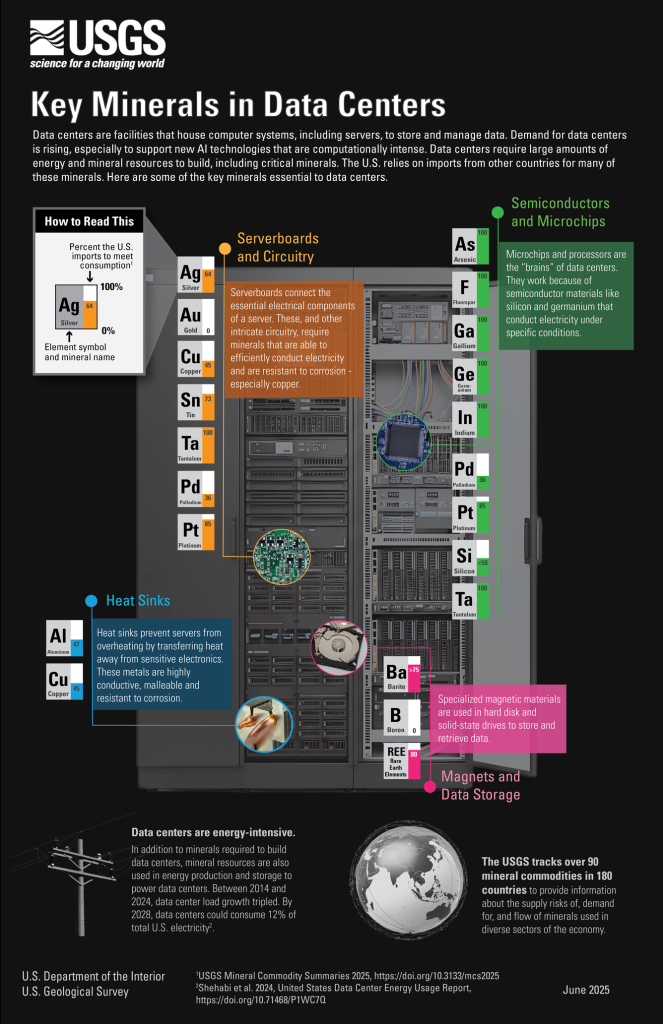
The electronic infrastructure inside data centers and lithium-ion battery arrays for backup power rely heavily on critical minerals and rare earth elements. The mining of these materials globally leads to severe soil erosion, toxic tailing ponds, and human rights violations in developing nations where these minerals are extracted. Furthermore, severe worker health hazards are documented despite minimal protections, including respiratory toxicities from cobalt and nickel, neurological and psychiatric impairments from manganese, and systemic DNA damage.
The U.S. Geological Survey’s Key Minerals in Data Centers Infographic below outlines the staggering mineral reliance of data centers, noting that 80% of Rare Earth Elements are utilized for magnets, data storage, and server electronics.
Data Centers Massively Increase E-Waste
The large volume of batteries, electronics, solvents, refrigerants, heavy metals and computer equipment creates massive amounts of hazardous e-waste. AI related e-waste streams could increase total accumulation by 1.2–5.0 million tons during 2020–2030.
The Nuclear Power for Data Centers Increases Health Risks
The federal government wants to fast track nuclear power plant approval to quadruple U.S. nuclear power capacity in order to support AI and data centers. While promoted as a “clean” energy solution, nuclear power produces harmful radioactive waste that remains hazardous for thousands of years. The United States still lacks a permanent repository for spent nuclear fuel, leaving most waste stored at reactor sites. Exposure to ionizing radiation is associated with increased health risks of cancer, genetic damage, and other adverse effects.
While some companies are proposing small modular nuclear reactors (SMRs) for data centers, research published in the Proceedings of the National Academy of Sciences found that small nuclear reactors are less efficient as they can generate 2-30 times more radioactive waste per unit of electricity produced compared to large nuclear reactors, and they also require significantly more uranium mining raising serious concerns regarding waste management, environmental contamination, and risks to the health of future generations.
Data Centers Industrialize Land at Unprecedented Scale
Hyperscale data center campuses and transmission corridors are transforming residential, agricultural, and rural landscapes into industrialized utility zones.
Data Center Infrastructure Displaces Communities and is Taking Land From Property Owners
In numerous cases nationwide, utilities and developers are using eminent domain and other government authorities to seize land for AI-related infrastructure, including data centers and new or expanded high-voltage transmission corridors. Many affected property owners argue they are not being offered fair market compensation for land, homes and farms taken for these projects.
Impermeable Data Center Land Development Increases Flooding Risk
Large-scale data center construction makes land more impermeable (replacing natural ground that absorbs rainfall with buildings), increasing stormwater runoff, and several communities have found that nearby data center construction has caused massive flooding.
The Unpaid Toll: Estimating and Addressing the Public Health Impact of Data Centers
“Our estimates show that U.S. data centers could contribute to various health outcomes including approximately 600,000 asthma symptom cases and 1,300 deaths in 2028 under the high- growth scenario, with total public health costs exceeding $20 billion. This corresponds to an increase of 213% relative to the 2023 level, compared with a projected 17% increase in U.S. stationary fuel-combustion-related health costs over the same period. Although national-level impacts remain modest, data center health costs vary substantially across counties: the highest county-level per-household health cost is about seven times the national average and approximately 200 times the lowest county-level value, warranting closer attention.”
-The Unpaid Toll: Estimating and Addressing the Public Health Impact of Data Centers, Han et. al. (2024)
Data Center Infrastructure Can Contribute to Endocrine Disruption
Data centers and the electrical infrastructure that supports them can contribute to endocrine disruption through the increased exposure to industrial chemicals, pollutants, and electromagnetic fields (EMFs) that may contaminate air, water, soil, and food systems.
PFAS “forever chemicals,” diesel exhaust, flame retardants, solvents, plasticizers, herbicides such as glyphosate, and chemicals used in cooling systems and water treatment as well as EMFs have all been associated in scientific literature with hormone disruption, reproductive harm, thyroid dysfunction, developmental impacts, infertility, and increased cancer risk.
Synergistic Effects of Multiple Environmental Exposures Associated with Data Centers
Communities and ecosystems located near hyperscale data center developments may experience simultaneous exposures from air emissions, water pollution, noise, cell towers, and power transmission lines. Consequently, it is important to consider total body burden, as cumulative and overlapping exposures to physical and chemical stressors can increase physiological stress and contribute to adverse health effects well beyond those associated with any single exposure.
A growing body of research indicates that electromagnetic fields can enhance or modify the biological effects of other environmental stressors. Studies have identified additive or synergistic effects involving non-ionizing EMFs and atrazine, phthalates, carbon black, hexavalent chromium, and lead, as well as evidence suggesting enhanced tumor-promoting effects when EMF exposure is combined with formaldehyde or ionizing radiation.
The Federal Push to Fast-Track Data Centers & AI Infrastructure
Federal policy is accelerating the development of data centers and other AI infrastructure, including wireless networks. Recent executive actions and agency initiatives are working to streamline permitting for data centers, along with the chemical manufacturing, energy generation, and transmission expansion needed to support these facilities.
- The White House AI Action Plan: Directs federal agencies to revise, or repeal regulations and policies that “unnecessarily hinder” AI development, deployment, telecommunications infrastructure, and data center expansion. LINK
- Executive Order: Accelerating Federal Permitting of Data Center Infrastructure: Seeks to fast-track federal approvals for data centers, energy projects, transmission infrastructure, and related construction needed to support AI growth-including coolants, semiconductors, and fire suppressants. LINK
- EPA to Fast-Track Review of AI Data Center Chemicals: The EPA announced it will streamline reviews of new chemicals that support AI data centers, aiming to reduce regulatory delays. LINK
- Electric Grid Declared Critical to National Defense: Designates electric grid infrastructure as essential to national security, enabling emergency federal authority to accelerate energy and transmission projects. LINK
The Federal Push to Override Local Control For Cell Towers is Directly Tied to AI and 6G
The rapid expansion of AI and data centers is being used to justify a sweeping buildout of new cell tower and wireless network infrastructure across the country by limiting local and state authority over permitting and oversight. Telecom states they are preparing for 6G, the next generation of wireless networks to be deployed in the 2030’s, in order to integrate AI directly into wireless infrastructure. 6G is being presented by industry as foundational architecture for data centers and AI-driven smart cities, autonomous vehicles, robotics, surveillance systems, and new machine-to-machine communications.
Industry and federal policymakers are framing the need for deregulation and pre-emption for cell towers as essential to maintaining U.S. leadership in AI. A letter sent by major U.S. telecom and wireless associations supporting Congressional bill H.R. 2289, which would fast track cell towers, states that the bill’s measures were ‘urgent because it directly supports America’s position in the global AI race.
CTIA, the leading lobbying association for the U.S. wireless telecommunications sector, just released a report and hosted a conference entitled ‘AI and Wireless’ where top telecom executives and policymakers emphasized that AI growth and data centers depend on unprecedented increases in cell towers, wireless network and fiber infrastructure.
While Congressional House Bill H.R. 2289 was stalled, the FCC, with just three unelected commissioners, is poised to move forward on a proposed rulemaking that would fulfil the telecom industry’s long-standing wish list by preempting local governments’ control over cell towers, wireless infrastructure, and the fiber optic buildouts.
- FCC NPRM 25-276: “Build America: Eliminating Barriers to Wireless Deployments,” would significantly pre-empt local town, city, county, and state authority over cell towers, 4G and 5G small cells, and other wireless infrastructure deployment. LINK
- FCC 25-253 NOI and June 2026 Proposal (NPRM ): “Build America: Eliminating Barriers to Wireline Deployments” would accelerate fiber and broadband construction by restricting municipal permitting authority, fees, and review timelines. LINK
The FCC’s 25-276 explicitly asks about overriding state and local level AI regulations, if local rules prohibit or have the effect of prohibiting wireless services and providers’ ability to use AI tools, further linking AI policy to federal preemption of local authority over telecommunications infrastructure.
If the FCC moves forward with these proposals, state and local governments could see their ability to establish common-sense safeguards for both AI systems and cell tower wireless infrastructure significantly restricted.
What You Can Do
Communities across the country are beginning to organize around the rapid expansion of hyperscale data centers and the electrical infrastructure. Raising awareness early and advocating for local safeguards today is essential.
Key Actions Communities Can Take on Data Centers
- Educate Your Community: Share information about the environmental, health, energy, and water impacts of data centers with your community and elected officials.
- Get Organized: Communities need a reliable method of communication to keep people informed. You can start a petition, listserv, or group chat, and host meetings at your local library to organize community action.
- Advocate for a Moratorium: Many communities are implementing temporary moratoriums on new data center development to ensure that adequate safeguards (ordinances and zoning protections) are in place before large-scale projects move forward.
- Advocate for Local Ordinances and Zoning Protections: Local governments should adopt ordinances that establish setbacks, noise and vibration limits, restrictions on diesel generators and emissions, water protections and more.
- Demand Full Transparency: Request reviews with reporting for:
- Air pollution
- Water consumption
- Thermal pollution
- Noise levels
- Energy demands
- EMF exposure
- Transmission and grid expansion plans
- Tax incentives and public subsidies
- Chemical use and waste streams
- Backup generator operations
- E-Waste management
Communities have the right to demand that technological development does not come at the expense of public health, environmental protection and affordable energy.
Key Information on High Voltage Transmission Lines and EMF Exposure
Learn more about data centers and the three types of exposure to electromagnetic fields (EMFs) they increase, including radiofrequency radiation, electric fields, and magnetic fields.
What key resources are other organizations sharing on data center environmental health effects?
Numerous environmental organizations are working on elevating the health and environmental risks of data centers. Their websites host key resources.
The Environmental and Energy Study Institute: They have a well referenced article series on the Environmental Impacts of Data Centers, including:
- Data Centers Are Contributing to PFAS Forever Chemical Pollution
- Communities Are Raising Noise Pollution Concerns About Data Centers
- Data Center Power Demands Are Contributing to Higher Energy Bills
Sierra Club: Their website resources and 2026 State Policy Guidance urges lawmakers and regulators to protect residents from higher electricity bills, require transparency about environmental impacts, expand renewable energy use, and support community opposition to harmful data center projects with examples of state efforts nationwide.
- The Southeastern PA Group (SPG) Data Center Resources for Local Governments
- Developed by the Community Protection Team has developed key materials to create a toolkit for local governments to develop more protective ordinances. LINK
- Sierra Club PA Data Center Resources (Focused on Local Governments)
- Sierra Club PA Chapter Local Governments Best Practices Fact Sheet for Data Centers
- Big Tech Unchecked Toolkit: A comprehensive 34-page document developed in Wisconsin that details the local permitting process, environmental impacts, and how to organize communities.
Food and Water Watch: Offers community organizing resources on its website, including a How to Stop a Data Center Near You campaign toolkit with template letters and neighborhood petitions.
How To Stop FCC Cell Tower Proposals
While the official comment periods for the FCC proposals have closed, local governments and communitites an still take critical action by submitting ex parte letters to the FCC, providing expert testimony and technical evidence, and passing resolutions opposing federal preemption while calling for the preservation of local authority over telecommunications and AI-related infrastructure decisions.
- Fact sheets and resources on federal proposals to fast-track cell tower approvals.
- Information on health effects linked with cell towers.
- Letters by cities, states and environmental organizations opposing cell tower fast track proposals.
We Are Moving on This Issue
Environmental Health Sciences is now developing new knowledge resources, public awareness materials and policymaker resources on data centers and AI, with a focus on endocrine disruption, including EMF. Contact us for presentations and questions.
Stay tuned as we continue expanding this critical work.