
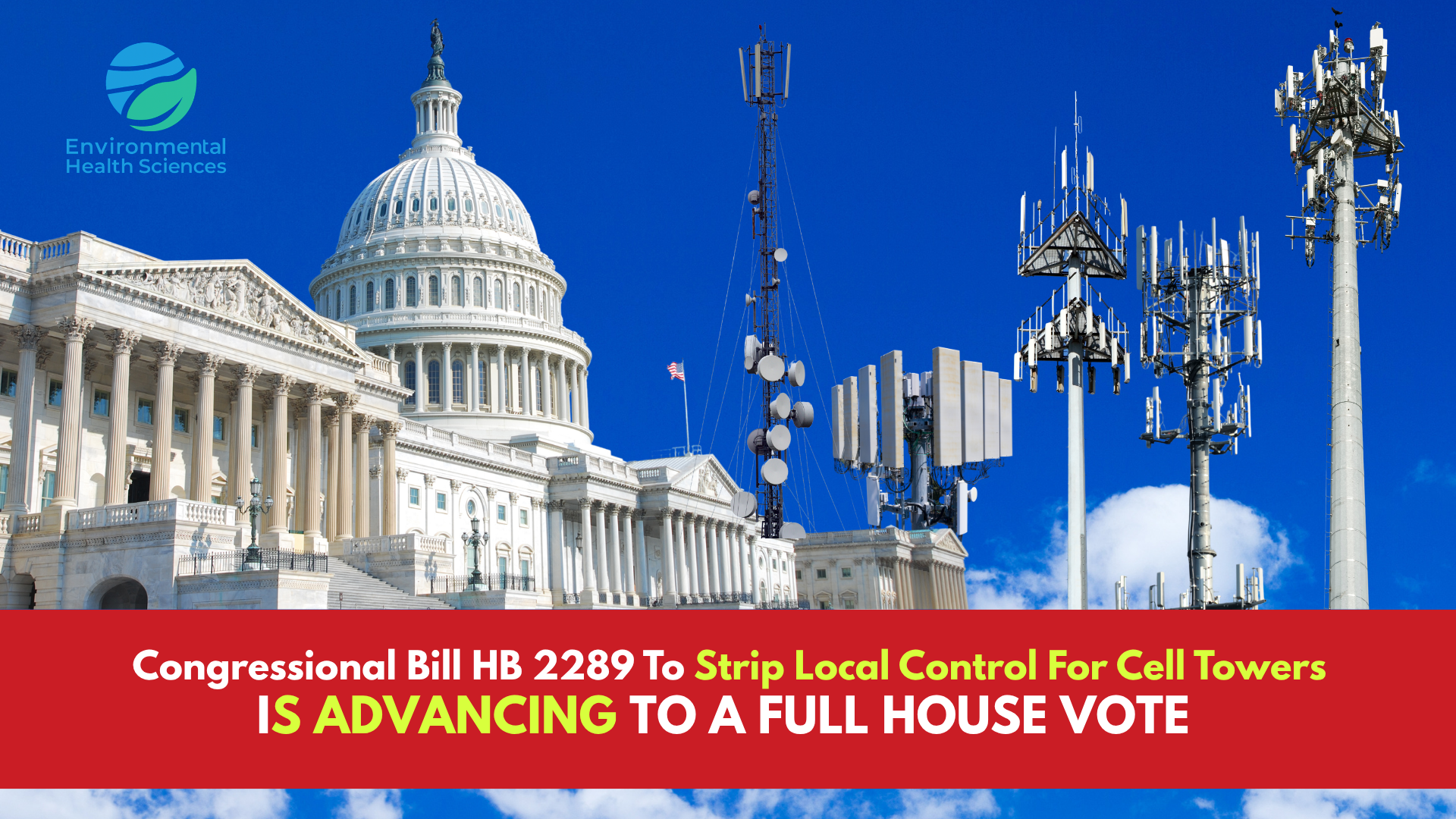
Congressional bill H.R. 2289 – which would fast-track cell towers in front of homes by stripping local government authority – was swiftly advancing to a full House vote, but has hit a temporary pause.
Although H.R. 2289, the American Broadband Deployment Act, was placed on the House Union Calendar (No. 532), meaning it cleared committee, it was abruptly postponed midday, likely due to the massive opposition by the majority of local governments in the country.
H.R. 2289 is Stalled — But Could Return.
And- the Senate could move a similar bill forward!
Policymakers need to be educated about the two federal cell tower fast-track proposals.
Once the Rules hearing for H.R. 2289 is rescheduled, the bill can move quickly to a final vote. If it passes, it advances to the Senate. Further, the FCC is likely to move forward on its cell tower fast-track proposal, which will likely include many of the same provisions to override local government authority.
On April 22, 2026, Communications Daily ran an article on the Bill with the headline ”Carter ‘Confident’ House Will Resurrect American Broadband Deployment Act This Congress,” stating that Rep. Buddy Carter, “lead sponsor of the American Broadband Deployment Act (HR-2289), told us Monday night he’s ‘confident’ that House leaders will eventually bring the bill back to the floor before this Congress ends, despite their decision to pull it earlier that day once it became clear that not enough Republicans supported its passage.”
Even if H.R. 2289 is not resurrected, the FCC’s cell tower fast-track proposal is poised to move forward.
“The bill that would fast-track cell towers and strip local government control, H.R. 2289, couldn’t even secure enough Republican votes to advance in a Republican-controlled House. Yet the FCC, with just three commissioners, is poised to push forward a nearly identical agenda to pre-empt local city, state, and town authority, without congressional approval. That should alarm every American,” stated Theodora Scarato, Director of the Wireless and EMF Program at Environmental Health Sciences.
- 9 Ways the FCC Could Pre-Empt Local Government Control
Key things the FCC is signaling it could do — and is actively asking for public comment on in 25-276:
- Automatic approvals: Missed 150-day shot clocks could result in tower applications being automatically approved (“deemed granted”), eliminating local oversight.
- Redefined aesthetics: The FCC proposes narrowing concealment rules, reducing communities’ ability to require towers to blend into surroundings.
- Limits on zoning authority: Aesthetic and visual-impact conditions could no longer be used to regulate tower height, design, or location.
- Fee caps: The FCC may override local cost-recovery fees that fund safety inspections, notifications, and environmental compliance—shifting costs to taxpayers.
- Setback preemption: Local setback and siting rules are labeled potential “regulatory impediments,” opening the door to federal override.
- No new conditions on renewals: Local governments could be barred from adding conditions when renewing existing tower permits.
- No independent RF testing: FCC preemption could remove community requirements for independent or periodic RF radiation testing.
- Declare that blocking upgrades or densification is an effective prohibition: The FCC would treat any local action that slows network upgrades as an “effective prohibition of service,” even without a coverage gap—reversing the long-standing requirement that carriers prove a gap before overriding local zoning.
- Pre-empt state and local authority regarding AI: In the Notice, the FCC explicitly asks about overriding state and local level AI regulations, and whether local rules ‘prohibit or have the effect of prohibiting wireless services and providers’ ability to use AI tools.
This Is Only A Temporary Pause — Not A Victory
We are still at a critical moment.
Both the FCC NPRM 25-276 and Congressional Bill H.R. 2289 would fast-track cell towers near homes in neighborhoods nationwide, overriding local control and stripping cities and towns of their ability to enforce basic safeguards like setbacks, safety review, and community input. The Congressional bill would additionally expand federal preemption regarding radiofrequency radiation-related health effects.
The House and Senate need to be educated on the issue.
The FCC can issue its new cell tower regulations at any time. The Congressional bill can return for a vote at any time, even as soon as next week, and industry lobbyists are already working behind the scenes to line up the votes needed to push it through. Even if H.R. 2289 is pulled from consideration, its provisions could still be passed by amending a different bill to include those measures, or incorporating them into a larger legislative package, such as an omnibus bill. We are up against some of the most powerful corporations in the country. Companies like Apple, Samsung, and major wireless carriers such as T-Mobile are represented by the CTIA – wireless industry association, which is pushing hard for this legislation, and for the FCC rulemaking to be completed.
Telecom Associations Say Cell Tower And Wireless Infrastructure Fast Tracking Is Needed For AI
Read the letter sent by major U.S. telecom and wireless associations stating that the measures in bill H.R. 2289 are “urgent because it directly supports America’s position in the global AI race”.
“Broadband underpins our society and economic growth, and its importance is only rising as Artificial Intelligence (“AI”) becomes embedded in daily life.” The letter further states that the bill would codify FCC streamlining orders and “as FCC Commissioner Trusty observed, ‘AI cannot function without connectivity. And, Americans cannot benefit from AI without access to connectivity.’”
Note: The CTIA Wireless Association is now headed by Ajit Pai, a former FCC Chairman. Pai succeeded Meredith Attwell Baker, also a former FCC Commissioner. This revolving door between industry and government regulators is how we arrived at the current situation. More on this can be found in a landmark publication in Frontiers in Public Health entitled “U.S. Policy on Wireless Technologies and Public Health Protection: Regulatory Gaps and Proposed Reforms” by Theodora Scarato, MSW, Director of the Wireless and EMF Program at Environmental Health Sciences. The article examines regulatory capture at the FCC, building on the documentation of industry influence in a 2015 Harvard Report, “Captured Agency.”
KEY ACTION STEPS
- Send a letter to your member of Congress (using our 1-Click tool) and then call them directly.
- Contact your local officials to write letters and to contact federal representatives. Set up meetings to talk to them. All officials – from your local Councilmembers to Representatives and Senators- need to be educated on the health and safety issues of these proposals. Key issues regarding cell towers and health that you can share with policymakers are detailed here.
- Share this alert with your community.
Cell Phone And Wireless Companies Are Lobbying For An Immediate Vote On H.R. 2289
On April 13, major telecom and infrastructure groups, including CTIA – The Wireless Association (representing companies such as Apple, AT&T, Verizon, and T-Mobile) – sent a letter to House leadership urging them to bring H.R. 2289 to the floor immediately, “because it directly supports America’s position in the global AI race.”
Organizations Serving Over 80% Of The U.S. Population State That H.R. 2289 Would Undermine Public Safety
On April 16, 2026, the National Association of Counties (NACo), the U.S. Conference of Mayors (USCM), the National League of Cities, and the National Association of Telecommunications Officers and Advisors (NATOA) wrote a letter to House leadership stating that H.R. 2289 “would undermine public safety, force local taxpayers to subsidize private corporations and disrupt the very broadband deployment progress it aims to accelerate.”
“H.R. 2289 creates a framework that prioritizes communication companies’ shareholder value at the expense of the safety and financial interests of the communities and the taxpayers they serve. Furthermore, by limiting cost-recovery mechanisms for application reviews, the bill effectively forces local taxpayers to subsidize private providers’ administrative expenses – a cost that falls entirely on the public.”
“ H.R. 2289 as written, would sacrifice local autonomy, impose unfunded mandates, and disrupt deployment progress already underway.”
The National Association of Counties (NACo), representing counties serving more than 80 percent of the nation’s population, states that “the preemption of local permitting authority will not lead to the expedited build-out of broadband infrastructure, but instead jeopardize the safety of the public.”
A Fierce Network article entitled “Is permitting reform streamlining or steamrolling?” quoted Mike Lynch, legal and regulatory affairs director with the National Association of Telecommunications Officers and Advisors (NATOA), as stating that “H.R. 2289 is an unprecedented and dangerous usurpation of local governments’ authority to manage public rights-of-way and land use. It’s a giveaway to the industry.”
The Physicians For Safe Technology Sent A Letter Warning Congress About H.R. 2289 And The FCC Proposals To Fast Track Cell Towers
Physicians For Safe Technology sent a letter to House leadership stating, “We ask that you oppose these FCC proposals and bills which will solidify in law the telecom industry’s unobstructed power, without recourse or remedy when faced with the failures and unintended consequences of AI, cell tower safety issues and environmental harm.”
Read the letter from Physicians for Safe Technology here.
Resources to Share with Policymakers
Decision-makers need to know about both these proposals and about the health risks of cell towers. Environmental Health Sciences (EHS) Resources on HR 2289 includes key quotes from opposing letters from states, cities, and towns. Key issues to share with policymakers regarding radiofrequency radiation health effects are detailed on this page.
Share these letters opposed to the FCC proposal to fast-track cell towers with your officials.
The National Association of Counties: Oppose the Preemption of Local Broadband Permitting Authorities
National Association of Towns and Townships Action Alert: Oppose H.R. 2289, American Broadband Deployment Act. Includes a draft letter of opposition for towns.
TAKE ACTION NOW
We hope you will use our resources to call your representatives, set up meetings, and elevate this issue in your community. We can do this!