
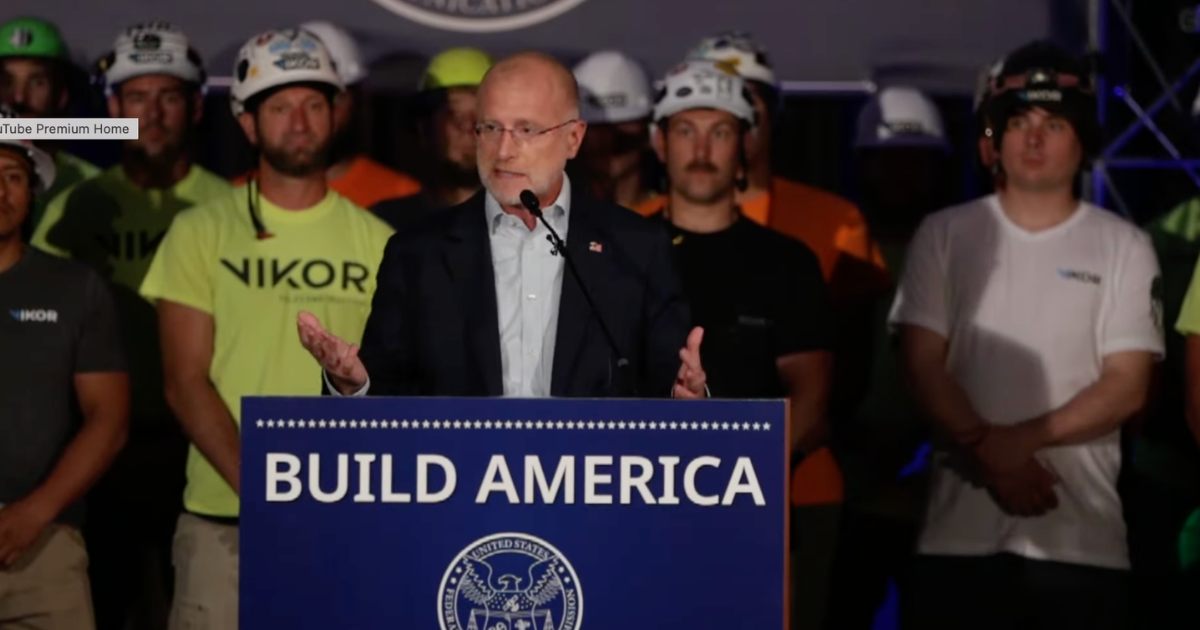
June 3, 2026: FCC Chairman Brendan Carr just proposed new rules to strip local city and state authority regarding wireline infrastructure, such as fiber-optic cable as part of his “Build America Agenda,” referring to local government rules “that constrain the deployment of modern, high-speed wireline infrastructure.”
Carr also proposed new rules to do a “top-to-bottom review” of the 3 billion dollar E-Rate Program which helps schools and libraries provide internet access to low-income students, claiming to be concerned about children’s screentime and empowering parents.
Theodora Scarato, Director of the Wireless and EMF Program at Environmental Health Sciences, an environmental health non-profit states:
On the FCC now concerned about screentime and E-rate funds:
“How can Chairman Carr claim to be concerned about children’s screen time while simultaneously fast-tracking cell towers, small cells, AI data center drive fiber-optic networks, and future 6G systems? This is a public relations stunt designed to distract from an industry-led deregulatory agenda that has long prioritized corporate profit over children’s health.
The FCC is marketing the E-rate “review” as a response to children’s excessive screen time, but the FCC proposal will most likely result in making it harder for schools and libraries to get E-rate funds to provide connectivity to underserved communities.
If Chairman Carr truly cared about children’s health, he would update the FCC’s cell tower, cell phone and wireless radiation exposure limits, which were adopted in 1996 and remain unchanged nearly 30 years later.
If Chairman Carr truly cared about children’s health, he would modernize antiquated premarket cell phone radiation testing procedures. Currently, the FCC authorized tests use a large adult male dummy, utterly failing to reflect how children use cell phones. Scientific research has found that children can absorb higher levels of cell phone RF radiation deeper into their brains compared to adults due to their thinner skulls and the higher water content in their brain tissue.
If Chairman Carr truly cared about empowering parents, he would ensure that all parents are informed that cell phones, Wi-Fi, and other wireless devices emit RF radiation, and that this radiation is highly absorbed into the body when devices are used close to the head or carried against the body. He would tell them that the FCC’s own laboratory tests found that when phones were tested close to the body, they violated FCC limits. He would also inform parents that FCC limits only protect against the effects of short-term heating and not for long -term daily exposures. Instead, the FCC argues that the RF exposure information in cell phone manuals is adequate and consumer disclosures and device labels about wireless RF radiation exposure from cell phones constitute “over-warning,” depriving parents of basic health and safety information.
The FCC’s press release states, We are now seeing a movement to address excessive screen time in schools, with some school districts removing devices and reducing screen time, particularly for younger children. Additionally, a number of bills have been introduced in Congress that are aimed at reducing excessive screen time for children, including for E-Rate supported ones. So, with graduation season upon us and many parents now looking ahead to the new school year to come, the time is ripe to have these
conversations at the FCC.”
While we have previously filed formal scientific comments objecting to children being given cellular hotspots into their homes due to the serious health risks of chronic wireless radiation exposure, the FCC’s “solution” is completely backwards. Instead of addressing the root of the problem- the need for affordable internet- the FCC’s action will likely systematically disqualify thousands of schools and libraries that previously relied on these subsidies, keeping the money locked up.
What families actually need, and what the FCC has failed to deliver, is universal, affordable, and safe hardwired internet access directly in their homes. For years, the FCC has promised to “connect the unconnected” and “bridge the digital divide”, yet today millions of Americans still lack affordable, reliable internet access. Now, instead of addressing that failure, the FCC is pivoting to talking about screen time.”
On the FCC preempting local governments
“While Americans are rising up and fighting data centers in local communities nationwide, most remain unaware of the numerous federal proposals quietly advancing in Washington that would clear the path for an unprecedented buildout of AI infrastructure. The fiber networks, power lines, electric substations, cell towers, “small” cells , and data centers needed to support artificial intelligence and future 6G networks are being fast-tracked. At the same time, local state, city, and town authorities and public participation in the process are systematically being stripped away.
The FCC press release states their proposal “aims to cut red tape and excessive fees,” referring to the local government process as “an onerous process” that “wastes federal resources.”
What is this really about? It is about AI and data centers. Local government oversight is being dismantled to accelerate the deployment of the fiber optic infrastructure needed to support artificial intelligence (AI) data centers and future 6G networks.
- This connection was made explicit in a letter sent by major U.S. telecom and wireless associations supporting Congressional bill H.R. 2289, the American Broadband Act, which would have stripped local and state government authority for both wireless and wireline projects. The letter states that the bill’s measures were ‘urgent because it directly supports America’s position in the global AI race,’ framing the deregulation and infrastructure acceleration as a matter of geopolitical competition with China.
- CTIA, the leading lobbying association for the U.S. wireless telecommunications sector, just released a report and hosted a conference entitled ‘AI and Wireless’ where top telecom executives and policymakers emphasized that AI growth and data centers depend on unprecedented increases in cell towers, wireless network and fiber infrastructure.
“Chairman Carr continues to act recklessly, ignoring the American people. Congress was unable to pass H.R. 2289, despite Republican control of the House and strong support from the telecommunications industry. Yet now the FCC, with only three sitting commissioners, is pushing the agenda through regulation. That should concern every American who values democracy.”
See the FCC graphic shared by the agency on LinkedIn.
According to the FCC press release, the FCC Notice would seek comment on codifying rules that would:
- Give state and local governments only 120 days to review wireline telecommunications applications, after which delays could be presumed unlawful, creating pressure to approve complex projects before communities have adequate time to evaluate impacts.
- Restrict local governments’ fees to recovering only narrowly defined direct costs and establish FCC “safe harbor” fee limits, likely shifting infrastructure review and oversight costs from industry to taxpayers.
- Count in-kind requirements imposed by local governments toward those fee limits, reducing communities’ ability to negotiate public benefits, infrastructure improvements, or other measures designed to offset project impacts.
- Prohibit local governments from imposing additional requirements on telecommunications infrastructure even when that infrastructure may also support other commercial services, further limiting local oversight and regulatory authority.
Taken together, these FCC proposals would significantly reduce the ability of state and local governments to manage telecommunications infrastructure projects and protect community interests.
The costs of this unprecedented aggressive deployment will be borne by local taxpayers, not the industry.”
What’s Next?
Carr will present the proposals at the agency’s June 25 meeting, and with just three Commissioners, you can be sure it will pass. Then, once the text is officially published in the Federal Register later this summer, a formal public comment window will open (typically lasting 30 to 60 days). Perfect timing for those on vacation at the beach.
Stay tuned for more.
Be sure to sign up for our Wireless and EMF newsletter and Theodora’s Substack to stay connected.
About Theodora Scarato, Director of the EMF and Wireless Program at Environmental Health Sciences
Scarato has published several scientific papers on children’s environmental health and her most recent publication on the FCC in Frontiers on Public Health is “U.S. policy on wireless technologies and public health protection: regulatory gaps and proposed reforms.”
Scarato’s work was pivotal in a 2021 landmark federal case against the FCC in which the court mandated the agency explain how its 1996 cell tower radiation exposure guidelines were adequate in regards to children’s vulnerability, long-term exposure and wildlife impacts. The court also ordered the FCC to respond as to how its compliance tests, which do not test phones at body contact, were relevant. The FCC has not responded to the mandate, so a writ of mandamus, to force compliance, was filed this month.