

Statement on the Recent Legal Filing Against The FCC Regarding Its Failure to Comply With the 2021 D.C. Circuit Court Order on Cell Tower, Cell Phone, and Wireless Radiation Exposure Limits by Theodora Scarato.
Theodora Scarato, MSW, Director of the Wireless Program at Environmental Health Sciences, is a petitioner in EHT et al. v. the FCC (also formerly Executive Director of EHT, the lead petitioner in the case).
The US has 30-year-old human exposure limits for wireless radiation.
This week’s filing of a writ of mandamus seeks to compel the U.S. FCC to comply with the federal court’s 2021 order in our lawsuit, requiring the agency to address the last thirty years of scientific evidence and justify its decades-old cell tower, cell phone, and wireless exposure limits. As I document in my recent policy review on wireless radiation published in Frontiers in Public Health, the FCC’s years of inaction following the court’s mandate is not just a regulatory delay; it’s a major public health policy failure.
We are living through one of the largest technological infrastructure expansions in human history. The US government should be ensuring its cell tower and wireless radio-frequency (RF)radiation limits are adequately protective as a top national priority. Instead, the FCC has aggressively and recklessly pushed to accelerate the densification of wireless infrastructure.
Five Years After Court Order, The FCC Still Fails to Ensure Proper Review of Cell Tower and Wireless Radiation Safety
In 2021, the FCC was ordered by the United States Court of Appeals for the D.C. Circuit to explain how its decades-old cell tower, cell phone and wireless radiation exposure limits adequately protect human health and the environment in light of the scientific evidence submitted to the record. The court found the FCC’s refusal to update its 1996 wireless exposure limits to be “arbitrary and capricious” and specifically mandated the agency to review evidence regarding:
- impacts on children
- long-term exposure
- non-cancer impacts (such as to the brain, immune and reproductive system)
- environmental impacts (birds, bees and trees)
- and consider technological developments since 1996.
Further, the agency was ordered to explain how its premarket RF radiation compliance testing procedures, which evaluate cell phones at separation distances away from the body, remain adequate in light of today’s real-world usage patterns, where people routinely carry phones in pockets and maintain close body contact with devices during near-constant daily exposure.
The fact that five years have passed without meaningful FCC action to address the issue of safety or respond to the court is egregious.
While the public believes the fairy tale of cell phone safety, and the industry-fueled mirage that federal agencies are regularly reviewing the science and ensuring that the public and environment are protected from this growing environmental pollution, the fact is that no federal agency has shown review of the totality of the up-to-date scientific research on wireless health effects.
I have filed hundreds of documents to the FCC since the 2021 court decision, including dozens of new peer-reviewed published scientific research studies linking exposure to harmful effects in anticipation of this and future lawsuits.
They were informed. They did nothing.
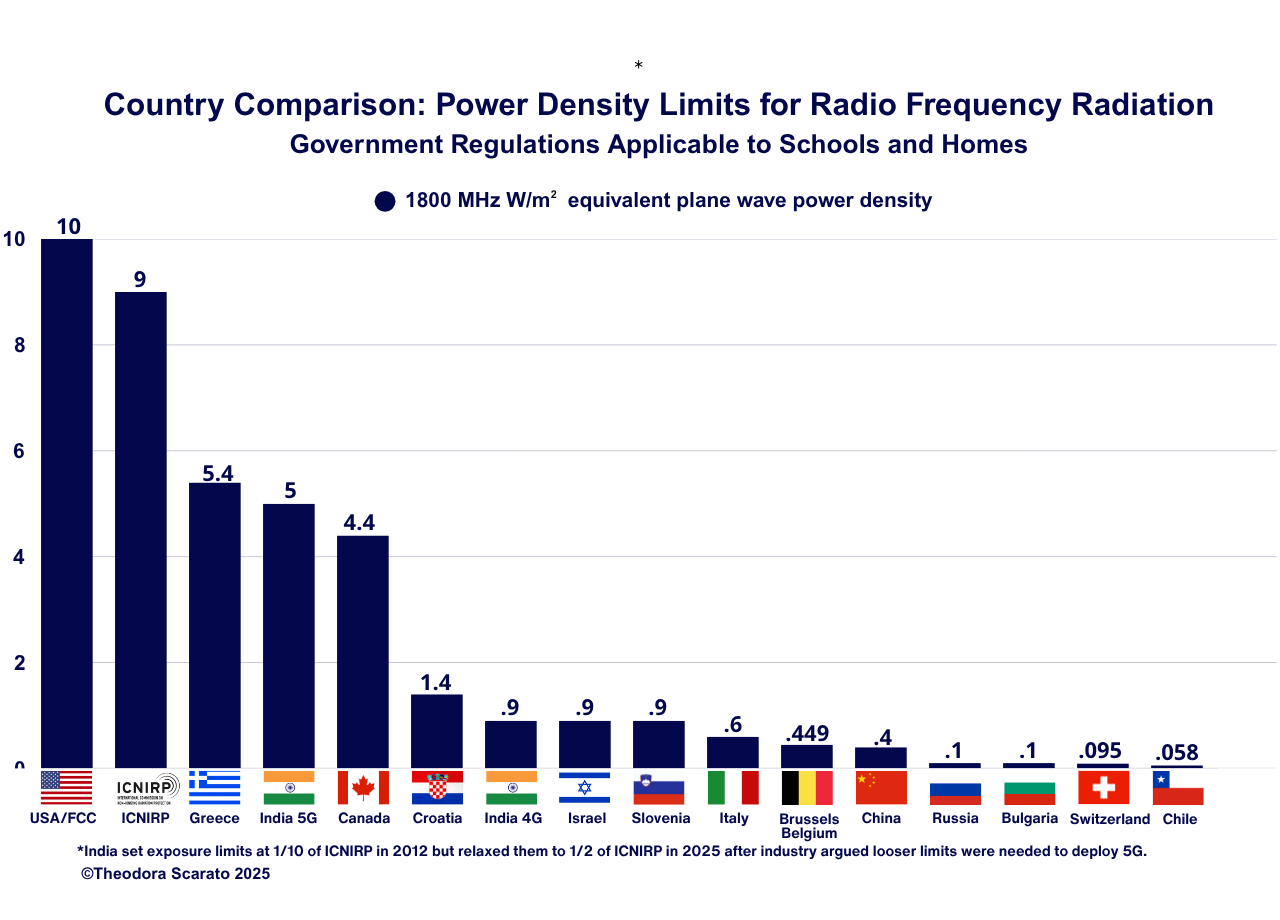
The U.S. FCC limits for cell tower radiation exposure allow radiation 10 to 100 times more than several other countries. The image below is from my recent paper “U.S. Policy on Wireless Technologies and Public Health Protection: Regulatory Gaps and Proposed Reforms” which details how the US EPA was defunded on setting health based limits and instead the FCC adopted limits by industry military filled groups in 1996.
A New Scientific Analysis Finds FCC Wireless Radiation Limits Should Be Reduced 200-Fold
Just this month, the International Commission on the Biological Effects of Electromagnetic Fields (ICBE-EMF) sent a scientific letter to U.S. Senate and House leadership and to the FCC Commissioner stating that Congress and the FCC ensure a formal review that takes into account the most recent scientific evidence. They highlight the recent peer-reviewed paper published in the journal Environmental Health co-authored by Dr. Ronald L. Melnick, a retired 28 year toxicologist from the National Institute of Environmental Health Sciences, and Dr. Joel M. Moskowitz, of the School of Public Health at the University of California, Berkeley on behalf of the International Commission on the Biological Effects of Electromagnetic Fields (ICBE-EMF). Taking results from a $30 million U.S. National Toxicology Program (NTP) cancer study, the researchers applied standard procedures developed by the U.S. Environmental Protection Agency and concluded that current FCC and ICNIRP public exposure limits need to be reduced by at least 200 times. (Read the ICBE-EMF Press Release here).
The ICBE-EMF states in its letter to Congress:
“Allowing the widespread deployment of cell towers near homes and schools without first assessing real-world RF exposures and conducting health studies, particularly on long-term effects in children and vulnerable adults, would represent a failure of public health protection.”
The ICBE-EMF states the FCC’s push to fast-track cell towers in its proposal “Build America” effectively treats American communities as test subjects in an uncontrolled national radiation experiment, one conducted without consent, without monitoring, and without updated safety limits. If Congress or the FCC proceed to fast-track cell towers, they will knowingly expose millions to higher levels of RF radiation at levels that multiple peer-reviewed studies associate with increased cancer risk, and neurological, immune, and reproductive harm.”
The FCC Withheld Its Own Laboratory Cell Phone Radiation Test Findings
One of the key issues in the case was the FCC’s antiquated cell phone testing procedures. Phones are not premarket RF radiation tested touching the body, the way people use phones today. My FOIA requests revealed that FCC’s own laboratory testing found that several popular cell phones exceeded federal radiation exposure limits when used in close body contact positions. Yet the FCC withheld these findings from the court and the public, even though the court proceedings directly raised questions about whether existing cell phone testing procedures accurately reflect real-world exposure conditions.
Children Face Unprecedented Wireless Radiation Exposure Never Considered in the FCC’s 1996 Limits
Children today are growing up immersed in levels of wireless radiation exposure never imagined when the FCC adopted its current limits in 1996. Today’s homes, schools, and communities are filled with dozens of wireless devices, often alongside nearby cell towers. My FOIA requests show RF levels at several schools with cell towers are significantly increasing.
Scientific research shows how children absorb more of the radiation from cell phones as well as cell towers when compared to adults. Most of the wireless frequencies now in widespread commercial use simply did not exist or were not widely deployed when the FCC established its current exposure guidelines nearly three decades ago. With no premarket safety testing and no robust or transparent post-market compliance, our children’s health is at serious risk.
The Bottom Line
The FCC must be held accountable. It’s time to move this issue forward.
The FCC should not be aggressively moving to fast-track the densification of cell towers across communities nationwide while failing to address the fundamental question raised by the court: whether the 1996 exposure limits for cell towers, cell phones, Wi-Fi, and wireless networks adequately protect the public and our environment.
A Note of Caution: The FCC is almost certainly preparing a response, one that will likely rely heavily on industry-friendly and funded scientists presented as independent public health experts, a strategy long used to manufacture doubt and delay meaningful regulatory action. In a future Substack post, I will examine how industry influence has shaped wireless radiation policy for decades and some of the industry’s latest moves.
Want To Read More About the FCC Failures?
The paper “U.S. Policy on Wireless Technologies and Public Health Protection: Regulatory Gaps and Proposed Reforms” traces the history of EPA wireless and EMF radiation research, documents the decades of regulatory capture, the years of industry influence, and outlines key deficiencies in both the exposure limits themselves, its compliance testing procedures, and their inadequate oversight activities. It concludes by providing much-needed policy recommendations for the federal government to modernize oversight, transparency, and public health safeguards.
Environmental Health Sciences also has a great overview of the FCC’s policy failures here.
This post is also on Theodora Scarato’s Substack.