
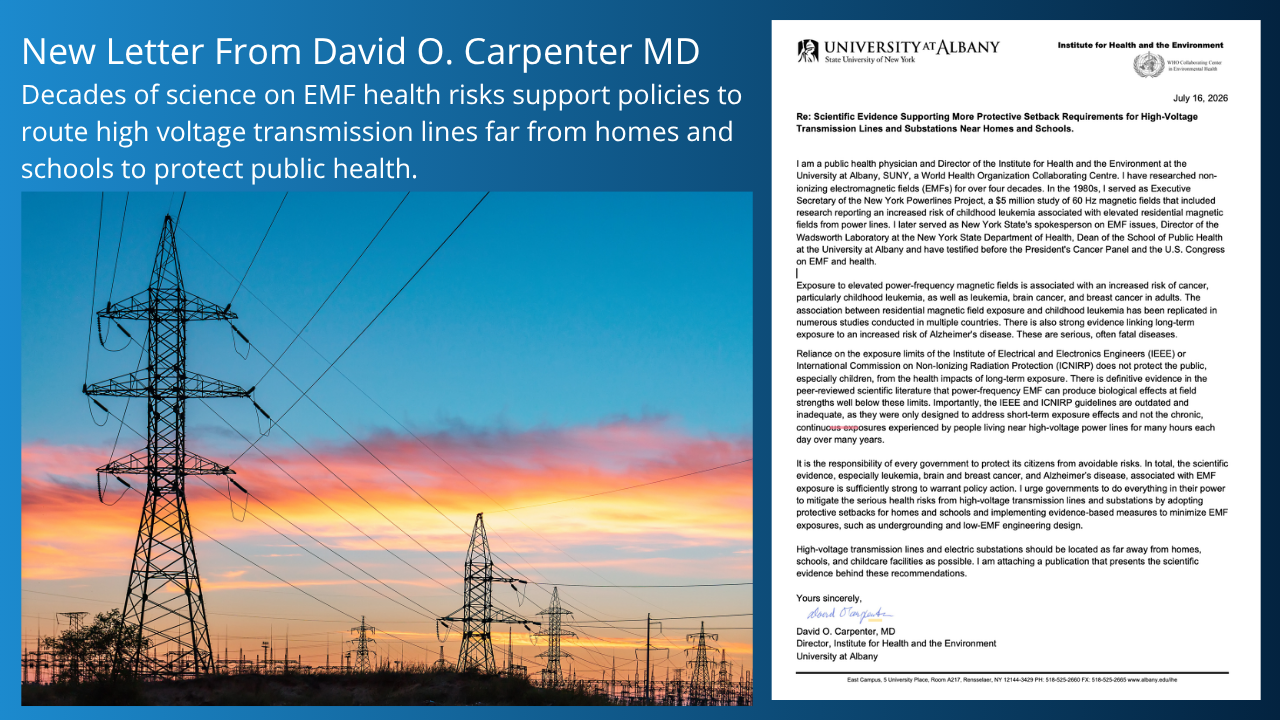
Harvard-trained public health physician Dr. David Carpenter outlines the scientific evidence supporting strong setbacks between high-voltage transmission lines, substations, homes, and schools.
Policy blog by Theodora Scarato, Director of the EMF and Wireless Program at Environmental Health Sciences
Dr. David O. Carpenter, one of the world’s leading experts on the health effects of non-ionizing electromagnetic fields, sent a letter to the Loudoun County School Board, Loudoun County Supervisors, and several other counties across the USA detailing the science on EMF health effects and urging them to adopt more protective setback requirements for high-voltage transmission lines and substations.
In his letter, Dr. Carpenter explains that decades of peer-reviewed scientific research link long-term exposure to EMF magnetic fields with increased risks of childhood leukemia, adult cancers, and Alzheimer’s disease.
Dr. Carpenter is Director of the Institute for Health and the Environment at the University at Albany, SUNY, a World Health Organization Collaborating Centre. He received his MD from Harvard and has spent more than four decades researching EMFs. He is also a Commissioner of the International Commission on the Biological Effects of Electromagnetic Fields, a multi-disciplinary international consortium of scientists, doctors, and researchers with expertise in the biological and health effects of non-ionizing electromagnetic field (EMF) frequencies.
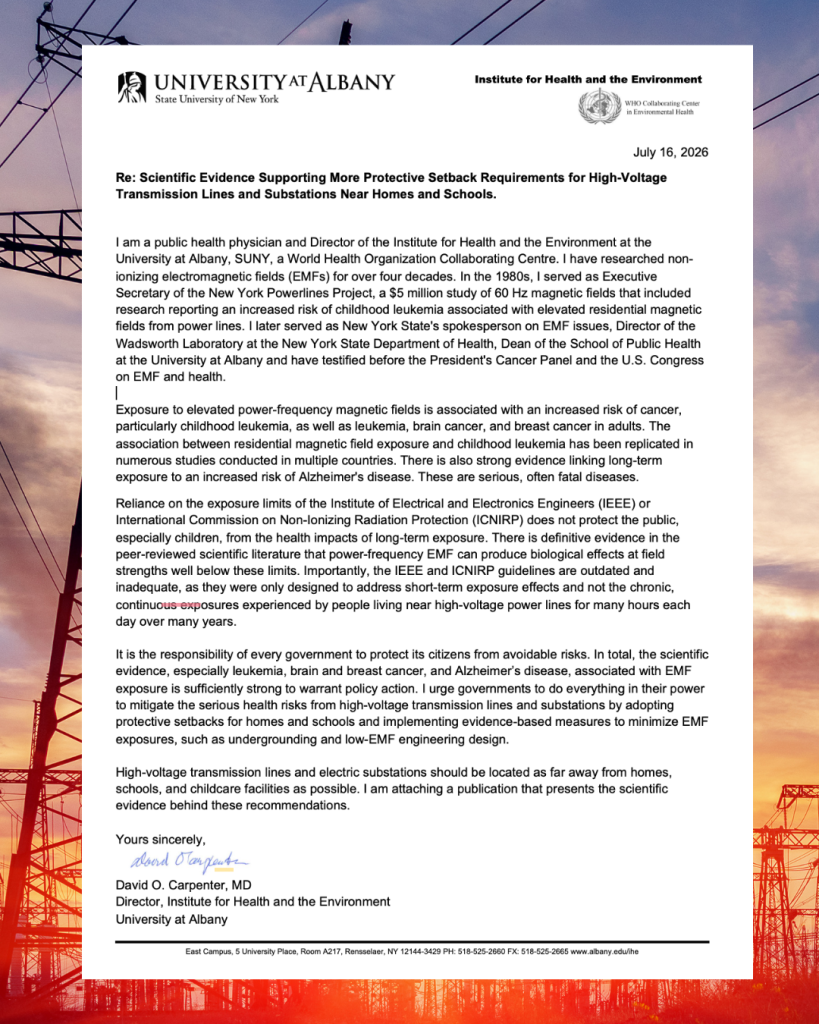
Here is the full text of Dr. Carpenter’s letter:
Re: Scientific Evidence Supporting More Protective Setback Requirements for High-Voltage Transmission Lines and Substations Near Homes and Schools.
I am a public health physician and Director of the Institute for Health and the Environment at the University at Albany, SUNY, a World Health Organization Collaborating Centre. I have researched non-ionizing electromagnetic fields (EMFs) for over four decades. In the 1980s, I served as Executive Secretary of the New York Powerlines Project, a $5 million study of 60 Hz magnetic fields that included research reporting an increased risk of childhood leukemia associated with elevated residential magnetic fields from power lines. I later served as New York State’s spokesperson on EMF issues, Director of the Wadsworth Laboratory at the New York State Department of Health, Dean of the School of Public Health at the University at Albany and have testified before the President’s Cancer Panel and the U.S. Congress on EMF and health.
Exposure to elevated power-frequency magnetic fields is associated with an increased risk of cancer, particularly childhood leukemia, as well as leukemia, brain cancer, and breast cancer in adults. The association between residential magnetic field exposure and childhood leukemia has been replicated in numerous studies conducted in multiple countries. There is also strong evidence linking long-term exposure to an increased risk of Alzheimer’s disease. These are serious, often fatal diseases.
Reliance on the exposure limits of the Institute of Electrical and Electronics Engineers (IEEE) or International Commission on Non-Ionizing Radiation Protection (ICNIRP) does not protect the public, especially children, from the health impacts of long-term exposure. There is definitive evidence in the peer-reviewed scientific literature that power-frequency EMF can produce biological effects at field strengths well below these limits. Importantly, the IEEE and ICNIRP guidelines are outdated and inadequate, as they were only designed to address short-term exposure effects and not the chronic, continuous exposures experienced by people living near high-voltage power lines for many hours each day over many years.
It is the responsibility of every government to protect its citizens from avoidable risks. In total, the scientific evidence, especially leukemia, brain and breast cancer, and Alzheimer’s disease, associated with EMF exposure is sufficiently strong to warrant policy action. I urge governments to do everything in their power to mitigate the serious health risks from high-voltage transmission lines and substations by adopting protective setbacks for homes and schools and implementing evidence-based measures to minimize EMF exposures, such as undergrounding and low-EMF engineering design.
High-voltage transmission lines and electric substations should be located as far away from homes, schools, and childcare facilities as possible. I am attaching a publication that presents the scientific evidence behind these recommendations.
Industry Impacts Study Results
Attached to the letter is a review paper by Dr. Carpenter entitled “Extremely low frequency electromagnetic fields and cancer: How source of funding affects results” published in the journal Environmental Research. Carpenter found industry funding affects the results of studies. Carpenter states, “Almost all government or independent studies find either a statistically significant association between magnetic field exposure and childhood leukemia, or an elevated risk of at least OR = 1.5, while almost all industry-supported studies fail to find any significant or even suggestive association.”Draft a sentence about my chapter, published in which talks about the lack of any kind of regulatory framework for electromagnetic fields in the United States, and how many countries have much more protective limits
Carpenter references numerous studies conducted over the last few decades and concludes that, “The evidence that magnetic fields increase the risk of cancer is neither inconsistent nor inconclusive. Furthermore, adults are also at risk, not just children, and there is strong evidence for cancers in addition to leukemia, particularly brain and breast cancer.”
From Virginia, West Virginia, Maryland, Pennsylvania, Ohio, Wisconsin, Minnesota, South Dakota, Georgia, and Texas, thousands of communities are being faced with new substations and high-voltage power line electric transmission corridors cutting through working farms, forests, neighborhoods, and even near schools, all to power the data center industry. Dr. Carpenter has written to Temecula City, California, Hampshire Commission, West Virginia, Loudoun County, Culpeper County, and Campbell County, Virginia.
The Need for Policy Change
Unlike many environmental contaminants, the United States has never established federal health-based exposure limits for the EMF from powerlines and substations. The history of how this occurred is important because the absence of a health-based limit does not mean the absence of scientific evidence. Rather, it reflects the power of the electric industry to influence science and policy.
The U.S. story is long and sordid. The EPA released a draft report in the 90’s that recommended designating powerline-frequency EMFs as a “probable human carcinogen,” but amidst ongoing controversy, that conclusion was deleted from the subsequently released draft, which then stated EMFs was a possible, but not proven, cause of cancer in humans. Although expert agencies repeatedly reviewed the EPA draft, it was ultimately shelved and never finalized. In the mid-1990s, the EPA’s EMF research program and efforts to develop health-based safety standards were fully halted after Congress eliminated funding, leaving the United States without any EPA developed human exposure limits or up to date science based risk assessment. As a result, the U.S. never adopted any federal safety limits to address health effects. In the absence of federal standards and with limited state regulation, permitting decisions for high-voltage transmission lines typically rely on industry-developed engineering standards instead of a comprehensive public health science-based evaluation.
In my book chapter, “Escalating Non-Ionizing Electromagnetic Fields from Telecommunications and Electricity: Comparing and Contrasting U.S. and International Policies and Approaches to Protecting Public and Environmental Health” I examine the lack of a comprehensive regulatory framework for regulating the health effects of powerline frequency EMF in the United States and contrast it with the more protective policies adopted by many countries around the world which have a variety of policies to reduce levels below EMF levels of 3 or 4 mG linked to childhood cancer.
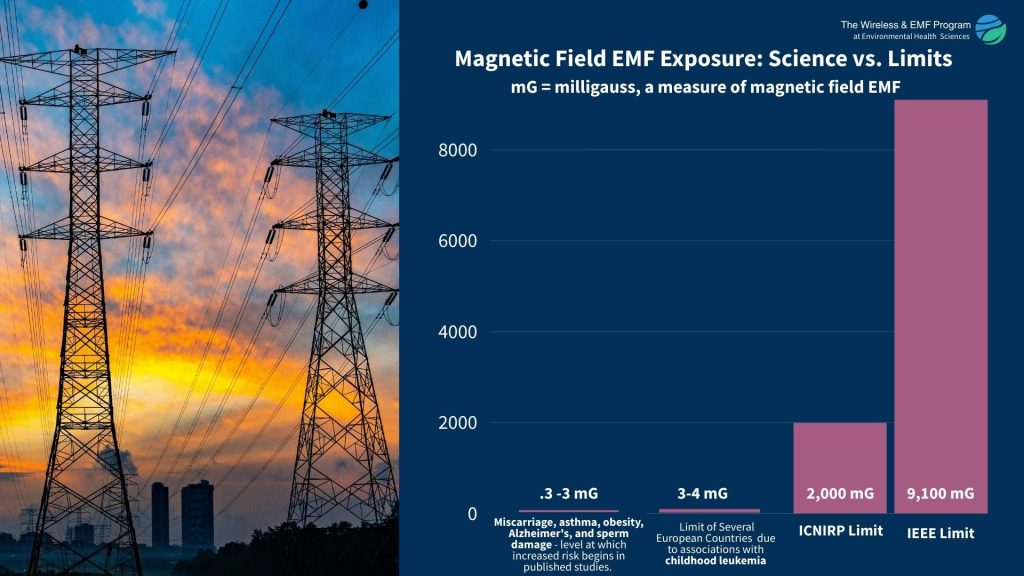
Environmental Health Sciences has a list of countries with more protections here.
It is time for a change. The United States should adopt a science-based regulatory framework for power-frequency EMFs and immediately implement protective setbacks between high-voltage transmission lines and substations and homes, schools, and other places where people live and work.
Please do two things now:
- Stay updated with our work at Environmental Health Sciences by joining our EMF Program newsletter.
- Download Dr. David Carpenter’s Open Letter Here. Share it with your local officials.
Learn More