The Gwinnett County, Georgia Board of Education just reversed its decision to allow a cell tower on property located between an elementary and a high school.
Although the school board had previously voted to sign the cell tower lease in December, they revoked their decision in the April 16th board meeting after parents organized and educated school board members about the health issues related to cell tower radiation.
The parents aren’t stopping. Now, they’re urging the school board to take the next step: passing a formal policy to ensure that cell towers cannot be proposed on school property again.
Watch a compilation of testimony from the parents and the vote.
A Growing Movement
Gwinnett County now joins a growing national trend of communities saying no to cell towers located on or near school properties.
Several school districts nationwide — from Los Angeles, California to Loudoun County, Virginia — have adopted policies that ban school cell towers in order to protect children’s health. Furthermore, numerous municipalities have local laws in place to ensure cell towers are distanced from schools and homes with required setbacks from 250 to 3,000 feet.
Parents and Teachers Nationwide Oppose Cell Towers at Schools
Parent Teacher Associations (PTAs) across the U.S. have formally opposed cell tower placements, passed resolutions, and called for stronger protections for children from the risks of nearby cell towers. They simply do not want to risk their children’s health.
When a cell tower was proposed near Hillsmere Elementary School, Maryland, the PTA sent a letter stating:
“Scientists and health care professionals are increasingly expressing concerns regarding both the overall roll-out of the 5G network, and the presence of mini-cells and cell towers near schools specifically.”
Several state PTAs have adopted resolutions calling for protective regulations.
The New York State PTA resolution states:
“The New York State Congress of Parents and Teachers, Inc. support legislation that would encourage local communities, including parents and school officials, to regulate the placement of cell towers and cell tower antennas particularly in schools and areas where children congregate.”
What the Science Says About Cell Towers and Health
Cell towers emit radiofrequency (RF) radiation. The majority of research studies have reported adverse biological effects associated with RF radiation exposure, including:
- Cancer
- Cellular stress and oxidative damage
- Genetic damage
- Neurological and cognitive impacts
Research shows that a close proximity cell tower can increase levels of RF radiation exposure at schools. Experts even recommend cell towers be placed at least 1,500 feet away to reduce health risks with some publications even making the same recommendation to companies themselves in order to mitigate liability risks related to RF radiation health damages.
Read the scientific research here.
Children Absorb More RF Radiation From Cell Towers
Children are considered uniquely vulnerable to wireless RF radiation. Children absorb higher amounts of RF radiation into their brain and body compared to adults. A study of children and cell tower radiation published in Environmental Research (Lee and Choi 2023) found that continuous 24-hour RF exposure from cell towers induced more than a ten-fold higher cumulative daily RF radiation absorption in the brain compared to a child’s exposure from cell phone use alone.
The American Academy of Pediatrics states that children are more sensitive to wireless exposures due to their still-developing brains and bodies and have repeatedly recommended strengthening protections for children. Even small impacts can have a large effect on children.
U.S. Policy For Cell Towers Is Outdated
While the U.S. does have FCC regulations regarding allowable cell tower radiation exposures, they are outdated and unchanged since 1996. There has been no review of the last three decades of science to ensure these limits are adequately protective. The International Commission on the Biological Effects of Electromagnetic Fields (ICBE-EMF) published a foundational paper documenting how FCC limits do not adequately protect children. A recent analysis of the findings of increased cancers in U.S. government animal studies concluded that the human exposure limit for wireless RF radiation exposure is 200 times too high to be protective against cancer risk.
Furthermore, a landmark 2021 court decision mandated the FCC to explain how its regulations protect children’s unique vulnerability, but to date, the agency has not complied with that order.
Safety And Liability Concerns Beyond Radiation
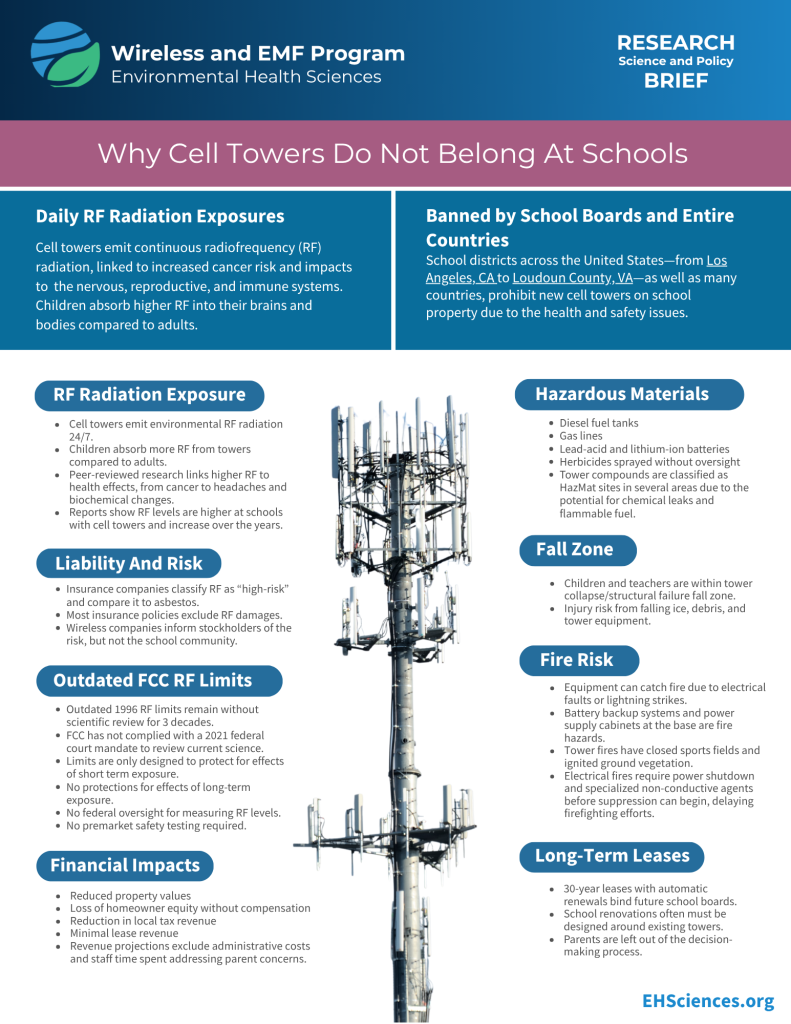
Health concerns are only part of the story. There are numerous safety risks associated with cell towers on school property, including:
- Fire hazards
- Tower collapse and fall zones
- Hazardous materials on site
- 30+ year lease agreements that limit future school construction or expansion
- Insurance exclusions, with some policies treating RF radiation exposure as a pollution-related liability
- Property value impacts on surrounding neighborhoods
Yes – Cell Towers Have Been Successfully Removed
School board members are generally not fully informed about the health and safety risks when a cell tower is proposed. These projects are presented by companies as simple revenue-generating agreements with little to no impact, while omitting key issues, including the lack of scientific consensus on long-term safety and the fact that companies disclose cell tower-related risks to shareholders, but not to the students or staff who will ultimately be affected. In many cases, school communities only become aware of these risks after decisions have already been made, leaving limited options for action. However, there are instances where strong community advocacy has successfully led to cell tower reversals.
- The Newport School Committee, Rhode Island voted to remove the cell tower at Rogers High School after long standing community concerns.
- In California, two towers adjoining Valentine Elementary and Huntington Middle schools, and at San Marino High School were relocated.
- In Montgomery County Maryland, a longtime cell tower at Woodward High School was nixed during renovations amidst strong community opposition, which prompted the Board to decline from authorizing any type of relocation of the tower.
- The Lakeway City Council in Texas withdrew its application to build a cell tower on city property near an elementary school.
How Parents Can Take Action
Parents who want to prevent cell towers at schools can start by organizing early, educating decision-makers, and working collectively with other families. To help guide this process, we’ve developed a step-by-step toolkit with resources to support your local efforts.
Federal Proposals To Fast-track Cell Towers: The Next Battle
School boards, as landowners, have the right to approve or reject cell towers on their own property. However, they have no authority over towers proposed nearby, including just off campus. That process typically rests with local governments. While school boards can pass resolutions opposing nearby towers, they often lack the power to stop them.
So while parents are successfully halting cell towers on school property, federal proposals are moving in the exact opposite direction. An FCC rulemaking as well as a congressional bill, H.R. 2289 would both fast-track the deployment of cell towers near homes and schools by stripping away the authority of local governments.
If these pass, parents and residents will have far less ability to provide meaningful input on cell tower proposals near schools and homes.
There is still time to stop these attempts to override local control over cell towers. Contact your lawmakers on these proposals using our one click action tool below.
News Stories on the Gwinnett County Board Decision
- Gwinnett County education board walks back decision to install cell tower between schools
- Gwinnett school board kills Peachtree Ridge cell phone tower proposal | News | gwinnettdailypost.com
- Gwinnett school board kills cell phone tower proposal – PressReader