
Cell towers, including 4G and 5G cellular antennas emit radio frequency (RF) radiation, a type of non-ionizing electromagnetic radiation. Although this type of radiation is non-ionizing, this does not ensure safety. Many scientists recommend caution because studies have reported a harmful health impacts after prolonged exposure.
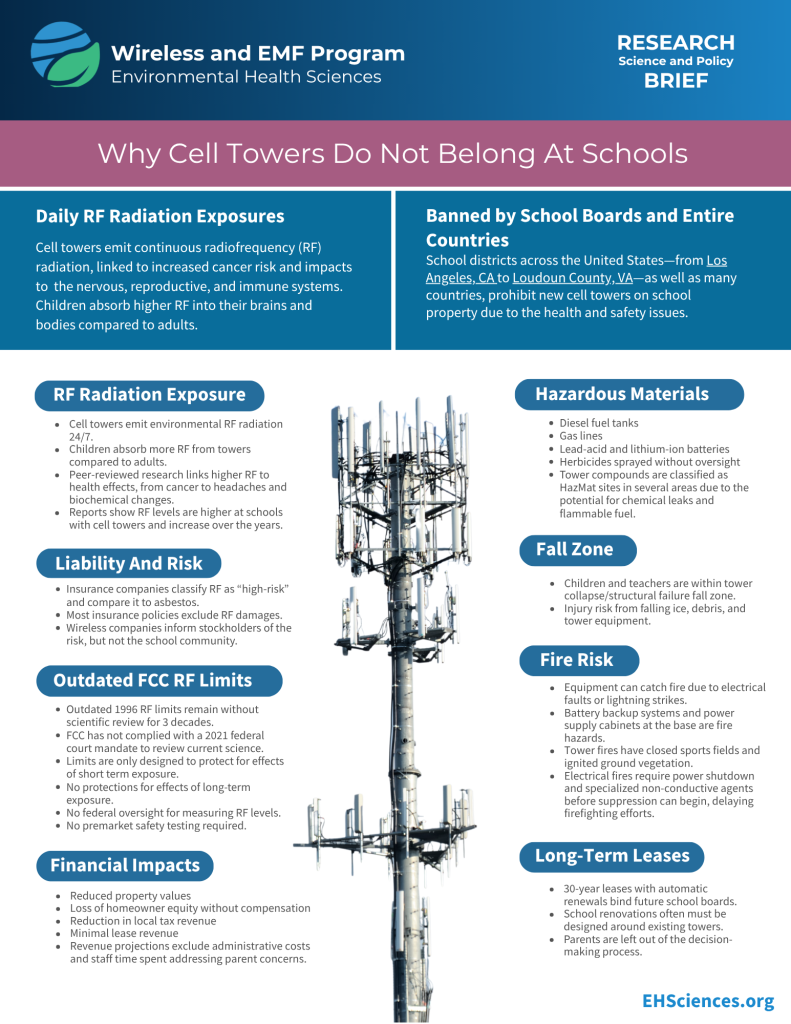
The U.S. lacks federal regulations governing the placement of cell towers near homes, hospitals, and schools. However, some state and local communities have taken steps to address the issue.
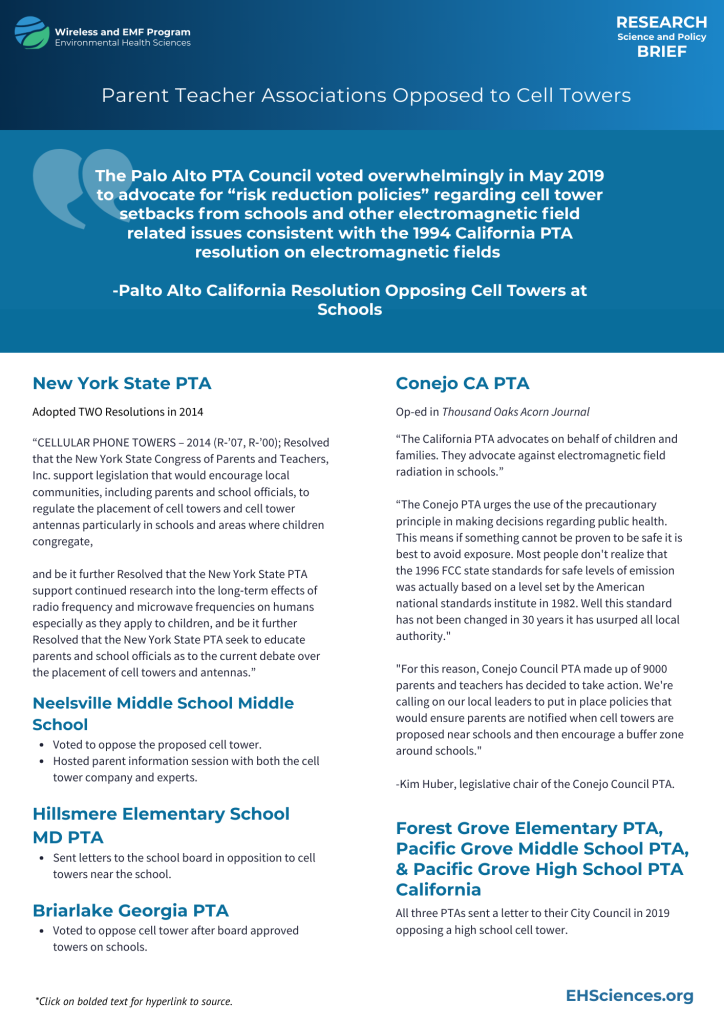
What school districts ban cell towers on school property?
Several U.S. school dictricts ban cell towers on schol property:
- Los Angeles Unified (CA): Passed three resolutions banning towers, including one that set a “cautionary level” for radiofrequency radiation at 10,000 times lower than US federal limits for public exposure.
- Palo Alto Unified (CA): Passed a 1,500-foot setback.
- Temecula Valley Unified (CA): Prohibited new towers and lease renewals via a policy and resolution.
- Portland OR: stopped considering new leases for cell towers.
- Montgomery County (MD): Stopped towers at elementary schools.
- West Linn-Wilsonville OR & Prince George’s County (MD): Did not renew cell tower leasing agreement.
- Loudoun County (VA.): Prohibited new towers for 5 years.
Click on the districts name and hyperlinked source for documents.
Hundreds of scientists are calling for safeguards due to growing evidence of harmful effects.
- Published Research on Cell Towers
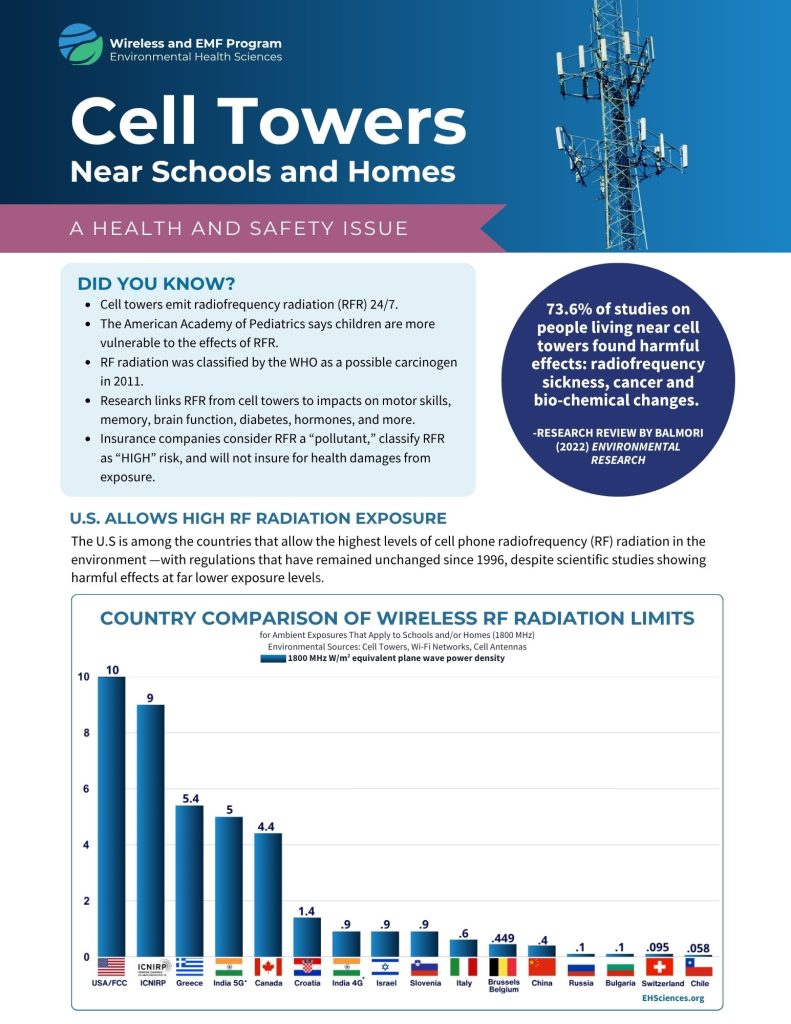
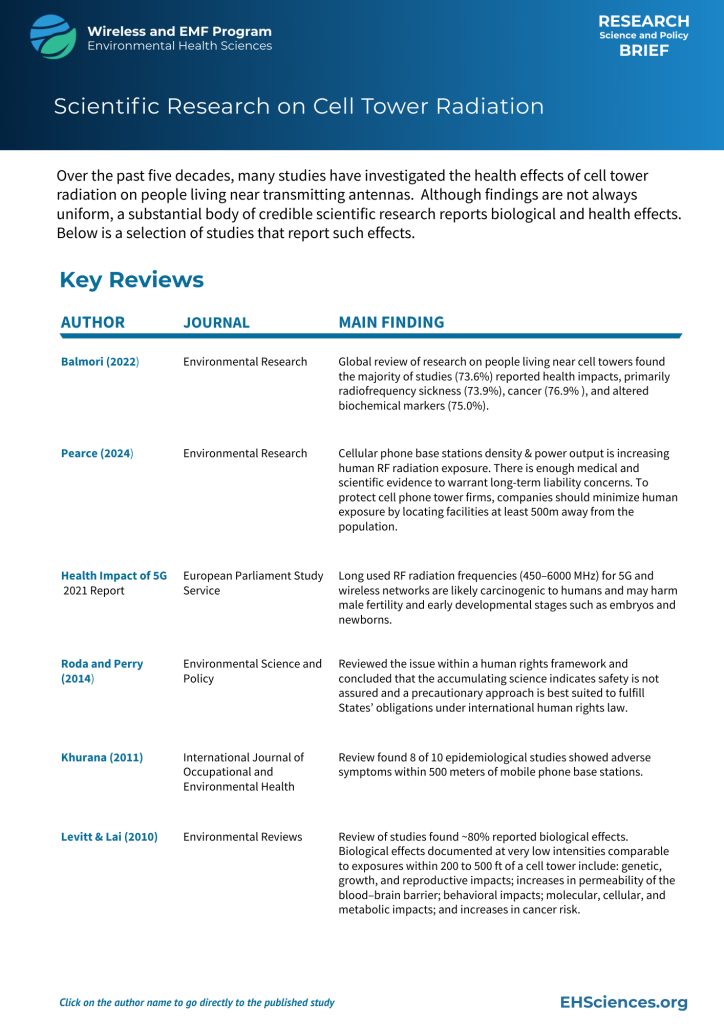
A 2022 review examined existing research on people living near cell towers and wireless network base stations and found the majority of studies reported impacts, primarily radiofrequency sickness, cancer, and altered biochemical markers.
In July 2021, the European Parliament released a commissioned report titled “Health Impact of 5G,” which concluded that widely used RF radiation frequencies (450–6000 MHz) are likely carcinogenic to humans and may harm male fertility and early development stages such as embryos and newborns.
In 2011, RF radiation was classified as a Group 2B “possible carcinogen” by the World Health Organization’s International Agency for Research on Cancer (WHO/IARC).. Since then, peer-reviewed studies on both people and animals have reported increased cancer risks. The 2018 large scale animal study published in Environmental Research by Falcioni et al. found elevated cancer rates in rats exposed to RF radiation at levels permitted for cell tower emissions. The World Health Organization commissioned a review of the laboratory studies and concluded there was “high certainty” evidence that RF radiation can cause cancer in animals.
Scientists involved in the original IARC evaluation have since stated that, based on current evidence, RF radiation would likely be reclassified as a probable or even proven human carcinogen if reassessed today.
Here are examples of studies in numerous countries focused on cell tower and wireless infrastructure that indicate safety is not assured:
- Germany: Gulati et al. (2024) found significantly higher rates of chromosomal aberrations—key indicators of genetic damage—in residents living near towers, supporting a biologically plausible link to increased cancer risk.
- Sweden: Hardell and Nilsson (2024) summarized several case reports on microwave syndrome symptoms (headaches, neurological isues, sleep problems etc) in people exposed to 5G antennas.
- Brazil: Rodrigues (2021) showed higher cancer mortality, especially lung and breast, near towers.
- Spain: López (2021) linked higher RF to increased headaches, dizziness and decreased sleep.
- Saudi Arabia: Meo (2018) linked exposure to delayed motor skills and attention deficits in teens.
- India: Zothansiama (2017) found blood changes predictive of cancer.
- India: Pachuau and Pachuaua (2016) found a strong correlation between higher tower radiation levels and health complaints with significant symptoms appearing above 2.145 mW/m².
- Saudi Arabia: Meo (2015) reported an association between higher exposures and higher risk of type 2 diabetes.
- India: Gandhi et al. (2014) A case-control study found significantly elevated DNA damage in residents living within 300 m of a mobile phone base station, especially among women, with power density and proximity identified as key predictors.
- Spain: Gomez-Perretta et al (2013) re-analysed the data from Navarro et al (2003) and found symptoms like fatigue, irritability, sleep disturbances, and poor concentration were linked to cellular base station exposure, independent of demographics, other EMF sources, or radiation-related anxiety.
- Taiwan: Li et al. (2012) found children living in areas with higher-than-median RF exposure had a significantly increased risk for all neoplasms (abnormal growths), benign and malignant.
- Egypt: Eskander et al. (2012) found long-term cell tower exposure over 6 years was linked to impacts to the endocrine system, including decreased ACTH, cortisol, and thyroid hormones, as well as significant drops in prolactin in females and testosterone in males.
- Brazil: Dode (2011) Cancer mortality was elevated within 500 meters of towers.
- Australia: Khurana (2011) found 8 of 10 reviewed studies showed adverse symptoms within 500m of cell towers and wireless infrastructure.
- Germany: Buchner (2011) found significant hormonal disruptions post-installation.
- Ukraine: Yakymenko (2011) reviewed dozens of studies and reported increased cancer.
- USA: Levitt & Lai (2010) reviewed100 studies on cell infrastructure and found about 80% showed biological effects.
- Germany: Eger and Neppe (2009) found a statistically significant increase in cancer incidence among residents within a 400-meter radius of a mobile phone base station five years after it became operational.
- Egypt: Abdel-Rassoul et al. (2007) found significantly higher rates of neuropsychiatric symptoms (e.g., headaches, memory changes, sleep disturbances) and reduced attention and memory performance linked to cell phone base station antennas.
- Israel: Wolf and Wolf (2004) reported increased incidence of cancer associated with living in proximity to a cell-phone transmitter station.
- Poland: Bortkiewicz et al., (2004) described increased reports of sleep disturbances, headaches, depression, and circulatory issues among people living near cell towers, with symptoms correlating to proximity and exposure level.
- Germany: Eger et al. (2004) found people living within 400 meters of a cellular transmitter had a significantly higher rate of newly diagnosed cancers and developed cancer on average 8 years earlier than those living farther away.
- France: Santini et al. (2003) surveyed 530 residents and found significantly higher rates of symptoms like nausea, sleep disturbances, and headaches within 300 m of cell towers.
- Spain: Navarro et al (2003) found a significant correlation between reported severity of “microwave sickness” health symptoms and the measured power density of RF radiation from a nearby cellular base station.
- Italy: Michelozzi et al., (1998) found significantly increased leukemia mortality, particularly in men, among residents living within 3.5 km of a high-power radio transmitter in Rome, with risk decreasing with distance.
- Latvia: Kolodynski and Kolodynska (1996) examined 609 schoolchildren and found that children residing in areas directly exposed to radar emissions exhibited statistically significant impairments in motor function, memory, attention, and reaction times.
International Policies to Restrict Cell Towers at Schools
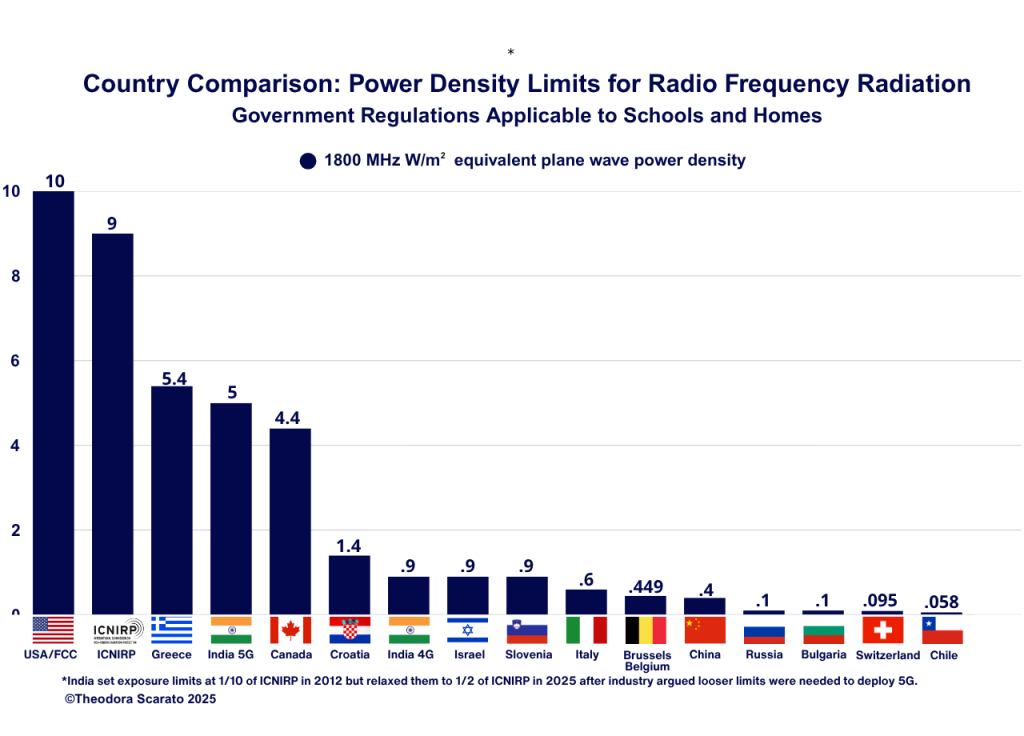
The United States allows higher levels of cell tower radiation in the environment than several other countries. Many nations—including Italy, Switzerland, China, and Russia—have adopted far stricter regulations. Scientists caution that even these more restrictive limits may not ensure safety as effects have been found at levels orders of magnitude lower. However, cell towers commonly permitted in the U.S. could violate regulations in these countries. These countries often require greater setbacks from homes, schools, and playgrounds to better protect public health, particularly for children
Country Policies to Ban Cell Towers at Schools
- Turkey: Cell antennas must be distanced from schools and playgrounds and not placed on the same floors as preschools or primary schools in multi-story buildings. RF levels are continuously monitored near schools and hospitals.
- Greece: Towers are prohibited on school grounds, with stricter RF limits within 300 meters of schools, hospitals, and elderly care homes.
- France: RF levels must be minimized within 100 meters of schools, daycare centers, and healthcare facilities.
- Bangladesh: Cell towers are banned on residential buildings, schools, colleges, playgrounds, high-density areas, and heritage sites.
- Israel: Requires at least a 100-meter setback between towers and schools or homes.
- Chile: Prohibits cell antennas in “sensitive areas” like kindergartens, hospitals, and nursing homes.
- Queensland, Australia: : New towers are not allowed on school property, must be 200 meters away, and emissions are capped at 1% of federal limits.
- New Zealand: Bans towers on school property and enforces a 50-meter setback.
- Toronto, Canada: Recommends exposures be 100 times lower than federal limits under a “Prudent Avoidance Policy.”
- Russia: Cell tower antennas and base stations are no longer allowed near schools, and a national plan is underway to relocate existing installations away from educational institutions.
EHS Factsheets on Cell Tower Radiation Policy
Download our factsheets on cell towers and schools here .
Fact Sheets and Briefings on Cell Tower Health and Safety Issues
Note: These can be emailed and placed on the official record of school boards because they include hyperlinks to scientific studies.
TEMECULA VALLEY UNIFIED SCHOOL DISTRICT
RESOLUTION 2023-2024/09 IN THE MATTER OF WIRELESS TELECOMMUNICATION INSTALLMENTS
WHEREAS, the health and safety of our students and employees are fundamental concerns of the Temecula Valley Unified School District;
WHEREAS, the Temecula Valley Unified School District cannot prevent wireless service facilities from being situated near its schools;
WHEREAS, the desire of the wireless companies to market new wireless services has since led to a proliferation of cellular facilities targeting residential areas and near schools;
WHEREAS, wireless infrastructure is being deployed at an unprecedented speed and cellular facilities have been approved without proper justification and proof that the placement is to serve existing demand or provide public safety benefits;
WHEREAS, serious concerns exist regarding wireless permits approved near schools without proper notification to school officials and nearby property owners or proper review and oversight of the wireless applications;
WHEREAS, cities, counties, and local municipalities have relied upon Section 704 of the Federal Telecommunications Act of 1996 to preempt local communities and school districts from opposing the placement, construction, and modification of personal wireless service facilities on the basis of environmental effects of radiofrequency emissions to the extent that the proposed facilities comply with the Federal Communications Commission regulations concerning such emissions;
WHEREAS, cities, counties, and local municipalities have not had to demonstrate that these telecommunication facilities comply with the Federal Communications Commission regulations concerning radiofrequency emissions as they relate to multiple-transmitter sites and complex environments whereby all significant contributions to environmental exposures are cumulatively considered;
WHEREAS, based upon new and emerging scientific evidence there continues to be considerable debate as to the adequacy of existing public exposure standards including those promulgated by the Federal Communications Commission. Specifically, a recent decision by the United State Court of Appeal found that the Federal Communications Commission, the commission regulating facilities and devices that transmit radio waves and microwaves, failed to adequately provide explanation or its guidelines on wireless facilities and their harmful effects of radiofrequency. (Environmental Health Trust v. Federal Communications Commission (D.C. 2021) 9 F.4th 893, 900.) While the court emphasized that it took no position on the scientific debate on the health and environmental effects of the radiation, it held that the Commission failed to provide a reasoned explanation on the cancer-related health effects and impacts of radiation on children. (Id. at 909.);
WHEREAS, the Federal Communications Commission is obligated to conduct periodic reviews of current research and analysis of health implications associated with radiofrequency exposures in cooperation with industry, agency, and organizations responsible for community health and safety to ensure exposure to guidelines are appropriate and scientifically valid;
WHEREAS, regardless of the regulatory compliance, the scientific and medical communities urge a cautionary approach to radiofrequency exposure. Recent environmental research suggests that exposure to radiofrequencies, including a cumulative effective of low- intensity exposure, can cause increased incidence of cancer, neuropsychiatric effects such as headaches, concentration difficulties, memory changes, and reproductive complications and infertility. (J.M. Pearce, “Limiting Liability with Positioning to Minimize Negative Health Effects of Cellular Phone Towers” (October 19, 2019).).
NOW, THEREFORE, BE IT RESOLVED the Board of Trustees of the Temecula Valley Unified School District adopts and implements revised Board Policy 3514, prohibiting new wireless telecommunication installments on Temecula Valley Unified School District’s school grounds as well as prohibiting any extension or renewal of existing ground leases for the maintenance of wireless telecommunication installments on District property.
BE IT FURTHER RESOLVED that the Board of Trustees requests and supports that the City of Temecula immediately establish local municipal zoning setback rules of 1,500 feet or more for operations of wireless telecommunication transmitters near a school site;BE IT FURTHER RESOLVED that the Board of Trustees requests the City of Temecula to provide timely notification when new wireless telecommunication transmitter permit applications are filed and provide comment on the health risks from the proposed installment as it relates to compliance with existing Federal Communications Commission regulations associated with cumulative exposures;