
The Serious Health, Safety, and Liability Risks of Cell Towers
Here are the reasons why cell towers should not be near schools and homes.
THE ISSUES
- The Cell Tower Fall Zone
- Cell Towers Increase in Height With Little Public Process
- Visual and Aesthetic Impacts
- Fire Risk
- Hazardous Materials
- Property Value Drops
- Daily Radiation Exposure
- Cell Tower RF Radiation Levels Will Likely Increase Every Year
- Insurance Authorities Compare Cell Tower Radiation to Asbestos
- Companies Warn Their Shareholders of Cell Tower Radiation Risk
1. The Critical Role of Cell Tower Fall Zones
A cell tower fall zone is the area surrounding the base of a tower where the tower structure, or parts of it, could reasonably be expected to fall in the event of a structural failure or collapse. This zone also accounts for hazards such as falling ice, detached equipment, or debris that may be dislodged during extreme weather conditions, accidents, or mechanical malfunctions. If a tower catches fire, burning pieces can also fall from the tower.
Everything located within the fall zone is considered at risk. Establishing an adequate fall zone is essential for public safety and infrastructure protection. It ensures that nearby buildings, structures, and people remain outside the potential impact area if the tower—or any portion of it—were to fall.
By maintaining this buffer, zoning regulations help minimize property damage, prevent injuries, and promote safe maintenance and operational practices around telecommunication towers.
Cell towers do fall, and parts can collapse. A cellphone tower collapsed in Las Vegas in April 2022 due to high winds, with the tower falling into the backyard of a Napa Auto Parts store, just feet from nearby homes.
Ensuring an appropriate fall zone reduces the chance that adjacent property and people are harmed. Unfortunately, many cell towers are irresponsibly placed on school sports fields or close to homes and playgrounds.
- Examples of cell tower collapse, ice hits and falling debris
Examples of cell tower collapse, ice hits and falling debris issues.
Cell Tower Collapse
- A cellular tower in Palmer was seen broken in half after recent high winds tore through the area.
- Lincoln County Sheriff’s Office reports cell tower destroyed in Monday’s storm
- Storms bring tornado to Carmel, downing radio tower
- Cell phone tower collapses near Tropicana and Nellis
- Cell tower collapse kills 7 children outside a school in Jakarta
- Cell Equipment Worker Atop Hammock Water Tower Falls Inside Cylinder, Triggering High-Wire Rescue
- OSHA Investigation of the February 1, 2014 Collapse of a Telecommunication Tower at the Summit Park Community in Clarksburg, WV
- Oswego, New York Cellular Tower Crushes Chief’s Vehicle
- Tower collapse: Heavy wind and rain blamed for downing ‘major communications’ equipment in Berkshires, knocking out police, fire radio service, Massachusetts
- Hurricane-force winds topple cell phone towers in Pennsylvania
Falling Ice and Debris
- Large pieces of ice fall hundreds of feet from TV tower
- Decorative Frond Falls From Palm Tree Cell Phone Tower, slices through man’s car.
- Ice falling off cell tower
-
2/20/2014 Crescenta CAAT&T Withdraws Cell Tower Application: Debris fall off cell tower onto the residence.
- Giant Icicles Fall From Sky, Smash Cars
- Ice Is Falling From The Cell Tower — After the Ice Storm
- Large pieces of ice fall hundreds of feet from TV tower
2. Cell Towers Can Increase in Height With Little Public Process
Once a cell tower is constructed, federal law makes it relatively easy for wireless carriers to add new antennas or equipment and in many cases, increase height by 20 feet with minimal local review. This is because Section 6409(a) of the Middle Class Tax Relief and Job Creation Act of 2012 requires local governments to approve most requests to modify an existing tower as long as the change does not “substantially change” the tower’s physical dimensions. In practice, this means that carriers co-locate additional equipment, enlarge antenna arrays, or add new technologies without going through the full public-hearing or zoning process that was required for the original tower approval.
As a result, communities may see a tower grow taller or more densely equipped over time, even though the public has little opportunity to weigh in once the initial structure is in place.
Stay updated on cell tower issues with our science and policy newsletter.
3. The Visual and Aesthetic Impacts of Cell Towers
Cell towers and 5G wireless facilities impact the aesthetic of the surrounding environment. They create visual clutter and can directly conflict with local design standards created to preserve architectural heritage, natural landscapes, and scenic vistas. Communities have the right to protect local aesthetics, especially near historic areas.
Although telecom companies frequently describe their wireless installations as “small,” “low-profile,” or “minimal,” the real-world impact is often the opposite, especially as networks become increasingly dense. “Small” cells are anything but small as the installations include not only pole-top antennas, but also large, boxy, and visually intrusive equipment cabinets at ground level, power supplies, cooling units, and extensive cabling. Together, this equipment can overwhelm the streetscape and clutter sidewalks. As 5G requires many nodes spaced only a few hundred feet apart, the cumulative effect becomes a significant visual blight, fundamentally altering neighborhood character.
Stay updated on cell tower issues with our science and policy newsletter.
4. The Fire Risk of Cell Towers
Cell tower equipment can catch fire, igniting vegetation on the ground and in some cases even causing the closure of school sports fields. This has happened at multiple schools. For example, a cell tower light pole caught fire at the Otay Ranch High School stadium in California, and similar cell tower fires occurred at Heritage High School in Virginia, Thurston High in Oregon, and Grandview Heights High School in Ohio.
Cell towers and 5G small-cell wireless installations pose recognized fire hazards due to their combination of high-powered electrical equipment, lithium-ion backup batteries, and densely packed electronics. Electrical faults, such as arcing, overheating, insulation failure, or wiring defects, can ignite fires inside equipment cabinets and at the base of towers, and electrical malfunctions are among the most frequently documented causes of tower-related fires worldwide. Fires on energized equipment cannot be extinguished with water until the grid is cut. This shutdown process can take up to an hour, allowing fires to grow unchecked.
Many 4G and 5G antennas are mounted on utility power poles, which can increase the ignition risk. When telecommunications wiring comes into contact with energized electrical conductors, arcing can occur, potentially triggering pole-top fires or wildfires. Multiple high-profile fires in California have been linked to telecom equipment failures, resulting in billions in damages and loss of life. Southern California’s Orange County filed lawsuits alleging that a telecommunications wire contacting a power company’s energized line helped spark the Silverado Fire, naming T-Mobile in the complaint.
Antennas mounted on rooftops create fire hazards for the building. One example is the fire that broke out on the rooftop of an apartment building in Brooklyn (Crown Heights) reported to be possibly caused by an electrical malfunction of a cell tower / antennas on the roof. These fire risks require meaningful review and mitigation, but the issue is too often ignored.
- Examples of Cell Tower Fires
Cell towers can create a fire risk.
PDF of Susan Foster’s Telecom and Fire Risk Brochure
Here are some examples of cell tower fires
- Fire damages the tower in kuala kangsar and disrupts mobile networks
- Video: Cellphone tower catches fire in Sacramento
- Cell Tower Catches Fire In Sanford, FL
- Fire breaks out in mobile tower panel in Thane India; none hurt
- Stadium Light Catches Fire High School In Chula Vista
- 5G small cell fire in LA 2019, Fire from across the street LA – 5G cell phone tower. Fire on afternoon of 8.9.19.
- Cellphone tower fire in Seattle
- Parts of Yonge St. and Hwy. 401 closed due to burning communications tower
- Cell phone tower near Heritage High School catches fire
- School Football Field Cell phone tower catches fire in Grandview, Ohio.
- Cell tower fire at Thurston High sends up smoky plume.
- Cell tower catches fire in Lapeer
- Virginia cell tower fire
- Cell phone tower in Hanover catches fire
- Fire Extinguished on Roof of Crown Heights Apartment Building
- Cell tower at Risk of Falling after Fire Atlanta Georgia.
- Cell tower fire closes Rockbridge Road, evacuates day care.
- New Jersey Cell Tower Fire
- Cell phone tower to be taken down following fire, Georgia
- Cell phone tower catches fire near U.S. 95 Las Vegas,
- Maryland Cell Tower Destroyed by Fire
- Cell tower catches fire, nearby buildings evacuated, San Bernardino County, California
- Osprey nest, electrical problem sparked Poulsbo cell tower fire Washington State
Additional reading: Hidden Fire Hazards:The Risks of Co-locating Telecom Equipment on Utility Poles – EKN Engineering
Stay updated on cell tower issues with our science and policy newsletter.
5. Hazardous Materials on Cell Tower Sites
Cell tower sites often store hazardous materials that pose chemical and environmental hazards if damaged or improperly maintained. The backup power systems can include lead acid batteries and diesel fuel tanks (some with over 180 gallons of fuel), which can potentially leak during equipment failure, accidents, or natural disasters. Some county fire departments even register cell tower sites as HAZMAT sites because first responders must be prepared for risks such as battery acid exposure, fuel ignition, groundwater contamination, and toxic smoke if equipment burns.
In 2025, Verizon Wireless agreed to pay $7.7 million to settle a civil enforcement case in California after state and local prosecutors found that the company violated environmental and hazardous-materials laws at its thousands of cell tower sites statewide. According to the Los Angeles, CA DA, Verizon was found to have failed to comply with reporting and training requirements, inspections, and payments for hazardous materials permits at numerous cell sites. As reported by Westside Today on January 3, 2026, “Many of those sites store hazardous substances that can pose safety and environmental risks if not managed correctly, including the potential for fires, explosions, and the release of toxic air contaminants.”
Cell tower companies routinely spray herbicides and toxic chemicals around tower bases to control vegetation and reduce fire risk (fire-retardant sprays). These treatments often include professional-grade “bare-ground” chemicals designed to stop all plant growth, and they must be applied by licensed professional applicators because of their toxicity and environmental risks. Such chemicals are not safe for children.
“In recent years, I have found that the best solution is to bring in a professional weed service to spray my tower sites.
These services are licensed to use much stronger chemicals than are available to the average person. In fact, some have said the professionals often use a chemical that functions quite like the infamous “Agent Orange” which was used to deforest parts of Vietnam in the 60’s.” -Weeding Out Problems at Tower Sites
Stay updated on cell tower issues with our science and policy newsletter.
6. Cell Towers Drop Property Values
Would you want to buy a house with a looming cell tower nearby? Cell towers can significantly decrease the property values of nearby homes, according to both real estate professionals and published analysis. Realtors across the U.S. consistently report that buyers are reluctant to purchase homes located near visible cell towers. In many markets, homes next to or within view of towers take longer to sell and often close for considerably less value. A report for the Smart Communities and Special Districts Coalition – representing over 31 million residents in 11 states and the District of Columbia- documented research that found a visible tower can reduce home value by as much as 20%. The stigma associated with cell towers directly translates into lower demand and diminished marketability.
7. Cell Towers Create Daily Full Body RF Radiation Exposure
Cell towers emit continuous cellular radiofrequency (RF) radiation 24/7. Numerous studies have reported associations between cell tower RF radiation exposure and health effects. A 2022 published review found over 73% of studies on people living near cell towers reported adverse effects such as higher cancer rates, biochemical changes, and radiofrequency sickness symptoms including headaches, sleep issues and memory issues.
- Peer Reviewed Scientific Research on Cell Towers and Health Effects
Scientific studies link cell towers to health harm
A review by Balmori 2022 examined existing research on people living near cell towers (known as mobile phone base stations internatonally) and found the majority of studies reported impacts, primarily radiofrequency sickness, cancer, and altered biochemical markers.
“Overall results of this review show three types of effects by base station antennas on the health of people: radiofrequency sickness (RS), cancer (C) and changes in biochemical parameters (CBP). Considering all the studies reviewed globally (n = 38), 73.6% (28/38) showed effects: 73.9% (17/23) for radiofrequency sickness, 76.9% (10/13) for cancer and 75.0% (6/8) for changes in biochemical parameters.”
In July 2021, the European Parliament released a commissioned report titled “Health Impact of 5G,” which concluded that widely used RF radiation frequencies (450–6000 MHz) are likely carcinogenic to humans and may harm male fertility and early development stages, such as embryos and newborns.
In 2011, RF radiation was classified as a Group 2B “possible carcinogen” by the World Health Organization’s International Agency for Research on Cancer (WHO/IARC). Since then, peer-reviewed studies on both people and animals have reported increased cancer risks. The 2018 large scale animal study published in Environmental Research by Falcioni et al. found elevated cancer rates in rats exposed to RF radiation at levels permitted for cell tower emissions.
Scientists involved in the original IARC evaluation have since stated that, based on current evidence, RF radiation would likely be reclassified as a probable or even proven human carcinogen if reassessed today.
Peer-reviewed Published Research on Cell Towers and Health
Here are examples of studies in numerous countries focused on cell towers and wireless infrastructure that indicate safety is not assured:
- India: (Sailo 2025) found that residents living within 50 meters of cell towers reported significantly more adverse health symptoms than those living farther away, with symptoms that included mood, cognitive, and inflammatory issues- all at cell tower radiation exposure levels well below the current FCC safety limits.
- Germany: Gulati et al. (2024) found significantly higher rates of chromosomal aberrations—key indicators of genetic damage—in residents living near towers, supporting a biologically plausible link to increased cancer risk.
- Sweden: Hardell and Nilsson (2024) summarized several case reports on microwave syndrome symptoms in people exposed to 5G antennas.
- Brazil: Rodrigues (2021) showed higher cancer mortality, especially lung and breast, near towers.
- Spain: López (2021) linked higher RF to increased headaches, dizziness and decreased sleep.
- Italy: Brizzi and Marinelli (2019) followed a community exposed to radar from 1970 until 1998 in a community iand found increased cancer and heart disease in the exposed residents.
- Saudi Arabia: Meo (2018) linked exposure to delayed motor skills and attention deficits in teens.
- India: Zothansiama (2017) found blood changes predictive of cancer.
- India: Pachuau and Pachuaua (2016) found a strong correlation between higher tower radiation levels and health complaints with significant symptoms appearing above 2.145 mW/m².
- India: Singh et al (2016) found significantly more reported health issues—including sleep disturbances, headaches and concentration difficulties as well as measured reduced salivary secretion – in people living closer to antennas.
- Saudi Arabia: Meo (2015) reported an association between higher exposures and higher risk of type 2 diabetes.
- India: Gandhi et al. (2014), a case-control study, found significantly elevated DNA damage in residents living within 300 m of a mobile phone base station, especially among women, with power density and proximity identified as key predictors.
- Spain: Gomez-Perretta et al (2013) re-analysed the data from Navarro et al (2003) and found symptoms like fatigue, irritability, sleep disturbances, and poor concentration were linked to cellular base station exposure, independent of demographics, other EMF sources, or radiation-related anxiety.
- Taiwan: Li et al. (2012) found children living in areas with higher-than-median RF exposure had a significantly increased risk for all neoplasms (abnormal growths), benign and malignant.
- Egypt: Eskander et al. (2012) found long-term cell tower exposure over 6 years was linked to impacts to the endocrine system, including decreased ACTH, cortisol, and thyroid hormones, as well as significant drops in prolactin in females and testosterone in males.
- Brazil: Dode (2011) Cancer mortality was elevated within 500 meters of towers.
- Australia: Khurana (2011) found 8 of 10 reviewed studies showed adverse symptoms within 500m of cell towers and wireless infrastructure.
- Germany: Buchner (2011) found significant hormonal disruptions post-installation.
- Ukraine: Yakymenko (2011) reviewed dozens of studies and reported increased cancer.
- USA: Levitt & Lai (2010) reviewed 100 studies on cell infrastructure and found about 80% showed biological effects.
- Germany: Eger and Neppe (2009) found a statistically significant increase in cancer incidence among residents within a 400-meter radius of a mobile phone base station five years after it became operational.
- Egypt: Abdel-Rassoul et al. (2007) found significantly higher rates of neuropsychiatric symptoms (e.g., headaches, memory changes, sleep disturbances) and reduced attention and memory performance linked to cell phone base station antennas.
- Israel: Wolf and Wolf (2004) reported increased incidence of cancer associated with living in proximity to a cell phone transmitter station.
- Poland: Bortkiewicz et al., (2004) described increased reports of sleep disturbances, headaches, depression, and circulatory issues among people living near cell towers, with symptoms correlating to proximity and exposure level.
- Germany: Eger et al. (2004) found people living within 400 meters of a cellular transmitter had a significantly higher rate of newly diagnosed cancers and developed cancer on average 8 years earlier than those living farther away.
- France: Santini et al. (2003) surveyed 530 residents and found significantly higher rates of symptoms like nausea, sleep disturbances, and headaches within 300 m of cell towers.
- Spain: Navarro et al (2003) found a significant correlation between reported severity of “microwave sickness” health symptoms and the measured power density of RF radiation from a nearby cellular base station.
- Italy:Michelozzi et al., (1998) found significantly increased leukemia mortality, particularly in men, among residents living within 3.5 km of a high-power radio transmitter in Rome, with risk decreasing with distance.
- Latvia: Kolodynski and Kolodynska (1996) examined 609 schoolchildren and found that children residing in areas directly exposed to radar emissions exhibited statistically significant impairments in motor function, memory, attention, and reaction times.
Want to read more science? Check out our website page with published science here.
Children are especially vulnerable because their bodies absorb more of this radiation. Their brains are still developing and more sensitive to harm. Experts recommend at least a 1,500-foot cell tower setback from schools and homes to reduce health risk.
- Doctor and Scientist Letters on Cell Tower Radiation Health Effects
Doctor and Scientist Letters on Cell Tower Radiation Health Effects
Published Science on Cell Tower Radiation
Letters From Scientists on Cell Towers
Dr. Martin Blank, Columbia University
Dr. David Carpenter, University of Albany
Dr. Davis Ph.D. and Dr. Anthony Miller
Dr. Ron Powell Ph.D, The Health Argument against Cell Phones and Cell Towers
Dr. Kent Chamberlin, University of New Hampshire
Dr. James Rochester Letter on Cell Towers at the Hampfield School District
Physicians For Safe Technology Dr. Cindy Russell
Dr. Dennis Booth on Cell Towers at Hempfield School District Letter
Stay updated on cell tower issues with our science and policy newsletter.
The International Association of Firefighters Resolution officially opposes cell towers on their stations “until a study with the highest scientific merit and integrity on health effects of exposure to low-intensity RF/MW radiation is conducted and it is proven that such sitings are not hazardous to the health of our members.”
In California, firefighter unions repeatedly and successfully lobbied state lawmakers to remove fire stations from a list of locations that legislation would fastrack 5G “small cells” on. Firefighters Local 1014 launched a campaign with 30 second hard hitting ads and a website that stated, “It’s a no-brainer that LA County should at least have done a proper study before putting 200-foot high-power microwave antennas on top of our heads.”
8. Cell Tower RF Radiation Levels Will Likely Increase Every Year
Cell tower RF radiation levels typically rise year after year because networks are continually upgraded and expanded, even after a tower is first approved.
Wireless companies present initial RF radiation exposure projections that appear low only because the tower is not yet operating at full capacity, antennas may be running at reduced power, fewer frequency bands are active, and future 4G, 5G, and C-band additions are not included. As new technologies, carriers, and antenna sectors are added, which is common, the total RF radiation output increases significantly.
A study from Greece that analysed data from the country’s national monitoring network with hundreds of sensors across the country found that legacy frequency bands overall did not increase but 5G RF exposure at 3.6 GHz increased over time due to network expansion, increasing by more than twofold between 2022 and 2024. A French government measurement campaign conducted between 2020 and 2023 near selected 5G 3.5 GHz sites reported an increase of roughly 15–20% in mean measured RF exposure over the campaign period, reflecting localized changes associated with 5G deployment.
Real-world monitoring at schools has shown increases over time. As an example, FOIA-obtained RF radiation reports for Fairfax, Virginia school cell towers show dramatic increases over just two years for several schools. Thoreau Middle School rose from 0.36% in 2019 to 14.87% in 2021 of the FCC limit (over 40-fold increase), Centreville High jumped from 0.36% in 2019 to 2.97% in 2021 (8 fold increase), and Robinson Secondary climbed from 0.37% in 2019 to 14.37% in 2021 (a nearly 40 increase).
While the wireless companies may state such levels are “very low” compared to FCC limits and therefore “safe”, the reality is that compliance with FCC limits does not assure safety from effects reported in scientific research like cancer. The FCC limits have been well-criticized for not accounting for children’s vulnerability or cumulative daily exposure. Many countries—including Italy, Switzerland, India, Russia, and China—have limits 10 to 100 times lower than the U.S. FCC standard. So when a company claims emissions are “low,” it simply means “low compared to an outdated U.S. FCC limit,” not low compared to science-based protections.
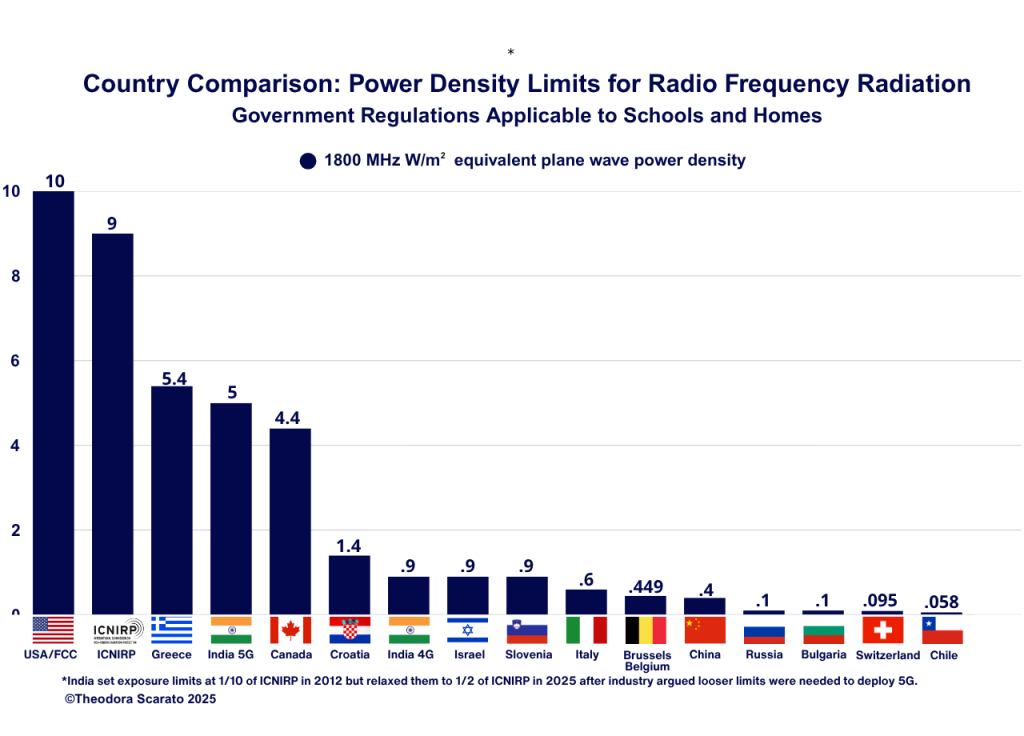
As wireless networks are continuously expanded and layered with additional technologies, carriers, and frequency bands, multiple measurement campaigns show that RF exposure at specific sites—particularly in 5G mid-band frequencies—tends to increase over time. Together with the rapid growth in the number of wireless devices used in homes and workplaces—often used in close proximity to the body—these expanding and overlapping networks contribute to increasing cumulative daily RF exposure.
9. Insurance Authorities Compare RF Radiation Risk to Asbestos
Major insurers classify cell tower radiofrequency (RF) radiation as a high-risk liability, often comparing it to hazards like asbestos and lead due to its potentially serious long-term impacts. The Swiss Re Institute, one of the world’s top reinsurance authorities, has labeled 5G an “off-the-leash” risk—its term for emerging technologies with unpredictable and potentially widespread consequences. Because of this financial exposure, most major U.S. insurance providers now exclude coverage for damages related to non-ionizing electromagnetic fields (EMF), including the RF radiation emitted by cell towers and wireless network infrastructure.
Furthermore, U.S. telecom carriers have been unable to obtain insurance coverage themselves for RF-related health or property claims for more than a decade and they offer cell phone protection insurance which defines RF as a pollutant.
10. Companies Warn Their Shareholders of RF Health Related Risk
Telecommunications companies tell shareholders that lawsuits, evolving science, and regulatory changes related to health effects from RF radiation could impact them financially. Some even disclose that they lack insurance coverage for health-related RF claims. However, they do not provide any warnings to the people living near cell towers.
“We cannot guarantee that claims relating to radio frequency emissions will not arise in the future or that the results of such studies will not be adverse to us…If a connection between radio frequency emissions and possible negative health effects were established, our operations, costs, or revenues may be materially and adversely affected. We currently do not maintain any significant insurance with respect to these matters.”- Crown Castle 10-K Report (2024)
“Our wireless business is also subject to lawsuits relating to alleged adverse health effects of wireless phones and radio frequency transmitters. Any of these allegations or changes in government agencies’ assessment of the risks associated with using wireless devices could result in significant legal and regulatory liability and other remedies, and could have a material adverse effect on our business, financial condition and operating results.”- Verizon 10-K Report (2024)
Many of these same companies even sell cell phone “protection” plans that explicitly define non-ionizing EMF as a form of “pollution.”
Stay updated on cell tower issues with our science and policy newsletter.
BONUS: More Reasons Cell Towers Should Not Be Near Schools
Cell towers located near schools introduce additional safety concerns, from criminal activity to climbing hazards.
Cell Tower Copper Theft Can Trigger Falling Equipment
Industrial cell towers placed on school campuses can attract criminal activity because their high-value copper wiring and equipment are prime targets for theft and vandalism. When thieves break into these structures, often cutting live cables or damaging electrical systems, they not only risk starting fires or causing equipment failures but also jeopardize the safety of students and staff who use the surrounding grounds because when thieves cut cables or strip equipment, the damage can cause equipment to fall off the tower, even toppling towers in some cases. These crimes can result in hundreds of thousands of dollars in damage, far exceeding the value of the stolen copper, while simultaneously putting students and staff at risk.
Cell Towers are Climbing Hazards
These tall structures can attract curious children, teens, or distressed individuals who may attempt to climb them, leading to severe or fatal falls. For example, a 16-year-old died after falling 60 feet from a utility pole in Utah. Placing cell towers near school grounds heightens the potential for climbing incidents, dangerous falls, and emergency response situations.
- Children and Adults Climbing and Falling From Cell Towers
Children and Adults Climbing and Falling From Cell Towers
- Up a tree and in hot water: Person jumps from cell tower; parachute gets tangled in tree
- Culpeper police talk a suicidal man down from cell phone tower
- Man who scaled the campus radio tower for 62 hours has died
- Officials Rescue Ill. Man, 18, From Cell Tower
- Suicidal man rescued after scaling cell tower
Environmental Health Sciences (EHS) is a scientific nonprofit organization focused on environmental health issues. Our Wireless and EMF Program works to create and disseminate knowledge resources that increase understanding of the health and ecological risks posed by wireless and other non-ionizing EMF exposures, counter industry misinformation, promote safer technology, and support meaningful policy change. Sign up for our Wireless and EMF Program newsletter.