
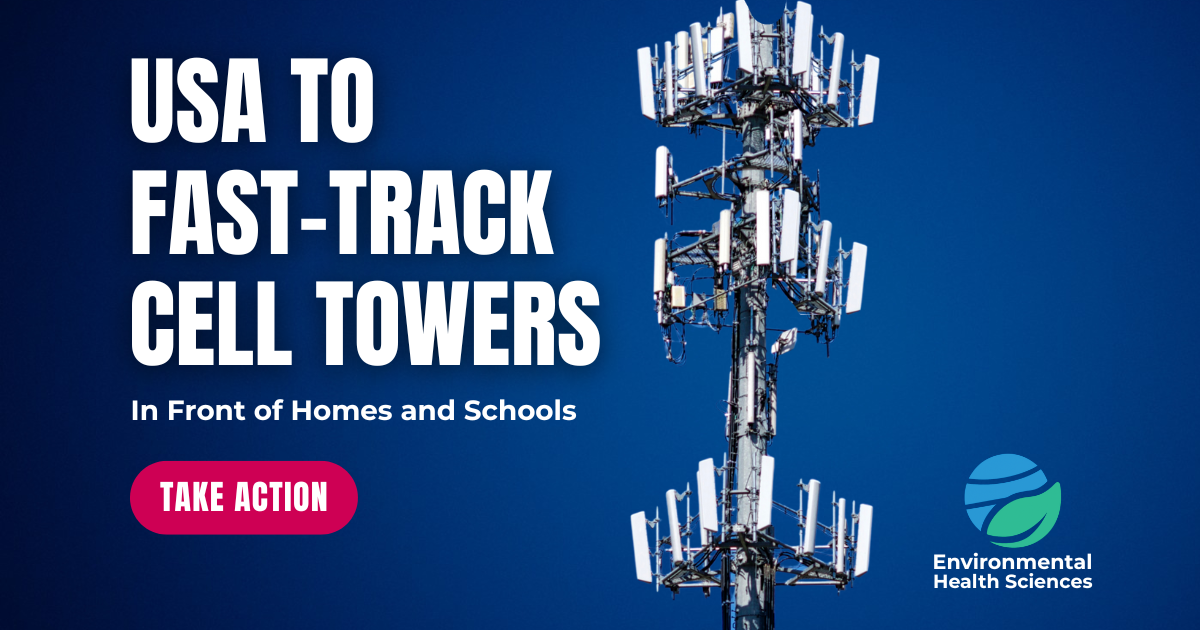
The FCC is pushing a major policy change that will allow industry to place cell towers in neighborhoods via a cell tower fast-track proposal that will replace local decision-making with federal control over cell towers. The FCC wants to strip local city, state, and county authority regarding setbacks, fees, aesthetics, compliance, and much more. This webpage explains how to take action.
Now is the time to file “reply” comments.
Deadline: January 15.
Add your voice
- File a Reply Comment: EHS has instructions so you can easily file a reply comment to the official FCC record. See below for instructions or file via our 1-click tool here.
- Inform Your Community: Contact your mayor, city council members, and planning or zoning officials and urge them to file a letter,
What can I share with my elected officials? Share the numerous letters submitted by local governments that we have compiled at this link. Download our factsheets to learn more and share them with your community.
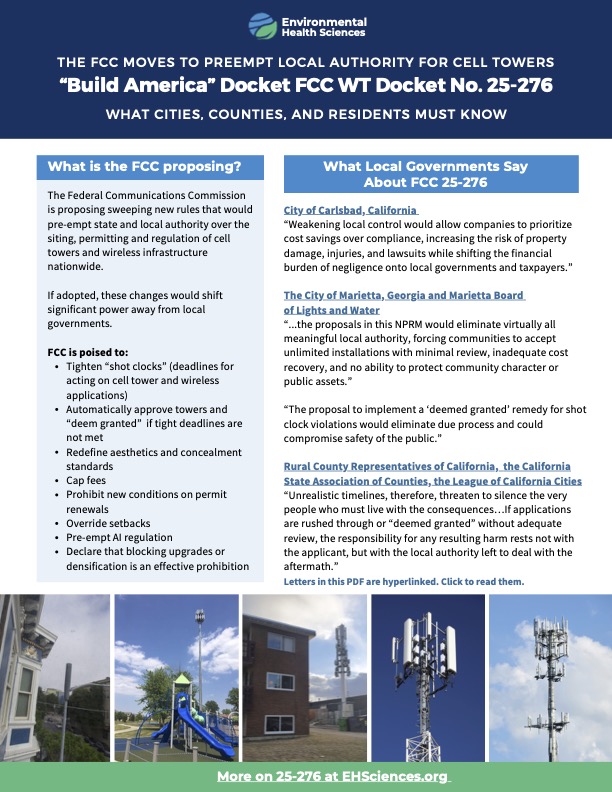
Cell towers present numerous health, safety, and property value risks. By law, the FCC must address the arguments made in comments submitted to the record. Over 3,000 comments have been filed already, but thousands more are needed!
Submit “reply” comments to the FCC today
As of January 1, we must now file “reply comments” which directly address comments already filed over the last 30 days. Your comments must respond to or expand on what others have already stated. This is an opportunity to challenge industry arguments. We have drafted example reply comments you can use, and you can read letters sent to the FCC 25-276 record here.
Here are several ways you can submit comments to the FCC, depending on the length and format.
These are instructions for submitting: a short comment, a longer standard filing, and a third option—using our online tool to make the process even easier. With our easy one-step online tool, we take your FCC comment and deliver it by mail to the official FCC record for you.
How To Submit A Short Reply Comment
A short comment has no more than 2,000 characters:
Here is a sample comment with key arguments.
- Sample Text For Short Reply Comment Against FCC Cell Tower Fast Track 25-276
I support the filings of the Environmental Health Sciences (12/31/2025) and the over 2,000 comments already filed on 25-276 that oppose the FCC’s 25-276 proposals because the FCC has not complied with the D.C. Circuit’s 2021 EHT v. FCC decision. Until the FCC fulfills its court-ordered obligations to explain how its 1996 RF limits protect children, wildlife, and the public from long-term, RF exposure, it lacks lawful basis to displace local safeguards and fast-track infrastructure that increases RF exposure.
As stated by the National League of Cities (12/31/2025), local governments must retain zoning authority because they are uniquely equipped to evaluate site-specific risks, environmental, fall zones, fire hazards and structural safety. Setbacks and placement standards are essential tools that protect communities, liability risk, and property value. “Deemed granted” approvals would deprive communities of the time for meaningful review.
The 1996 Telecommunications Act expressly preserves state and local authority over the placement, construction, and modification of personal wireless service facilities. Nothing in the Act authorizes the FCC to supplant local zoning with federal mandates. As noted by the City of San Mateo (December 30, 2025) and numerous other jurisdictions, carefully developed local ordinances do not prohibit service but instead ensure responsible deployment consistent with community needs and statutory requirements.
AT&T asserts (12/31/2025) that there is no basis for local RF compliance testing. This claim is unsupported. The FCC does not maintain a routine program for systematically measuring, monitoring, or auditing real-world RF emissions. In the absence of such data, the Commission cannot determine national compliance rates. As documented by EHS 12/31/2025, exceedances of FCC limits are widespread, and local RF testing serves as a necessary gap-filling function rather than an impermissible regulation.
- Visit the FCC website at this link. (It goes right to FCC Docket 25-276)
- Enter your name, address and email address (optional) in the appropriate fields.
- Paste in your short comments or use suggested text below.
- Check the boxes for the Privacy Act
- Toggle to receive an email confirmation
- Check the box to Continue to Review Screen.
- Check the box that says I’m not a robot.
- Click Submit.
How to Submit a Longer Reply Comment
Here are arguments you can use in your filing.
- Sample Text For Long Reply Comment to FCC 25-276
The FCC Cannot Lawfully Expand Preemption While in Non-Compliance with EHT v. FCC
As Environmental Health Sciences (EHS) explains (12/31/2025 Comment), the Commission has failed to comply with the D.C. Circuit’s 2021 decision in Environmental Health Trust et al. v. FCC, which required the agency to explain how its 1996 radiofrequency (RF) exposure limits protect against long-term exposure, impacts to children, and environmental harm. The FCC has not completed this remand.
Until the Commission satisfies its court-ordered obligations, it cannot lawfully rely on those outdated limits to justify expanded federal preemption, accelerated approvals, or the displacement of state and local safeguards. The EHS and other organization filings properly identify this failure as a legal deficiency that undermines the entire rulemaking.
Industry commenters ask the Commission to move faster, not to comply with the court. Speed cannot substitute for legality. Proceeding with expanded preemption while the Commission remains in non-compliance with a binding court remand would be arbitrary and capricious under the Administrative Procedure Act, as the Commission would be relying on regulatory assumptions it has been ordered, but failed, to justify.
The Record Demonstrates a Lack of Federal RF Monitoring, Oversight, and Enforcement
As EHS documents and the submitted publication “U.S. policy on wireless technologies and public health protection: Regulatory gaps and proposed reforms” documents, the FCC does not operate a routine program to measure, monitor, or audit real-world RF emissions from wireless facilities. There is no systematic federal mechanism to assess ongoing compliance or to identify exceedances once facilities are deployed.
In the absence of such oversight, the Commission cannot credibly conclude that violations are rare or adequately policed. The EHS filing summarizes independent measurements, peer-reviewed studies, and site-specific investigations demonstrating that exceedances of FCC exposure limits do occur under real-world conditions.
Local RF verification therefore serves a necessary gap-filling function. The record reflects an improper burden shift in which industry commenters assume compliance while opposing any mechanism to verify it. Where routine federal monitoring and audits do not exist, prohibiting or preempting local compliance efforts would eliminate the only meaningful means currently available to independently verify adherence to FCC RF radiation exposure limits.
Local Zoning Authority Is Preserved by Statute and Essential for Public Safety
Over 2,000 public comments and numerous organizations’ comments correctly state that the Telecommunications Act of 1996 expressly preserves state and local authority over the placement, construction, and modification of wireless facilities. Section 332(c)(7)(A) reflects Congress’s recognition that infrastructure siting implicates land-use, safety, and environmental considerations that are inherently local and site-specific.
Setbacks, placement standards, and conditional approvals are not RF regulation; they are traditional zoning tools used across infrastructure categories to protect public safety, reduce liability risk, and preserve community character and property values. The EHS filing properly rejects efforts to reframe these neutral land-use standards as unlawful barriers.
Proposals such as “deemed granted” approvals would deprive communities of meaningful review, silence public participation, and convert incomplete applications into automatic approvals—regardless of unresolved safety or environmental concerns.
Claims That Local Safeguards “Prohibit Service” Are Unsupported
As filings by cities such as San Mateo state, their local ordinances that regulate siting and placement do not equate to a prohibition of service. Numerous jurisdictions have demonstrated that wireless facilities can be deployed successfully while still complying with zoning standards, setbacks, and environmental review requirements.
The statute prohibits effective bans on service—not reasonable regulation. Industry commentators (CTIA and AT &T) offer anecdotal delay narratives but fail to demonstrate that local safeguards, as a class, prevent service availability. Courts have consistently upheld this distinction.
Children, Long-Term Exposure, and Environmental Impacts Remain Unaddressed
Filings by the International Commission on the Biological Effects of Electromagnetic Fields, Alliance of Nurses for Healthy Environments, Rocky Mountains for Safe Technology, Environmental Health Sciences, and Physicians For Safe Technology include a detailed discussion of children’s vulnerability, cumulative exposure, and environmental impacts, issues the FCC was explicitly ordered to address in EHT et. al v the FCC and has not. These comments provide a well-supported, record-based explanation of why the Commission’s proposals in WT Docket No. 25-276 should not proceed. The FCC’s failure to comply with EHT v. FCC, the absence of federal RF monitoring and enforcement, and the statutory preservation of local zoning authority all independently require rejection of the proposed expansions of preemption and fast-track approvals.
Until these issues are addressed through a lawful, evidence-based process, the Commission cannot reasonably claim that accelerated deployment and expanded preemption are consistent with the public interest.
To submit a Standard Filing (more than 2,000 characters):
- Draft your comment separately and save it as one of these file types: .docx, .doc, .pdf, .xlsx, .xls, .txt, .pptx, .ppt, .rtf
- You can submit multiple files with 100 MB per submission. If you want to submit more than one comment, you can.
- Go to this link at the FCC website (It goes right to FCC Docket 25-276)
- Complete the form with your name, address and state.
- Note: When you put in “name of filer” be sure to press enter.
- Under “type of filing” put in reply comments
- Upload your comment PDF file.
- Toggle to receive an email confirmation
- Check the box that says I’m not a robot.
- Be sure to click Continue to Review Screen.
- Click Submit once it states the file is ready to be submitted.
Note: Some people are having trouble because the Zip+4 section is filled in. Check to ensure that is empty.
Submit your comments to the FCC before January 15, and urge your local elected officials to also submit comments from their locality.
Thousands of comments are needed!
Example of a Short 2,000 character FCC reply comment for 25-276
I support the filings of the Environmental Health Sciences (12/31/2025) and the over 2,000 comments already filed on 25-276 that oppose the FCC’s 25-276 proposals because the FCC has not complied with the D.C. Circuit’s 2021 EHT v. FCC decision. Until the FCC fulfills its court-ordered obligations to explain how its 1996 RF limits protect children, wildlife, and the public from long-term, RF exposure, it lacks a lawful basis to displace local safeguards and fast-track infrastructure that increases RF exposure.
As stated by the National League of Cities (12/31/2025), local governments must retain zoning authority because they are uniquely equipped to evaluate site-specific risks, environmental, fall zones, fire hazards and structural safety. Setbacks and placement standards are essential tools that protect communities, liability risk, and property value. “Deemed granted” approvals would deprive communities of the time for meaningful review.
The 1996 Telecommunications Act expressly preserves state and local authority over the placement, construction, and modification of personal wireless service facilities. Nothing in the Act authorizes the FCC to supplant local zoning with federal mandates. As noted by the City of San Mateo (December 30, 2025) and numerous other jurisdictions, carefully developed local ordinances do not prohibit service but instead ensure responsible deployment consistent with community needs and statutory requirements.
AT&T asserts (December 31, 2025) that there is no basis for local RF compliance testing. This claim is unsupported. The FCC does not maintain a routine program for systematically measuring, monitoring, or auditing real-world RF emissions. In the absence of such data, the Commission cannot determine national compliance rates. As documented by EHS 12/31/2025, exceedances of FCC limits are widespread, and local RF testing serves as a necessary gap-filling function rather than an impermissible regulation.