
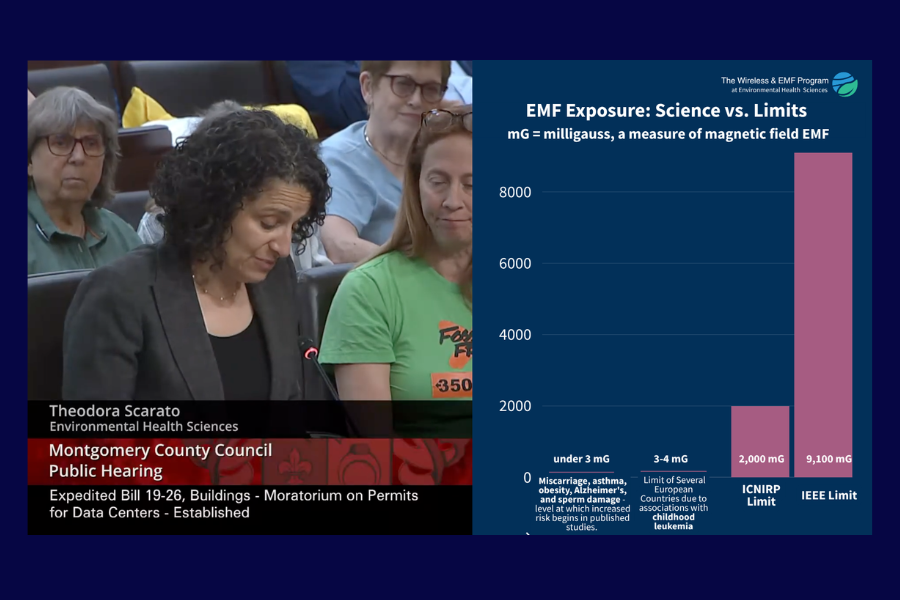
Theodora Scarato Testimony on Need for a Two-Year Data Center Moratorium in Montgomery County MD
On June 16, 2026, the Montgomery County Council considered a proposal for a two-year moratorium on new data center development to allow time for the County to establish data center-specific zoning, land-use, environmental, and public health regulations. More than 100 individuals testified during the hearing. The following is my testimony, focused on the public health risks associated with electromagnetic fields (EMFs) generated by the transmission lines and substations needed to power large-scale data centers.
I am the Director of the Wireless and EMF Program at Environmental Health Sciences, a national nonprofit that has worked for years on plastics, pesticides, air pollution, EMFs, and other environmental health exposures.
Data centers are a public health issue because they bring together nearly every type of pollution, affecting communities for miles—not just through the air, land, light, noise, water, and heat-island effects of the facilities themselves, but also through their unchecked lifecycle impacts.
Data centers are driving up PFAS “forever chemical” pollution. Thousands of drinking water wells in North Carolina have already been contaminated with PFAS linked to semiconductor manufacturing. PFAS materials are often used in data centers’ cooling and fire-suppression systems.
Speed should not come before safety.
But there is yet another critical issue: EMFs. The voracious energy demands of data centers require an unprecedented buildout of new electric substations and high-voltage transmission lines, increasing EMF exposure to nearby homes and schools.
This is an EMF meter.
Last month, I measured EMF levels near the San Francisco 49ers’ playing field, which is next door to an electric substation. The team said it had hired an as-yet unnamed expert who concluded that EMF levels were “400 times below the safe zone” and that the issue was a “nothing burger.” But the EMF measurement report was never publicly released. That’s essentially: trust us, we’re the experts.
I recorded EMF levels at the playing field fence line above 10 milligauss, including readings as high as 17 milligauss near the adjacent youth soccer fields.
These EMF levels are well above the 3–4 milligauss levels repeatedly associated with childhood leukemia in published research.
They are also well above levels linked to Alzheimer’s disease and miscarriage.
And they are well above the levels that several countries use as a threshold for homes and schools.
Dr. David Carpenter, MD, Director of the Institute for Health and the Environment at the University at Albany, published a review of the peer-reviewed science on power-line EMFs and concluded that industry-funded studies more often found no effects, whereas independent studies more often reported effects. He concluded that there is “strong evidence linking EMF exposure to cancers beyond leukemia, particularly brain and breast cancer.”
Dr. Henry Lai’s latest analysis found that the majority of peer-reviewed research over the last four decades has reported effects: 90% for oxidative stress, 84% for genetic effects, and 92% for neurological effects.
Yet the United States does not have any federal safety limits for the EMFs emitted by substations and power lines. None. In the 1990s, the EPA’s work to develop health-protective safety standards for power-line EMFs, as well as cell-tower radiation exposure, was defunded and never completed. (See Microwave News EPA’s EMR Programs Face Budget Ax here)
But industry-tied groups did set limits— between 2,000 and 9,200 milligauss–while 3 to 4 milligauss is the level repeatedly associated with childhood leukemia.
Their limits are designed only to protect against the effects of short-term exposure, specifically nerve stimulation, not long-term health risks.
Why? Because, just as the tobacco and asbestos industries did for years, they claim that cancer causation is “not established.” Then they cite expert panels that, in many cases, were stacked with industry-friendly scientists relying on industry-funded research.
Hundreds of scientists say public exposure should be reduced, not increased.
- See the EMF Scientists Appeal.
- See the International Commission on the Biological Effects of Electromagnetic Fields (ICBE-EMF).
EMF safety is a house of cards. A fairy tale.
And there is more. A Bloomberg analysis of more than 770,000 residential sensors found degraded power quality from harmonic distortion within 20 miles of data center clusters, creating electrical pollution in the home as well.
Before any data center is approved, the public deserves a full accounting and risk-mitigation plan addressing EMF levels, harmonics, air pollution, PFAS materials, wastewater contaminants, noise, infrasound, light pollution, and e-waste management. Until such regulatory safeguards, full transparency, independent oversight, and ongoing monitoring are in place, a two-year moratorium is the only defensible course of action.
Stay updated with Theodora Scarato’s work at Environmental Health Sciences
Subscribe to the EMF Program Newsletter