
Numerous Organizations and Local Governments Oppose the FCC Cell Tower Fast-Track Rules: Over 5,904Comments filed!
This webpage lists key letters and is updated regularly by Theodora Scarato, Director of the Wireless Program at Environmental Health Sciences. It is not all of the submissions, however. See ALL submissions at the FCC website here. Last update December January 21, 2026 at 8:00 am.
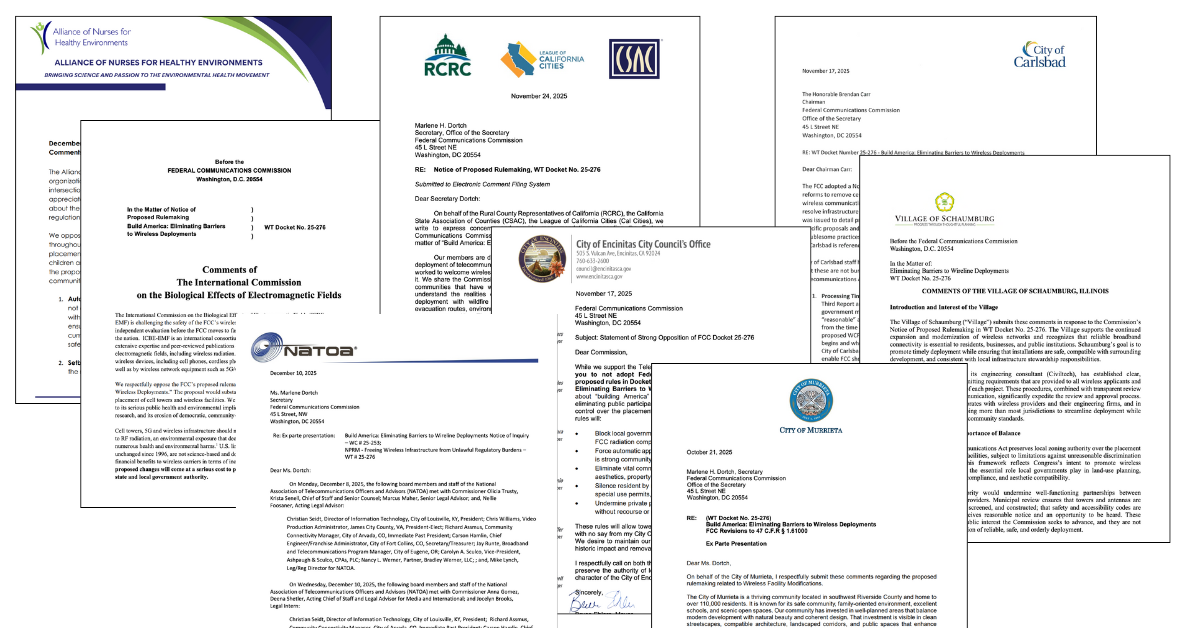
The FCC is proposing sweeping new rules to fast-track cell towers and wireless infrastructure by stripping local city and state authority in its proceeding entitled ” Build America: Eliminating Barriers to Wireless Deployments (WT Docket No. 25-276).” In response, numerous scientific, public health, environmental, consumer, and local government organizations have filed official letters to the FCC record warning that fast-tracking cell towers and wireless infrastructure will increase cell tower health and safety risks, undermine environmental protections, and strip communities of essential local government safeguards.
Large associations representing cities and counties—including the National League of Cities (NLC), National Association of Counties (NACo), U.S. Conference of Mayors (USCM), National Association of Telecommunications Officers and Advisors (NATOA), California State Association of Counties (CSAC), League of California Cities (Cal Cities), and the Rural County Representatives of California (RCRC)—have formally urged the FCC to withdraw or revise the proposal, warning that accelerated timelines, federal preemption, and “deemed granted” approvals would erode local control, public safety oversight, and democratic accountability while shifting liability and risk onto communities.
Many submissions also document that cell towers bring numerous health and safety risks and U.S. RF radiation exposure limits, unchanged since 1996, are outdated, not science-based, and fail to adequately protect public health, children, or the environment. They reference the landmark lawsuit wherein the federal court ordered the FCC to explain how its 1996 limits protect children and the environment against long-term health effects.
More than 4,000 comments have been filed in this proceeding, the vast majority in opposition. By contrast, filings from T-Mobile, the CTIA, and AT-&T recommend the FCC move forward to strip local government authority. None of their filings address the FCC’s lack of compliance with the 2021 DC Circuit order that the FCC explain how its cell tower radiation limits adequately protect children, communities, and the environment from long-term exposure.
Here is a sampling of organization and government submissions you can share with your local government officials. EHS regularly visits the FCC 25-276 docket to see what has been submitted.
As of January 21, 2026, over 5,904 comments had been filed, with thousands by members of the public. This page only links to a selection of the comments. Blue headings are linked to the filing.
MAJOR UPDATE: Environmental Health Sciences has filed a motion to extend reply comments as at least 127 comments were improperly addressed by the FCC.
To stay updated on our work, sign up for the Wireless & EMF Program newsletter.
Scientific, Public Health, and Environmental Organizations
International Commission on the Biological Effects of Electromagnetic Fields
“Cell towers, 5G and wireless infrastructure should not be fast-tracked as this will increase public exposure to RF radiation, an environmental exposure that decades of scientific research has associated with numerous health and environmental harms. U.S. limits on allowable exposures to RF radiation, unchanged since 1996, are not science-based and do not protect the public. Although there are clear financial benefits to wireless carriers in terms of increased profitability, we caution that the FCC’s proposed changes will come at a serious cost to public health and the environment, as well as strip state and local government authority.”
Alliance of Nurses for Healthy Environments
“The Federal Communications Commission (FCC) established human exposure limits for cell phones and cellular network RF-EMF in 1996 and they have not been updated despite the dramatic changes in wireless communications in the last 25 years. The FCC is not a health agency and does not have medical or public health experts on staff. In 2021, a federal court ruled that the FCC needed to reexamine their decision to retain the 1996 limits (No. 20-1025, 2021). To date, governmental health and environmental agencies such as the Environmental Protection Agency (EPA), the Food and Drug Administration (FDA), the Department of Health and Human Services and National Cancer Institutes have not reviewed the totality of the latest science on health effects of EMFs.”
Environmental Health Sciences
Comments Part 1 Environmental Health Sciences, September 18, 2025
“The record before the Commission is clear: the environmental and human health consequences of wireless infrastructure are neither speculative nor remote, but reasonably foreseeable, well documented in the scientific literature, and already observable in both human populations and ecological systems. The FCC should not act to fast-track cell towers and wireless infrastructure until the wireless radio-frequency radiation guidelines properly reflect current science and today’s technology.”
December 20, 2025, the Frontiers in Public Health publication by Theodora Scarato, “U.S. policy on wireless technologies and public health protection: regulatory gaps and proposed reforms,” was submitted to the FCC as it details the regulatory capture, industry influence, and lack of transparency at the FCC.
EHS also submitted letters from 565 members of the public and letters from Ohio Representatives and Senators on the need for the FCC to respond to the EHT et al. v. the FCC court case
Comments Part 2 Environmental Health Sciences, December 31, 2025
“The FCC lacks a national RF exposure monitoring program, conducts minimal post-market surveillance,
and relies heavily on industry self-certification. Without real-world measurements, routine audits, or
transparent enforcement, the FCC cannot verify compliance with its own limits or assess cumulative
exposure. A regulatory framework that does not measure or monitor exposure cannot plausibly claim to
protect public health or the environment.”
“Transparency is essential to informed public participation and regulatory accountability. The FCC has
withheld safety-relevant testing data from the public and the courts. WT Docket No. 25-276 proposes sweeping federal preemption of state and local authority based on the
premise that the FCC’s RF regulations are sufficient to protect public health. However, the Commission’s
documented withholding of non-compliant cell phone radiation test results directly undermines this claim.
An agency that suppresses safety-relevant data cannot credibly assert exclusive authority over health-related decisions or lawfully bar state and local governments from acting to protect residents.”
EHS Reply Comments countering arguments made by the CTIA, T-Mobile AT&T and COMAR Jerrold Bushberg
1779 Letters by Members of the Public: These comments span 45 days.
Supplemental Motion to Correct the Record and to Extend and Readjust the Reply Comment
Period for FCC 25-267: The FCC did not properly post timely submitted comments mailed to the agency. The FCC’s failure to correct the docket and extend the reply-comment period under these circumstances would prejudice public participation and materially impair the ability of interested parties to meaningfully participate in and respond to the rulemaking on the basis of a complete
administrative record.
Accordingly, the reply-comment period should be extended and readjusted so that it
commences only after the docket accurately reflects all timely submitted comments, properly
attributed to each individual filer.
Physicians For Safe Technology
“In addition, the rapid expansion of untested wireless technology networks without adequate health or safety testing, nor regulatory guardrails, create unmanageable risks to public health, the environment and cybersecurity of cities and citizens. It will also add to the massive increase in energy consumption that cannot be offset by efficiencies, as voluntary and involuntary usage of this technology will skyrocket.” – Comments of PST plus additional Submission with numerous scientific publications
“The FCC has lost its way. Formed “for the purpose of promoting safety of life and property” with “adequate facilities,” it has instead become a sock puppet for the industry it was intended to regulate,2 pursuing maximal facilities deployment no matter the cost. It has exemplified the revolving door, by exchanging leadership between CTIA, the most prominent wireless lobby, and the Commission. It shields the wireless industry from liability and preempts local governments from exercising police powers to protect the public, children, and those with disabilities. In short, the FCC sees its constituents exclusively as industry, not ordinary Americans.
Wired Broadband, Inc. Reply Comments
“Commission oversight of environmental impacts is all the more important, as wireless providers have not been good environmental stewards.”
Consumers for Safe Cell Phones
“WIRED fiber to and throughout homes, schools and businesses is a superior method of providing faster, safer and more cyber-secure broadband. The FCC should be issuing rules that promote wired access instead of favoring the inferior and more harmful wireless access.”
We strongly urge the FCC not enact the proposed rules in Docket 25-276, misleadingly titled “Build America: Eliminating Barriers to Wireless Deployments.” This initiative is not about “building America” — it is about stripping away local rights, eliminating public participation, and giving the wireless industry near-total control over the placement of cell towers.
Rocky Mountains for Safe Technology
Comment plus hundreds of scientific research studies
“The general public remains unaware of what is swirling around them. The general public tends to believe that if something is unsafe, our government will tell us. There will be a warning label, recall or a reversal of policy. Few people are aware that health, described as “environmental concerns” in the Telecommunications Act of 1996, cannot be a reason for denial in cell tower permitting and placement. Norm Alster’s “Captured Agency” should be required reading for anybody who thinks we are being protected by our federal government with respect to cell phones and cell towers, as well as other wireless devices.”
Local Government Associations and Organizations
“America’s local government leaders willingly partner with federal agencies, state governments, and broadband providers to close the digital divide in all communities, for all residents. Expanding blanket impositions of one-size-fits-all regulatory overreach into local zoning and planning decisions does not accomplish that goal.”
The United States Conference of Mayors (USCM), the National League of Cities (NLC), the National Association of Counties (NACo) and the National Association of Telecommunications Officers and Advisors (NATOA) REPLY COMMENTS
“The proposals advanced by industry commenters go too far in restricting municipal
authority and fail to account for the real costs and complexities of infrastructure
management. The Commission should adopt a more balanced approach that preserves
essential local prerogatives.”
“We urge the Commission to:
● Preserve local aesthetic and placement authority,
● Recognize local governments are entitled to compensation which reflects the
full costs of wireless deployment, not an arbitrary national assessment of what
costs “should” be,
● Reject the creation of a “rocket docket,”
● Reject premature preemption of state and local AI regulations, and
● Facilitate industry and local cooperation rather than heavy-handed federal
mandates.”
“Unrealistic timelines, therefore, threaten to silence the very people who must live with the consequences…If applications are rushed through or ‘“deemed granted’” without adequate review, the responsibility for any resulting harm rests not with the applicant, but with the local authority left to deal with the aftermath.”
“Critically, the state of California, through state law and a regulatory framework established by the California Public Utilities Commission (CPUC), has developed resiliency standards such as 72-hour back-up power requirements in the highest fire risk (and, therefore, largely rural) areas of the state, as well as through other means such as network redundancy, network hardening, emergency preparedness planning with a qualified workforce, and coordination with other utilities and emergency responders. These standards exist because many high-risk areas have lived through multiple catastrophic wildfires and because wireless communications often fail at the exact moments communities need them the most.”
“Congress preserved state and local authority for a reason, and communities cannot afford policies that place haste over safety, or uniformity over local judgement. For these reasons, we urge the Commission to withdraw this NPRM”
Note: NLC, NACo, USCM and NATOA also filed Joint Comments on the FCC proceeding, Notice of Inquiry – Build America: Eliminating Barriers to Wireline Deployments, WC Docket No. 25-253 (which pre-empted local control related to wireline infrastructure) stating, “ As representatives of the level of government closest to the people, local leaders have worked hard to collaborate creatively with federal, state, and private sector partners to bring high-speed, affordable broadband and telecommunications services to all communities.
“The Local Government Associations strenuously object to the Commission’s depiction of local permitting as an obstacle to the provision of wireline telecommunications services. The parties suggesting this are seeking to strip local governments of their ability to responsibly manage public assets in the rights-of-way, while still expecting to have access to rights-of-way that are safe, well-planned, and conducive to technology-neutral competition.”
The National Association of Telecommunications Officers and Advisors
“The National Association of Telecommunications Officers and Advisors expressed concerns about question proposing preemption of Local Public Rights of Way (PROW) authority and shot clocks and fees caps that would severely restricting how local governments may regulate the placement, construction, and modification of communications facilities in public rights-of-way and on locally controlled property.”
“Participants shared real-world experiences from their cities, towns and counties with wireline and wireless deployment in their communities that presented public safety risks within their communities and strongly suggested that local governments would better be able to protect their streets, sidewalks, and constituents’ safety with support from the Commission and improved communications and planning from both wireless and wireline provide.”
BC4AD Coalition
Comment: “The FCC has still not addressed the non-thermal effects from RF Radiation. Americans are being exposed to RF Radiation from multiple devices and thus what are the effects from the cumulative exposure? As more and more of various RF radiation emitting devices are being placed in cars, poles, routers, toasters, refrigerators, ovens, dishwashers, doors, washer/dryers, video game consoles, stronger GPUs, lightbulbs, electrical switches, traffic signals, security cameras, surround sound speakers, printers, etc. it is beyond obvious that the exposure is dramatically increasing as well as the length of exposure.”
“The FCC constantly pushes out so called “rules” like shot clocks that are reckless and a danger to public health and safety that burden local municipalities that are already understaffed and underfunded. This empowers big telecommunications companies to skirt the rules, mislead local governments, damage other public infrastructure and utilities as evidenced in the City of San Mateo public record. The FCC has repeatedly shown a pattern of practice of doing the bidding on behalf of big telecom, and transgressing against people’s constitutional rights. Therefore, it is our wish and demand that the FCC upholds the people’s rights.”
Attachments (different link): The BC4AD Coalition submitted a set of PDFs compiling news and investigative reports describing repeated telecommunications/fiber construction damage—including gas-line strikes and leaks (one explosion leaving people homeless), water main and service-line breaks that saddle utilities and residents with major repair costs, sewer ruptures and flooding, sinkholes, and widespread road/yard restoration problems, alongside examples of city penalties and lawsuits. The news reports are evidence of how expedited approvals can increase public-safety risks and shift costs onto communities.
West Montgomery County Citizens Association
“In 2019, Montgomery County, Maryland took historic legal action against the Federal Communications Commission by becoming the only jurisdiction in the nation to directly challenge the FCC’s “small cell” rules on radiofrequency (RF) health and safety grounds. The County argued that the FCC was advancing the rapid placement of 4G and 5G antennas in residential neighborhoods while sharply limiting local governments’ ability to consider health, environmental, or safety impacts, without first determining whether its 1996 RF exposure limits adequately protect the public. At the time, the FCC had left unresolved its own inquiry, opened in 2013, on whether those limits should be updated, even as it accelerated unprecedented nationwide wireless densification. By the time oral argument in the case occurred, the FCC had issued its 2019 decision asserting, without meaningful analysis, that its 1996 RF exposure limits did not need to be updated, leading the court to deem Montgomery County’s challenge moot on procedural grounds rather than resolving the underlying health and safety issues. That decision was later challenged and, in 2021, a federal appeals court ruled that the FCC acted arbitrarily and capriciously in EHT et al. v the FCC and ordered the agency to explain how its RF limits protect against long-term and non-thermal harms, an explanation the FCC has still not provided, leaving the nation in essentially the same unresolved position as when Montgomery County first filed suit. The FCC cannot proceed to preempt local control without responding to the DC Circuit court mandate.”
States
“States across the political spectrum are legitimately concerned about how businesses using AI may harm their citizens and/or interfere with their own core responsibilities. If the Commission had the authority to preempt state oversight of everything that includes the use of AI, then it could, for example, bar a state court from disciplining an attorney who had electronically filed a brief replete with hallucinatory citations. That is just one example of the overreach that the Commission contemplates.”
California Public Utilities Commission
“The CPUC urges the FCC to resist using federal preemption as a deployment tool in the context of wireless infrastructure oversight because it would likely have the unintended consequence of displacing state and local police powers that protect public health, safety, welfare, and emergency preparedness, particularly in disaster-prone states such as California. If the FCC adopts a “rocket docket” process for permit disputes, it should ensure public safety, due process, and transparency.”
California Public Utilities Commission REPLY
Blanket preemption is not the solution here. Wireless infrastructure should be deployed not just quickly, but responsibly, resiliently, and in a manner that protects the public when it is most vulnerable. And, the FCC should reject industry attempts to use this wireless facilities NPRM to piggyback preemption of state and local artificial intelligence (AI) and broadband regulation, which are outside the scope of wireless facilities oversight.
Cities, Towns and Local Governments
“The Telecommunications Act’s legislative history confirms the plain text’s broad
preservation of local authority.”
“The Commission should not proceed on the proposals it has put forward, instead it should
issue a further notice considering adequately the legal implications of the new developments in
administrative law and determining how to better align Commission actions within the confines of
its authority.”
“Local Communities support new proceedings to thoroughly review the latest scientific data and update the Commission’s current guidelines for exposure to RF radiation. Thirty-year-old standards and a court remand that remains unaddressed by the Commission do little to quell public concerns about the issue”
“It is in everyone’s best interests to recognize that siting RF emitting equipment ever closer to the general public will heighten RF anxiety, and the Commission alone bears the regulatory authority and responsibility to address public concerns about siting in closer proximity to the public through updated standards.”
National Association of Towns and Townships (more than 10,000 towns and townships of varying sizes in states throughout the Midwest and Northeast)
“The NPRM’s proposals risk creating a one-size-fits-all regulatory framework that assumes all local governments are large cities with dedicated staff and resources, treats delay as presumptive evidence of obstruction without accounting for legitimate capacity constraints, prioritizes speed over safety by automating approvals without essential engineering review, shifts costs to local taxpayers through unfunded permit processing mandates, and eliminates community input on facilities with significant visual and property value impacts.”
Colorado Communications and Utility Alliance, Association of Washington Cities, City of Aurora, CO, City of Boulder, CO, City of Colorado Springs, CO, City of Seattle, WA, City of Tacoma, WA, City of Tumwater, WA, City of Redmond, WA, King County, WA, Thurston County, WA
“The Commission’s proposal would force local governments to keep one set of land use rules for all other kinds of land use applicants, while creating a new, privileged set of rules for wireless facilities applicants, which would have the effect of forcing local taxpayers to subsidize the costs that these applications impose on local communities. Even more problematically, there is no quid pro quo in the Commission’s proposal. The proposal contains no requirements on the wireless industry that it increase deployment in return for these preemptory rules, demonstrating that while the proposed rules amount to a financial gift to the industry, they will do nothing to spur investment in wireless infrastructure.”
“Industry commenters have not identified any new and creative arguments that provide a legal foundation for new Commission authority to preempt those areas that Congress has generally left to the prerogative of local communities. Instead, industry commenters have offered only a handful of anecdotal complaints, many of which lack critical context or are factually inaccurate. The very limited specific allegations against named jurisdictions, both in Colorado and Washington and throughout the country, do not withstand scrutiny once these named jurisdictions are able to set the record straight.”
“The Coalition respectfully urges the Commission to decline to adopt the unsupported and legally unauthorized proposed rules and instead focus on (1) collaborative approaches that respect traditional local authority while facilitating efficient deployment of next-generation wireless infrastructure; (2) utilizing its existing authority to address siting disputes on a case by case basis, 17 when the existing rules for those proceedings require due process protections of all interested parties; and (3) updating its radio frequency emissions rules in order to demonstrate to the American public that the Commission is willing to act in a manner consistent with its federal obligations to protect public safety and the public interest.”
League of Oregon Cities Reply Comments
“The Commission Should Update Its RF Standards The League agrees with commenters’suggestions that the Commission must update its RF emissions standards.83 The Commission’s failure to update its RF regulations even after the D.C. Circuit, in 2021, overturned the Commission’s decision to terminate a Notice of Inquiry without updating its RF emissions standards has created an opening for misinformation.84 Local governmentsface the brunt of residents’ concerns based on this misinformation—routinely hearing extensive public comment on RF emissions when wireless siting is on the agenda—but are all too aware that they are powerless to address them. 85 Rather than point fingers at local governments for allegedly violating Section 332(c)(7), 86 the Commission should update its thirty year old RF emissions standards. Local governments do not need to be told what Section 332(c)(7)(B)(iv) says. They need the Commission to issue updated regulations that local governments can point to when their residents raise RF-related concerns.”
City of Sebastopol, California Resolution Opposing FCC 25-276
WHEREAS, the City of Sebastopol, like all local governments across the United States, would have its ability to regulate the siting of cell towers and wireless infrastructure severely constrained, if not eliminated, by the NPRM; and”
City of Palo Alto Reply Comments
“Categorical preemption of local standards for setbacks, design review, or area-specific aesthetic considerations would be counterproductive and contrary to statute. Furthermore, clarifications under Section 6409 should not gut previously-approved concealment elements or conditions.”
City of Fort Worth: Reply Comments
“The extension of the Small Cell Rules to the deployment of macro cell towers and related wireless infrastructure in Texas and Fort Worth, is not needed and is opposed by the City of Fort Worth.”
Town of Fountain Hills, Arizona
“The Notice asserts that local regulations often create impediments to deployment and suggests that further federal intervention is needed to eliminate such “barriers.” This characterization does not reflect the reality in our community…local procedures ensure transparency, fairness, legal compliance, and public input. They are essential for balancing rapid technological deployment with long-term community wellbeing. If the proposed rule becomes effective, the Town may be prohibited from adopting needed regulatory updates—and may even be forced to repeal standards that currently protect our residents. Such outcomes would undermine careful
The City is entrusted to administer and manage the public rights-of-way and is allowed
to receive fair and reasonable compensation for private uses of the rights-of-way. Given
that the wireless service providers have an estimated 85-90 percent of their macro sites
within the City installed on private property with leases that are much higher in cost than
the City’s macro site fee for their sites in the rights-of-way, it is an overreach of the
Commission to consider limiting the fair and reasonable compensation for macro sites in
the rights-of-way.
City and County of San Francisco
“The City opposes the NPRM’s proposals to restrict state and local government actions because doing so would be contrary to Sections 2532 and 332(c)(7)3 of the Communications Act and Section 6409(a) of the Spectrum Act,4 and because the proposals would undermine efforts to promote efficient deployment under clear rules.”
“Expiration or time limits on permits are necessary as it is common knowledge that tower owners are not keeping the facilities in good order. This is revealed in the care and keeping of branching, painting of equipment and structures, landscaping and brush management for fire safety. A permit renewal allows the jurisdiction to enforce the conditions that were originally placed on the project.”
The Villages of Lake-Sumter, Inc.The Villages Operating Company
For state and local governments, which should be the sole focus of any rule, the Commission should refrain from unnecessarily revising its standards for unreasonable discrimination under 47 U.S.C. § 332(c)(7).
City of Austin, Texas
“Federal intervention here risks eroding community standards, compromising infrastructure planning, and imposing significant financial burdens on taxpayers. We specifically ask the Commission to: • Preserve local authority to manage public rights-of-way (ROW) and enforce objective design standards…”
“the City urges the Commission to respect the regulatory power explicitly delegated to local governments by Congress, to respect the strenuous efforts of the City to abide by these federal limitations, and to respect the authority of the residents in its jurisdiction to advise (within the confines of federal law) the City on how to best facilitate the deployment of wireless infrastructure through local control.”
In the materials submitted, a San Mateo, California group included a May 31, 2024 City of San Mateo letter to Crown Castle asserting Crown Castle “prematurely energized nineteen (19) locations” before receiving final City approval and demanding it “immediately de-energize” the sites), while also flagging alleged noncompliance with approved plans, impending/expired permits, and a broader “troubling pattern of conduct” that included a contractor “damaging numerous other public and private utilities and property,” concluding that Crown Castle has been “less than fully compliant” and has “damaged its reputation in the community.”
City of Walla Walla, Washington
“Unlike less intrusive small cells, macro sites have a larger footprint and are less likely to have a stealthy appearance. Maintaining the current shot clock for co-locations at 90 days and 150 days for new macro sites is reasonable. Reduction of these timeframes will be challenging for local jurisdictions who may have staffing challenges, meet public notice requirements or historic district reviews (for example within a downtown zone). “
City of Arlington, Texas
“The Commission’s proposed action would disrupt the smooth permitting procedures that Arlington and providers alike have developed.”
“Simply put, the Commission proposes to extend special treatment to the wireless industry that is unfair and inconsistent with the treatment of other utilities and entities using space in our community. Electric, gas, and other utility providers all compensate municipalities appropriately for their use of City time and resources under established state and local frameworks. Granting wireless providers preferential fee treatment or preempting municipal cost recovery would be unjustified and inequitable. Any preferential federal carve-out for one sector undermines that fairness and risks creating inconsistent regulatory expectations for local governments. The Commission would essentially be a providing subsidy to one (deep pocketed and well resourced) category of applicant, a subsidy paid by other applicants and local taxpayers.”
Scottsdale is concerned that further federal preemptions of municipal fee authority would undermine local governments’ ability to protect public assets, manage ROWW safety, and recover real, ongoing administrative costs that result from hosting private commercial facilities in public spaces
San Diego Unified Port District
“The Port’s approach already ensures efficiency, fairness, and compliance without imposing additional layers of regulations. The Port’s experience demonstrates that locally tailored, predictable permitting frameworks developed through a collaborative, transparent process can advance the Commission’s deployment objectives without the need for additional federal intervention. Therefore, the Port believes that additional federal oversight of local agency review criteria and permitting procedures is not necessary and could result in new regulatory delays that run counter to the goals of the proposed rulemaking.”
“Cities invest substantial resources to adopt measurable, objective design criteria and wireless siting guidelines that reconcile coverage objectives with neighborhood form. By narrowing ‘“concealment’” to apply primarily to stealth-designed facilities and treating other visual conditions as optional, the proposal would unsettle locally adopted standards, reopen settled approvals, and erode the predictability that applicants and communities rely on.”
“As written, these amendments erode local control, undermine established planning and public investments, contradict the Commission’s own progress narrative, shift costs to local governments, and diminish environmental and community safeguards. Local design review and objective aesthetic standards are essential to maintaining community character. Congress preserved municipal authority to regulate the placement, construction, and modification of personal wireless facilities so long as such regulation does not prohibit service.”
“By redefining aesthetic and concealment standards as potential barriers, the proposal disturbs that balance and moves toward federal preemption of traditional land use powers.”
“Local standards are not barriers to technology; they are safeguards that ensure new infrastructure integrates with established neighborhoods, protects public welfare, preserves property values, and maintains community character.”
Village of Schaumburg, Illinois
“Local judgment and engineering review are indispensable to safe deployment.”
“Design standards protect visual quality, infrastructure function, and neighborhood character.
The NPRM’s suggestion of applying the small-cell timelines and fee caps from the 2018 order to macro towers overlooks the substantial differences in engineering, safety, and environmental considerations between these facility types. Macro installations often require structural analysis, RF compliance review, fall-zone evaluation, FAA lighting review, and public hearings. Imposing uniform national shot clocks or “deemed granted” outcomes would be inconsistent with the level of scrutiny these facilities require.”
“Local governments have systems in place to ensure that businesses operate safely and meet public health standards, protecting residents and limiting liability since cities are often held responsible when harm occurs. These safeguards strengthen community trust and keep neighborhoods safe. Weakening local control would allow companies to prioritize cost savings over compliance, increasing the risk of property damage, injuries, and lawsuits while shifting the financial burden of negligence onto local governments and taxpayers. It would also reduce residents’ ability to raise concerns directly, ultimately driving up costs, delaying solutions, and eroding community trust and safety.”
“Thus, the means by which the FCC wants to “supercharge” deployment is through a federal takeover of state and local authority. In essence, the FCC has proposed to eliminate any remaining state and local control over cell tower siting, transferring this authority to private, for-profit companies whose primary interest is profits, not public health.”
The Surveillance Technology Oversight Project
“FCC should not preempt state and municipal AI regulations, because such regulations are critical to the safe and accountable development of AI. The FCC does not have authority under the Communications Act to preempt state and local AI regulations.
Even if the FCC had authority to preempt certain state and local AI regulations under Section 253(a) of the Communications Act, states would still be permitted to enact such regulations under the public safety and consumer protection exceptions in Section 253(b) of that same Act.“
The City of Marietta, GA and Marietta Board of Lights and Water wrote to the FCC, stating:
“…the proposals in this NPRM would eliminate virtually all meaningful local authority, forcing communities to accept unlimited installations with minimal review, inadequate cost recovery, and no ability to protect community character or public assets.
This represents a dramatic shift in the federal-state-local balance that Congress established.”
“The proposal to implement a “deemed granted” remedy for shot clock violations would eliminate due process and could compromise safety of the public.”
“These rules will allow towers to be placed literally anywhere in Encinitas, with no say from my City Council nor our residents. This is unacceptable. We desire to maintain our control over their locations, aesthetic impact, historic impact and removal when no longer in use.”
“Save Gansevoort was recently able to document multiple omissions and inaccuracies in reports compiled by out-of-state consultants regarding the impacts of proposed 5G towers on the Greenwich Village and Gansevoort Market Historic Districts in New York City. Our work led to the FCC finding that the towers would indeed have adverse effects. Had local voices been silenced – as will happen if the proposed rules are adopted – the errors in these siting applications would not have been discovered. The result would have been significant damage to the character of our historic districts and unnecessarily inefficient siting of cellular infrastructure.”
Environmental Health Sciences also submitted letters to the FCC from federal, state and local officials to ensure there were not the record
Letters from Ohio Representatives to FCC regarding their lack of response to the DC Circuit 2021 Court Order
Elected officials across Ohio—including municipal leaders, state senators, and state representatives—have repeatedly urged the Federal CCC to update its wireless radiation rules, warning that the agency’s human exposure limits “have not been updated since 1996” and may no longer protect public health or the environment. In formal letters to the FCC, Village of Greenhills Mayor David Moore and Ohio State Senators Stephen A. Huffman, Steve Wilson, Louis W. Blessing III, and Catherine D. Ingram joined Ohio State Representatives Tim Barhorst, Ron Ferguson, P. Scott Lipps, Mike Odioso, Michelle Teska, Melanie Miller, Meredith Lawson-Rowe, Kellie Deeter, Jennifer Gross, Jean Schmidt, Diane Mullins, Cindy Abrams, Cecil Thomas, and Adam Mathews in letters regarding the FCC’s failure to modernize its standards. Several lawmakers cited the 2021 U.S. Court of Appeals decision directing the FCC to address evidence related to children, long-term exposure, and environmental impacts, noting that “the FCC has not complied with the court’s order” and that “there is no federal agency tasked with ensuring the safety of cell towers, 5G/6G small cells, and related wireless infrastructure.”
Law Offices
Zoe Berg, Esq. Of-Counsel Law Office of Robert J. Berg PLLC
I would strongly advise against codifying any language that mentions the use of “monopines” (or what I like to call “Frankenpines”) as a cell tower stealth-design element. Put simply, monopine cell towers are a massive point source of plastic and microplastic pollution. Wireless telecommunications companies often fail to disclose to local and State permitting authorities that the faux pine needles attached to their monopine towers are made of PVC plastic which are glued onto fiberglass reinforced plastic or PVC pine boughs, limbs, and branches.
Robert Berg, Law Office of Robert J. Berg
The current FCC is headed by a corrupt telecommunications industry-owned narcissist, Chairman Brendan Carr, who, through his authoritarian control over the FCC’s agenda, has initiated a baseless campaign to undermine the express text of the TCA and engage in ultra vires administrative legislating well beyond the FCC’s Congressionally-granted authority. The instant Notice of Proposed Rulemaking marks the nadir of this Agency’s already abysmal record of disserving the American public. Sadly, the FCC is not engaging in a good faith proceeding seeking a truthful determination of the facts. Rather, the FCC has embarked on this Notice of Rulemaking at the behest of its true masters, the U.S. telecommunications powerhouses, with whom its leaders have long engaged in a parasitic revolving-door relationship that sucks the lifeblood from the American public and into the telecom leeches’ crops.
Individual commenters and local organizations
The FCC also cannot lawfully preempt local RF-related protections while it remains out of compliance with the U.S. Court of Appeals for the D.C. Circuit’s 2021 decision in EHT et al. v. FCC. Until RF guidelines are updated, it must preserve local control and withdraw this NPRM.
Technical Comments of Sue Present
“The Commission Lacks Statutory Authority to Act as a National Zoning Regulator. The Communications Act does not authorize the Commission to dictate aesthetic standards, redefine “concealment elements,” or eliminate local discretion under the guise of preventing service prohibitions. Section 332 preserves state and local authority except in narrowly defined circumstances. It does not grant the FCC license to micromanage land use or override traditional zoning powers. The NPRM’s sweeping preemption proposals exceed the Commission’s statutory authority, violate principles of federalism, and intrude upon powers reserved to the states under the Tenth Amendment. Congress did not intend the FCC to function as a national zoning board, and the Commission should not attempt to assume that role now.”
The average citizen in the United States looks to the federal government for protection from
risks to our health, safety and well-being. Imagine how shocked people would be to find out
that the FCC set regulatory standards based on results from behavioral studies conducted
in the 1980s involving exposures between 40 and 60 minutes using five (5) monkeys and
eight (8) rats. When the temperature increased to the point the animals no longer chose to
eat, that temperature was noted, and then an arbitrary safety factor was added which has
as little meaning as did the original experiments.
Rees submitted the “Safety of Wireless Technologies: The Scientific View” demonstrating “23 of today’s top 36 fast-growing chronic diseases were predicted by the Navy study in 1971. Incidences of these 23 chronic diseases have added trillions in annual health care costs to the U.S. economy and led to tremendous unnecessary human suffering and economic costs for individuals and society. It is time for the FCC to course correct. Now is the time to acknowledge the very serious mistake regulators have made in supporting the growth of the wireless industry at the expense of public health, the ecosystem, economic health and the health of future generations.”
Do any comments support the FCC cell tower fast-track proposals?
For the most part, the only filings that support FCC proposals are telecommunications companies or wireless industry organizations. Here are some details.
Wireless Industry Filings Omit the DC Circuit Order: More than 4,000 comments have been filed in this proceeding, the vast majority from cities, counties, organizations, and members of the public opposing the FCC’s proposal. By contrast, filings from T-Mobile, the CTIA, and AT&T avoid addressing the FCC’s lack of compliance with the 2021 DC Circuit order that the FCC explain how its cell tower radiation limits adequately protect children, communities, and the environment from long-term exposure.
Companies Do Not Want Oversight, Setbacks, or AI regulation: AT&T states, “State and local governments have no authority to impose their own setback or separation requirements to address RF exposure” and “local governments lack authority to require providers to submit or pay for RF exposure studies of any kind.”
The CTIA- Wireless Industry wants the FCC to go further and take additional actions to remove local authority by eliminating the need for companies to show a gap in service stating that “Localities’ second-guessing of these investment decisions serves only to slow down deployment and delay providing the public with the wireless services they increasingly demand.” The CTIA also recommends the FCC preempt state AI bills which are “problematic” with “onerous obligations.” T-Mobile states it “continues to face deployment delays due to such unfounded RF emission health concerns” which are “baseless.”
Additional industry comments include: Wireless Tower Solutions Corporation, Verta, INCOMPAS , WISPA Wireless, Extenent
The FCC refuses to extend the comment period.
The FCC Refused To Extend the Comment Period: Several U.S. counties requested an extension of time to file comments because they were due over the holiday on New Year’s Eve. The FCC denied the request, stating, “Federal holidays are a common and predictable occurrence and therefore a single federal holiday does not warrant an extension… we find any further delays in the comment deadlines is not in the public interest.”