
Environmental Health Sciences (EHS) sent a letter to Senators ahead of the Senate Federal Communications Commission Oversight hearing on December 17, 2025 to highlight issues regarding cell tower health risk and cell phone and Wi-Fi safety. The letter called for transparency, accountability, and evidence-based public health protections.
A PDF of the letter is available here.
December 15, 2025
Letter Submitted to All Members of the Senate Committee on Commerce, Science, and Transportation
Re: Senate Oversight Hearing to the FCC December 15, 2015- Questions for the FCC on Cell Phone and Wireless Radiation Transparency, Safety, and Compliance
Dear Members of the Senate Oversight Committee,
Environmental Health Sciences is a science-based nonprofit organization, and its Wireless and
EMF Program is dedicated to advancing evidence-based, practical solutions to ensure that modern wireless technologies are deployed in ways that protect public health and the environment.
We respectfully urge the Committee to use its upcoming oversight hearing to question the Federal Communications Commission (FCC) on its lack of transparency, oversight, and enforcement regarding cell phone and wireless radiation safety. Substantial evidence from our Freedom of Information requests shows that the FCC has withheld critical safety information from the public, the courts, and policymakers, despite growing scientific evidence of harm and clear statutory obligations to protect public health.
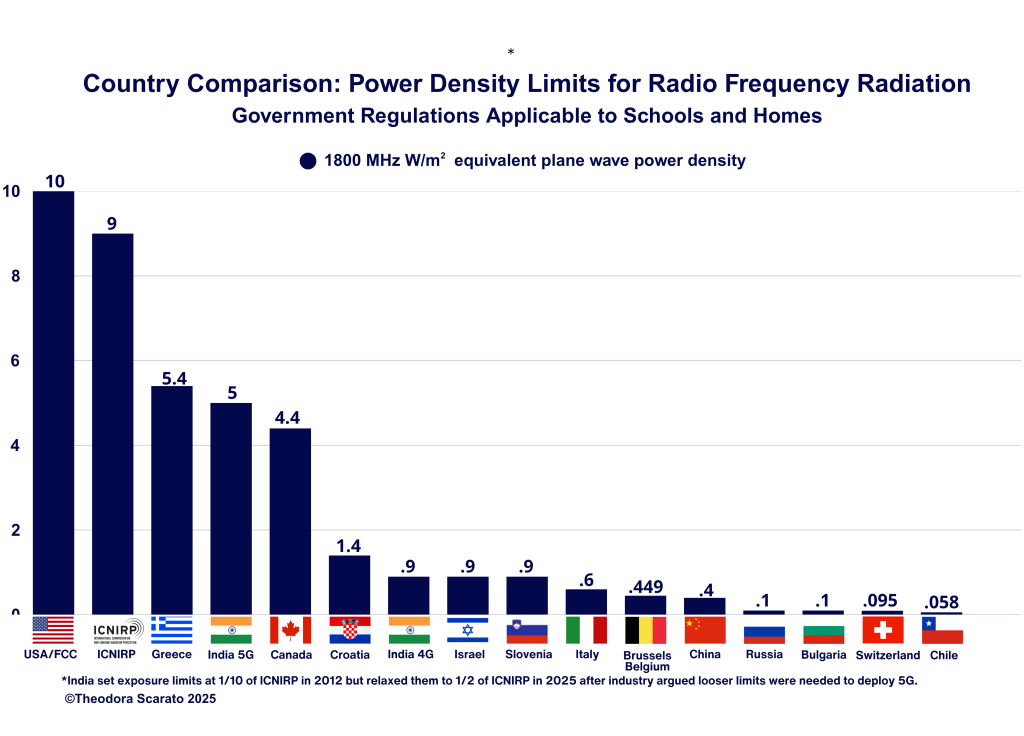
The human exposure limits for cell tower radiation of the U.S. are far more lenient than numerous other countries.
This submission is intended to support the Committee’s oversight responsibilities by identifying significant gaps in regulatory compliance, transparency, and public health protection related to federal wireless radiation policy.
Below are key specific questions we ask the Committee to raise with the FCC. This document includes background information with scientific references and more detailed questions.
- How can the FCC fast-track cell towers when it has not responded to the 2021 D.C. Circuit Court mandate requiring the agency to explain how its cell tower and cell phone radiofrequency radiation exposure limits are adequately protective in light of mounting scientific evidence of harm?
- How can the FCC provide public assurances of safety while no federal health or environmental agency is actively conducting comprehensive oversight of cell tower radiofrequency radiation exposures and when there is no premarket safety testing of wireless technologies nor post-market health surveillance?
- Why did the FCC withhold its own laboratory test results, finding cell phone radiation exposure levels exceeding FCC radiation limits when phones were tested in body positions contact-like- like in a pants pocket- from the public?
- Why did the FCC omit its cell phone radiation test results finding RF radiation that exceeded FCC limits from its court filings?
- Why did the FCC omit its cell phone radiation test results, finding RF radiation that exceeded FCC limits, from its open rulemaking on RF radiation limits and rules?
- Why is the FCC withholding its Apple iPhone 12 RF radiation measurement data?
- How can the FCC fast-track cell towers yet it lacks a national cell tower and wireless radiation measurement and monitoring program?
- How can the FCC fast-track cell towers, yet it lacks adequate oversight, compliance, and enforcement mechanisms for cell towers and wireless facilities?
- How can the FCC fast-track cell towers and wireless technologies, yet it lacks a robust oversight and enforcement program to protect workers from occupational radiofrequency radiation exposures?
- Why is the FCC narrowing National Environmental Policy Act protections despite the fact that its rules omit protections for birds, bees, and trees, and that substantial science indicates ecological risks?
- How can the FCC preempt health and environmental issues via Section 704 of the Telecommunications Act, despite continued reliance on outdated, and obsolete FCC exposure limits?
- What is the FCC doing to compete on safety and promote already available wireless radiation exposure-reducing technologies?
The American public cannot make informed decisions about wireless technology when safety data are hidden, complaints are ignored, and oversight is virtually nonexistent. Transparency and accountability are not optional; they are fundamental to democracy.
We urge the Committee to press the FCC for clear answers and a concrete plan to bring U.S. wireless radiation policy in-line with science and modern technologies.
Respectfully submitted,
Theodora Scarato, Director, Wireless and EMF Program, Environmental Health Sciences
Additional FCC documents produced under the Freedom of Information Act are available upon request.
Background Facts and Additional Questions
1.The FCC Has Not Responded to the 2021 DC Circuit Court Mandate to Explain How its Cell Tower and Cell Phone Radiation Limits Are Adequately Protective Amidst Mounting Scientific Evidence of Harm
As a federal regulatory agency, the FCC is required to engage in reasoned decision-making and to ensure that its regulations adequately protect public health and the environment; however, the FCC has failed to respond to the D.C. Circuit’s order in EHT et al. v. FCC directing the agency to explain how its unchanged 1996 wireless RF radiation exposure limits protect children, address long-term and non-cancer health effects, and account for environmental impacts, despite record evidence concerning reproductive, endocrine, neurological, cardiovascular, developmental, and ecological harms (1). The court found the FCC did not show proper review of scientific evidence on its record, including impacts to memory, brain development, the studies indicating children’s unique vulnerability, and research reporting impacts to the environment- birds, bees, and trees.
A central argument by petitioners is that FCC’s wireless RF radiation exposure limits, adopted in 1996 and left unchanged for decades, are outdated and antiquated standards that were developed solely to prevent acute, short-term thermal effects, without consideration of long-term or cumulative exposures, contemporary wireless technologies, or the now-ubiquitous use of body-worn devices by children, whose patterns of exposure and biological vulnerability were neither anticipated nor evaluated at the time the limits were established.
The court noted that the FCC failed to respond to letters from the American Academy of Pediatrics urging an update to RF radiation limits to account for children’s unique vulnerability, including their greater cumulative exposure into the brain (2), heightened biological sensitivity, and the modern pattern of cell phone and wireless device use in close proximity to the body (3).
Children were not using cell phones in 1996, nor Wi-Fi and smart speakers. Recent studies have found that the placement of cell towers near schools increases children’s baseline RF exposure (4) , and that exposure is further elevated in classrooms densely populated with Wi-Fi devices, where multiple simultaneous emissions compound cumulative exposure levels (5).
To date, the FCC has failed to provide any explanation as required by the court in 2021. In the meantime, a large and growing body of peer-reviewed science links cell phone and cell tower radiation to adverse health effects (6-10). We have ensured this scientific evidence is submitted to the FCC (11) but have had no response from the FCC.
Questions regarding the FCC’s lack of compliance with the 2021 Court mandate
- How can the FCC continue to promote and accelerate wireless densification, including 5G and 6G deployment, while it has failed to respond to the federal court’s order in EHT et al. v. FCC requiring the agency to explain how its RF exposure limits protect public health, particularly children, and against long-term exposure?
- Why does the FCC continue to rely on and refuse to update its 1996 RF exposure limits, which are based largely on a small number of short-term animal studies involving less than one hour of exposure, despite decades of new scientific evidence on chronic, cumulative, and non-thermal effects of wireless radiation exposure?
- How does the FCC justify relying on 1996 limits that were only designed to protect against short term health effects?
- How can the FCC assert that its 1996 radiofrequency exposure limits adequately protect children’s health when those limits were established before children routinely used wireless devices, do not account for children’s higher relative absorption and lifelong cumulative exposure, and were based solely on preventing short-term heating effects rather than long-term or developmental harms?
2.The FCC Provides Misleading Assurances of Safety While Lacking Active Federal Health Oversight of Cell Tower Radiation
The wireless industry has repeatedly invoked FCC authority and its assurances of safety despite the reality that federal health and environmental agencies are not reviewing the totality of the scientific evidence to ensure public health and environmental protection (12,13). There is no FCC required premarket safety testing of wireless technologies for health effects, nor post-market health surveillance. New technologies are given the green light so long as RF emissions meet 1996 limits, despite such technologies and frequencies not even being in existence at that time.
In a letter opposing proposed wireless safety bills in Massachusetts (14), CTIA asserted that “the FCC’s oversight of these issues was confirmed in October 2018 by FCC Commissioner Carr,” quoting his statement that “the FCC, as well as other agencies that are experts in health and safety issues, are always looking very closely at these issues, staying up to date on the latest science… and have reached the determination that these are safe.” CTIA further claimed that “the consensus among health experts is that the weight of scientific evidence shows no known adverse health effects to humans from exposure to wireless antennas or devices.”
Neither of these statements is accurate, yet the FCC has taken no action to correct or disavow these representations.
In EHT et al. v. FCC, the D.C. Circuit highlighted how the record showed that federal health and safety agencies did not provide any substantive, independent evaluation of the FCC’s radiofrequency exposure limits or affirm their adequacy, despite the FCC’s repeated claims of interagency consensus (15, 16). The Environmental Protection Agency abandoned non-ionizing radiation research decades ago; OSHA and NIOSH have no active RF health research or surveillance programs; the National Cancer Institute does not conduct risk assessments or make safety determinations (17); the CDC has repeatedly funded industry consultants to draft its webpages (18); and the FDA has only shown limited review to narrow questions about cell phones while disclaiming jurisdiction over cell tower emissions. Despite the rapid expansion of wireless infrastructure and near-universal exposure to wireless (RF) radiation, in practice, no federal agency is currently conducting comprehensive, ongoing oversight to evaluate real-world cell tower radiofrequency radiation exposures or associated long-term health risks.
The FCC itself has repeatedly acknowledged that it is not a health agency stating (19) that, “since the Commission is not a health and safety agency, we defer to other organizations and agencies with respect to interpreting the biological research necessary to determine what levels are safe.” Yet there is no federal agency conducting such activities. The FCC also does not routinely measure or monitor emissions, nor have a robust oversight program post-deployment, leaving a regulatory vacuum in which no federal entity is meaningfully responsible for evaluating cumulative exposures, long-term health effects, or compliance for cell towers and wireless facilities in today’s dense wireless environment.
Moreover, there is not a scientific consensus for safety as hundreds of scientists and medical doctors recommend public exposure be reduced due to mounting scientific evidence (20-24).
Public health regulation requires a reasoned evaluation of credible evidence indicating risk, particularly where exposures are widespread, involuntary, and long-term. Yet instead, the FCC is moving forward with proposals to fast-track cell towers, which will increase RF radiation exposure.
Questions regarding the absence of cell tower and wireless radiation health risk activities to ensure public safety.
- As the FCC is not a health or environmental agency, and there are no federal health or environmental agencies actively evaluating cell tower radiation health risks, which entity is currently responsible for protecting the public from chronic, cumulative cell tower RF radiation exposure from cell towers?
- Given the regulatory vacuum, how can the FCC credibly assure the public that its policies protect public health and the environment?
- Why hasn’t the FCC corrected the record, the industry statements and media?
3.Why Did the FCC Omit Its Cell Phone Radiation Test Results, Finding High Levels That Exceed FCC Limits, From the Public?
These systemic oversight failures are compounded by the FCC’s repeated withholding of safety-relevant data from the public, the courts, and policymakers.
Background: Cell phones are tested for radiation compliance with the FCC’s cell phone radiofrequency (RF) radiation exposure limit with SAR tests. SAR stands for the Specific Absorption Rate, and the SAR test places the cell phone in relation to a body phantom filled with a salt and sugar liquid. Importantly, FCC rules allow a separation distance (from 5 to 25 mm) between the phone and body. Cell phones are not required to be tested in body contact positions — like in a pocket or pressed to the abdomen — the way we use phones today. Manufacturers have long been able to choose the separation distance.
Research shows that cell phones radiation tested in body contact positions will exceed RF radiation limits, yet the FCC has so far refused to change its test requirement to ensure body contact (0 mm) tests for compliance (25).
The Issue: After the Chicago Tribune’s 2019 investigation (26) found that popular smartphones exceeded FCC wireless radiofrequency (RF) radiation limits when tested closer to the body (at 2 mm), the FCC conducted its own testing which found cell phone RF radiation levels exceeded the FCC limit when tested at 2 millimeter (mm) from the body, like a cell phone in the pocket—yet the FCC failed to disclose those results publicly or to the Tribune (27).
The FCC cell phone test results found cell phone radiation SAR levels in the 2 mm tests as high as 5.2 W/kg -violating the FCC’s limit of 1.6 W/kg by over 3 times. The FCC’s letter states: “We observed that at a 2 mm separation distance, the FCC radiofrequency (RF) exposure limits were exceeded.” The spreadsheet the FCC released stated “Confidential.”
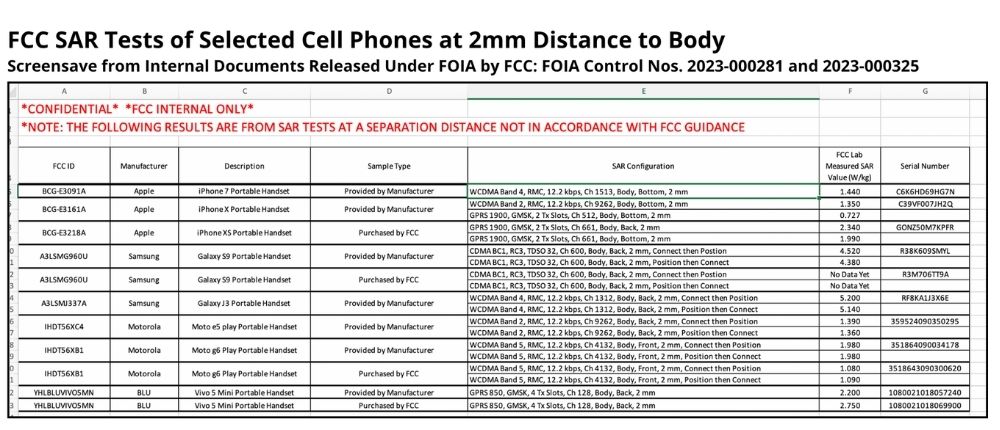
The FCC also tested cell phones at the separation distances the manufacturer chose (from 5 to 15 mm) and these tests showed radiation levels compliant with FCC limits. The FCC then issued a December 19, 2019, report which only shared the 5 to 15 mm test data, and omitted the FCC’s radiation 2 mm pocket radiation tests. The Chicago Tribune then ran a follow up article the next day stating that the FCC found “no evidence of violations of any FCC rules” for the safety limit,” which ended by stating “the FCC’s recent study did not test phones at 2 mm distance” even though the FCC, had in fact, tested cell phones at 2 mm distance.
Questions to ask the FCC about its transparency to the American public
- Why did the FCC release a report with only the compliant test data using larger manufacturer-selected distances (5–15 mm), while omitting the results showing exceedances of the FCC limit?
- Why did the FCC not correct the public record when media reports (the Chicago Tribune) inaccurately stated that the FCC had not tested phones at 2 mm?
- What is the basis for years of withholding factual testing data that directly relates to consumer safety and RF radiation exposure affecting millions of Americans?
4. Why Did the FCC Omit its 2 mm Cell Phone Radiation Test Results from Its Court Filings?
The FCC also omitted its 2 mm cell phone radiation test findings in their court statement of interest filings in the Apple v. Cohen case (28) in which plaintiffs alleged that cell phones emitted excessive radiation and also in its court filings for the CTIA v. City of Berkeley case (29) in which the CTIA Wireless Industry sued the city of Berkeley for its Cell Phone Right to Know ordinance which informed people at point of sale that phones could exceed radiation limits if not used with the separation distance.
Questions to ask the FCC about its legal filings.
- Why did the FCC omit its own 2 millimeter (mm) body-contact cell phone radiation test findings—which showed phones exceeding federal SAR limits—from its statements in Apple v. Cohen and CTIA v. City of Berkeley?
- Given that these legal proceedings directly concerned cell phone radiation in close body conditions, how does the FCC justify withholding its own test results that demonstrated radiation limit exceedances when phones were tested as people actually use them, close to the body?
5. Why Did the FCC Omit its 2 mm Cell Phone Radiation Test Results From Its Open Rulemaking on RF Rules?
The FCC also omitted its 2 mm tests from its then open rulemaking on RF limits, which notably specifically requested comment on the cell phone radiation test procedures that allow manufacturers to use a separation distance. The 2013 FCC inquiry asked, “Specifically, we seek comment on the feasibility of evaluating portable RF sources without a separation distance when worn on the body to ensure compliance with our limits under present-day usage conditions ” (30).
But instead of transparently sharing its 2 mm cell phone radiation data, the FCC stated in its December 4, 2019 decision to maintain its 1996 human exposure limits for RF that they were opposed to requiring manufacturers to premarket testing phones in body contact positions. The FCC concluded that “Even though some parties claim that the RF exposure evaluation procedures for phones should require testing with a “zero” spacing – against the body – this is unnecessary” (31).
The FCC then proceeded to withhold test data from the subsequent federal case EHT et al v. FCC United States Court of Appeals for the District of Columbia, Case Nos. 20-1025; 20-1138 (now on Remand), which Theodora Scarato, director of the Wireless and EMF Program at Environmental Health Sciences is a petitioner in, despite the fact that the issue of the cellphone test set up that allows a separation distance was central to the case (32, 33).
Questions to ask the FCC about its transparency to the public and court regarding its rules for cell phone RF radiation compliance testing.
- Given that the FCC NPRM directly asked if phones should be tested in body-contact conditions, how does the FCC justify withholding its own test results from its NPRM and court submissions in Environmental Health Trust et al. v. FCC that demonstrated limit exceedances when phones were tested in close body positions?
6. The FCC Lacks Oversight and Transparency for Cell Phone Radiation and is Withholding of the Apple iPhone 12 RF Radiation Measurements
In addition to the FCC’s 2 mm cell phone SAR testing, we have filed multiple Freedom of Information requests seeking records of FCC-conducted cell phone radiation testing to understand the scope of the FCC’s post-market surveillance and oversight of wireless devices. Through these requests, internal FCC records showed that the agency conducted only minimal surveillance testing as approximately four cell phone surveillance tests were released when we requested surveillance activities for the time period of January 1, 2020 through November 22, 2024 (34).
France, in contrast, is required to publicly release their cell phone radiation SAR test results and non-compliance findings. France has a robust post-market surveillance program that routinely tests cell phones to ensure compliance and to date, France has required corrections or withdrawals for more than 60 models. See the French government ANFR cell phone radiation test database here (35). In fact, just recently ANFR was ordered to release tests it had omitted from this database thanks to the transparency work of the Phonegate Association (36). Yet the FCC continues to withhold this information from U.S. consumers.
Released internal documents from Freedom of Information requests indicate that the FCC tested the Apple iPhone 12 in its own laboratories after France found radiation exceedances, yet the FCC has refused to release the Apple iPhone 12 radiation testing report and the underlying SAR measurement data from the tests, repeatedly invoking Exemption 5 even though it includes factual information.

Questions to ask about the scope of the FCC’s Oversight for Cell Phone Radiation Tests and the Apple iPhone 12 Tests.
- What post-market surveillance and oversight program does the FCC maintain to ensure that cell phones remain compliant with RF exposure limits after they are authorized for sale? Specifically, how many phones are tested each year, what criteria are used to select devices for testing, what testing distances and methodologies are employed, and on what timeline are such surveillance tests conducted and reported? Additionally, what procedures are in place to ensure transparency and public disclosure of the results of any post-market compliance testing?
- Why does the FCC not operate a publicly accessible cell phone radiation SAR compliance and enforcement program that publishes all pre-market and post-market cell phone SAR test results, clearly identifies non-compliant devices, and transparently discloses any enforcement actions taken to protect consumers?
- Why is the FCC refusing to release the Apple iPhone 12 RF radiation SAR test measurements?
7. The FCC Lacks a National Measurement and Monitoring Program for Cell Tower Radiation Exposures
The FCC does not maintain a national RF radiation measurement and environmental monitoring program, despite the rapid expansion of wireless infrastructure, dense small-cell deployment, and widespread 5G rollout. This absence represents a significant gap in federal oversight. Decades ago, the United States operated a national RF measurement and monitoring program that collected real-world exposure data; however, this program was discontinued and never replaced. The EPA published the last publicly available measurement report in 1986. A 2018 multi-country study (37) found RF environmental measurements in Los Angeles, California at 70 times higher than levels measured in City in the late ‘70s, as part of a twelve-city study referenced in the 1986 EPA report 938). Decades ago, TV and FM radio broadcast antennas were the dominant contributors to environmental RF exposures. Today the RF emissions from cellular base station antennas (cell towers and 4G/5G facilities) are the dominant contributor to ambient RF exposures in most outdoor areas.
The FCC’s approach is essentially the honor system. The FCC relies almost exclusively on pre-market compliance testing conducted by or for manufacturers, with minimal post-market surveillance and no systematic collection of real-world exposure data. This approach stands in stark contrast to practices in numerous other countries, which conduct ongoing environmental RF measurements, publish monitoring results, track changes in population exposure over time, and use this data to inform policy and enforcement decisions.
Without a national monitoring program, the FCC lacks confirmation of compliance and empirical data on cumulative, ambient, and long-term RF exposure levels experienced by the public—particularly in homes, schools, and communities subject to dense wireless deployments. The absence of such a program undermines transparency, prevents independent verification of safety assumptions, and leaves the public without basic information about their exposure.
Questions regarding the lack of a robust measurement and monitoring program:
- Why has the FCC abandoned a basic national RF radiation measurement and monitoring function that previously existed?
- What statutory, budgetary, or policy decisions led to the defunding or elimination of this program, and why has it not been reinstated despite dramatic increases in wireless networks?
- How does the FCC assess real-world, cumulative RF exposure in the absence of systematic environmental measurements?
- How can the FCC credibly assure the public that its exposure limits are protective without collecting data to assess public exposures and monitor health and environmental impacts
- Why does the FCC not publish routine, location-based RF exposure measurements to enable public transparency and independent scientific review?
8. The FCC lacks oversight regarding compliance and enforcement for cell towers and wireless facilities.
Numerous countries conduct routine audits of cell tower sites to ensure compliance with RF exposure limits (39-45). These programs often include spot checks of a defined percentage of cell towers and wireless sites each year, mandatory reporting, and in some cases, continuous national monitoring of ambient emissions. Further, the results are often publicly posted on easy-to-understand websites.
By contrast, the United States has no comparable national auditing, monitoring, or enforcement program. The FCC has not demonstrated that it conducts systematic inspections, routine spot checks, or any ongoing compliance verification of operational cell towers. The FCC has yet to fully respond to our repeated Freedom of Information requests for enforcement actions and responses to RF-related complaints.
Out-of-compliance wireless facilities have been documented, especially in regards to rooftop sites which have been documented as failing to meet RF exposure compliance regulations for RF radiation exposure and also for issues like proper signage and containment of the high RF radiation exposure areas (47,48). As an example, a 2021 RF study that was part of a petition submitted to the U.S. Health and Human Services used professional-grade calibrated spectrum management tools to measure RF levels in a rooftop lounge area, where people sunbathe, as it is next to wireless antennas, and they documented significant RF exceedances. According to their Crest Factor analysis, the emissions routinely spiked to 132-to-264% beyond the FCC Human RF exposure standard (49). This situation likely reflects a systemic issue with rooftop installations nationwide.
Questions regarding the FCC’s lack of oversight regarding compliance and enforcement for cell towers and wireless facilities.
- What is the FCC doing to ensure cell tower and rooftop antenna compliance, given documented cases of RF exposure exceeding both public and occupational limits?
- Why does the FCC rely almost entirely on industry self-certification, conduct no routine audits, perform no random spot checks, and rarely investigate complaints related to cell tower RF radiation despite evidence of widespread non-compliance, particularly with higher-powered 5G installations?
- What is the FCC’s process for receiving, investigating, and resolving RF exposure complaints, and why are all RF complaints, investigative findings, and agency responses not made publicly available?
9. The FCC Lacks an Adequate Oversight and Enforcement to Protect Workers From Occupational Exposures
Cell tower climbers, maintenance workers, broadcast technicians, utility workers, firefighters, and construction crews are increasingly subject to involuntary occupational radiofrequency (RF) exposure as wireless infrastructure rapidly densifies. Cell tower climbers have reported RF overexposure incidents (50), and a peer-reviewed case study published in the journal Multiple Sclerosis and Related Disorders (51) documented a worker with intense RF exposure who later developed neurological symptoms mimicking multiple sclerosis (MS) years after the initial exposure. The FCC’s occupational RF exposure limits, which allow workers to be exposed to up to five times the level permitted for the general public, are highly questionable, particularly given the absence of routine monitoring, EMF measuring, medical surveillance, or enforcement, and the growing evidence of adverse health effects associated with RF exposure. The lack of a robust occupational RF radiation protection program in the U.S.A. leaves the true number of exposed and injured workers unknown and raises serious questions about how the FCC can determine whether its regulations are protective in real-world occupational settings.
Theodora Scarato’s American Public Health Association (APHA) 2025 presentation documents that occupational RF exposure is now widespread across multiple job categories, from education and healthcare to retail, construction, emergency response, and telecommunications, and increasingly unavoidable in the modern workplace (52, 53).These exposures occur without routine monitoring, medical surveillance, or meaningful enforcement and are governed by outdated 1996 federal limits that fail to account for chronic, cumulative, and non-thermal biological effects documented in the scientific literature (54).
Questions regarding the FCCS inadequate oversight for occupational RF exposures
- Why are FCC RF radiation exposure limits for workers based solely on effects from short-term exposure when workers in modern workplaces are exposed daily to continuous RF radiation?
- Why do FCC RF radiation exposure limits for workers allow higher RF exposures, especially in today’s dense wireless environment where worker do not have as much control over the exposure.
- What measures does the FCC require to protect cell tower climbers and maintenance workers from excessive radiofrequency (RF) exposure, given documented incidents of overexposure, injuries, and fatalities (including antenna shut-down procedures, lock-out/tag-out requirements, real-time RF monitoring, and post-exposure medical evaluation)
- How does the FCC provide oversight and verify compliance in the field rather than relying on carrier self-reporting
- How does the FCC verify compliance with occupational RF limits in the field, rather than relying on carrier self-certification and theoretical modeling?
- How many inspections, audits, or enforcement actions related to occupational RF overexposure has the FCC conducted in the past five years?
- Given that virtually all workers are now exposed to ambient RF radiation, what steps is the FCC taking to update its standards, monitoring, and enforcement to reflect real-world occupational conditions rather than theoretical compliance?
10. The FCC is Narrowing NEPA Protections Despite RF Radiation Related Rules That Omit Protections for Wildlife and Habitat
The FCC has moved to narrow and essentially eliminate most of the protections of the National Environmental Policy Act (NEPA) for wireless infrastructure via two proposed rulemakings, both “Modernizing the Commission’s National Environmental Policy Act Rules”, WT Docket No. 25- 217(55) and “Build America: Eliminating Barriers to Wireless Deployments, WT Docket No. 25-276 (56), at the same time that peer-reviewed scientific evidence documenting serious impacts to the environment, to flora and fauna, continues to grow (57-79). Studies have reported impacts to plants and trees as well as a wide range of impacts to animals, including to their orientation, migration, reproduction, mating, nesting, den building, habitat and survivorship (65-66).
Newer technologies with higher frequencies are creating unique risks for honeybees and other insect pollinators as the frequencies are more highly absorbed into their smaller bodies (67-70). Wildlife biologists and experts are urgently calling for updated exposure limits along with safeguards for flora and fauna (71-79).
Despite rising environmental levels, the FCC limits are solely designed to ensure protection for humans, not flora or fauna. FCC protections for birds, bees, trees and wildlife simply do not exist. This is a critical regulatory gap. Further, FCC RF compliance procedures entirely fail to protect wildlife, plants and trees as cell towers and base station antennas are allowed to have non-compliance zones that extend sometimes well over 50 -100 feet, creating hazardous exposures for the animals that live in the air or in trees near the infrastructure. Yet consideration of these flora and fauna impacts is omitted from evaluations during the application process.
In its 2021 decision, the DC Circuit stated that the FCC had “completely failed even to acknowledge, let alone respond to, comments concerning the impact of RF radiation on the environment,” highlighting a U.S. Department of Interior letter which detailed published studies showing RF impacts to birds. The letter states that “There is a growing level of anecdotal evidence linking effects of non-thermal, non-ionizing electromagnetic radiation from communication towers on nesting and roosting wild birds and other wildlife.“ It further stated, “the electromagnetic radiation standards used by the Federal Communications Commission (FCC) continue to be based on thermal heating, a criterion now nearly 30 years out of date and inapplicable today” (80).
Questions regarding the FCC Narrowing of NEPA Protections
- How can the FCC justify limiting or eliminating NEPA review for wireless infrastructure when there is mounting peer-reviewed evidence of RF radiation impacts on wildlife and the environment, and when the agency regulations do not pertain to impacts on flora and fauna?
- If the FCC is not a health or environmental agency, and no other federal agency is actively evaluating environmental risks (flora and fauna) from chronic RF radiation exposure, which federal agency is currently responsible for ensuring that accelerated wireless deployment does not cause environmental harm?
11. Federal Preemption Under Section 704 of the Telecom Act Silences Health and Environmental Concerns Despite Outdated and Obsolete FCC Limits
Despite the growing body of peer-reviewed scientific evidence which indicates that the FCC’s rules are inadequate, Section 704 of the Telecommunications Act of 1996 prohibits state and local governments from “regulating the placement, construction, or modification of personal wireless service facilities on the basis of the environmental effects of RF emissions, so long as such facilities comply with FCC regulations” (81-84). This provision has been interpreted by some courts as a federal preemption, functioning in practice as a de facto “RF gag rule” to decisionmakers that shields the wireless industry (82-84). As a result, public discussion of health and environmental concerns related to RF radiation is effectively silenced during cell tower siting proceedings, and industry frequently invokes the threat of litigation when issues of health are raised (such as in cell towers going up near schools, daycares and homes).
This situation reflects a serious failure of governance: federal agencies have failed to conduct timely, rigorous scientific reviews, yet policymakers and local officials are effectively prohibited from acknowledging or addressing potential risks because federal standards remain outdated. Section 704 not only restricts state and local decision-makers from considering health or environmental concerns when siting wireless facilities near schools and homes, but also forecloses meaningful judicial review and due process, leaving communities without any practical mechanism to prevent harm and respond to legitimate health, safety, and ecological concerns related to cell tower siting.
12. The FCC Has Not Competed on Safety in the Race to Deploy Wireless Infrastructure nor Promoted Available RF Exposure-Reducing Technologies
The FCC is racing to fast-track cell towers and wireless deployment without comparably promoting innovation in device and network design that would reduce wireless RF radiation exposure. Peer-reviewed research demonstrates that wireless technologies can be engineered to substantially reduce RF radiation exposure through design choices such as optimized antenna configurations, miniaturized MIMO systems, power control, and deploying wired Ethernet and corded alternatives with exposure-conscious building design—particularly for schools and residential settings (85,86).
Engineering solutions for cell phones have been proposed by experts of the International Commission on the Biological Effects of Electromagnetic Fields that are simple and would drastically reduce exposure to cell phones (88). Researchers have found, as an example, the miniaturization of the MIMO mobile terminal antenna could significantly reduce wireless RF radiation absorption into head tissues: 85.51% in the scalp, 85.62% in the skull, 89.02% in the cerebrum, 93.04% in the cerebellum, and 88.02% in the brainstem (89).
Despite the feasibility of these urgently needed solutions (90) , the FCC has not fast-tracked safer technologies or incentives for exposure-minimizing designs and the related research and design needed. Instead, current FCC policies prioritize speed and cost over public and environmental health, allowing market forces to sideline safer designs rather than encouraging competition on safety.
Questions Regarding the FCC’s Failure to Compete on Safety
- What is the FCC doing to ensure that U.S. companies are competing on safety, including the development, deployment and promotion of low and no RF radiation emitting communication technologies?
- How does the FCC justify fast-tracking cell towers without comparably promoting or incentivizing technologies that significantly reduce RF radiation exposure or have no RF radiation emissions (such as hardwired ethernet), despite peer-reviewed evidence that relatively simple engineering modifications can substantially reduce RF absorption into the brain?
- What concrete steps, if any, has the FCC taken to incentivize RF exposure-reducing technologies for sensitive populations, including use by children in schools, homes, and other sensitive environments?
About Environmental Health Sciences
Environmental Health Sciences is a non-profit environmental health organization with a Wireless and EMF Risk and Solutions Program advancing scientific research on cell tower radiation health effects, wireless exposure, cell phone safety, and EMF health risks.