

A bill introduced in the U.S. Congress, H.R. 2289, would dramatically reduce the ability of cities and counties to properly oversee wireless, telecommunications—while granting sweeping advantages to industry. The bill rewrites federal law to override local authority, tighten shot clocks, cap fees, and remove reviews under the National Environmental Policy Act and the National Historic Preservation Act for modifying cell towers and wireless sites.
Opposition by Local Governments
Virginia Blue Ridge Power Agency
“As currently drafted, H.R. 278 [ included in H.R. 2289] would expand federal control over public power utility infrastructure, creating serious safety concerns without any assurance that purported “savings” would be passed on to customers.”
California Municipal Utilities Association
As currently drafted, Section 102 of H.R. 2289 (H.R. 278) would expand federal control over public power utility infrastructure, creating serious safety concerns without any assurance that purported “savings” would be passed on to customers.
Indiana Municipal Power Agency
“While public power utilities strongly support expanding broadband access, we do not believe this legislation will achieve that objective. As currently drafted, H.R. 278 [included in H.R. 2289] would expand federal control over public power utility infrastructure, undermining local authority and engineering safety without any assurance that purported ‘savings’ would be passed on to customers.”
City of Salem, Virgina, Electric Department
“Our members remain committed to supporting broadband deployment, but we do not believe the provisions in Section 102 of H.R. 2289 will advance that goal…As currently drafted, H.R. 278 [ in H.R. 2289] would expand federal control over public power utility infrastructure, creating serious safety concerns without any assurance that purported ‘savings’ would be passed on to customers. While public power utilities strongly support expanding broadband access, we do not believe this legislation will achieve that objective.”
Missouri River Energy Services
“Imposing federally mandated timelines and deemed-granted provisions, as envisioned in H.R. 278 [included in H.R. 2289], would shift risk and cost to electric customers and undermine utilities’ ability to meet safety, engineering, and staffing requirements.
Our members remain committed to supporting broadband deployment, some partner directly with providers or operate broadband networks themselves, but we do not believe the provisions in Section 102 of H.R. 2289 will advance that goal. Instead, they would preempt local authority and reduce the tools public power utilities need to manage their systems responsibly.”
As currently drafted, H.R. 278 [included in H.R. 2298] would expand federal control over public power utility infrastructure in Alabama, creating serious safety concerns without any assurance that purported “savings” would be passed on to customers. While public power utilities strongly support expanding broadband access, I do not believe this legislation will achieve that objective.
“These bills represent an unprecedented federal intrusion into established local decision-making processes, favoring large broadband, telecommunications, wireless, and cable companies at the expense of residents and taxpayers. These bills strip local governments of the ability to effectively manage the infrastructure built on local streets and in neighborhoods, while imposing no reciprocal obligations on providers.”
The American Public Power Association of not-for-profit, community-owned utilities submitted a letter in opposition to H.R. 278 which is now included in the text of H.R. 2289 opposing the strict 90-day shot clocks, “deemed granted” approvals, unclear denial standards, and fee limitations. The Association is advocating to preserve local control of the pole attachment process for public power utilities.
The House Energy and Commerce (E & C) Committee held a full committee markup of fifteen bills, including H.R. 2289, on Wednesday, December 3, 2025, where H.R. 2289 and the related telecom-backed bills passed out of the House Committee with H.R. 2289 advancing 26–24 along party lines. These bills now move to the full House, where leadership will decide when to schedule them for floor consideration. The next steps include placement on the House calendar, potential debate and amendments under a rule from the House Rules Committee, and then a final vote by the full chamber. If passed, the legislation would proceed to the Senate for further action.
Watch the earlier November 18 E &C Subcommittee meeting here.
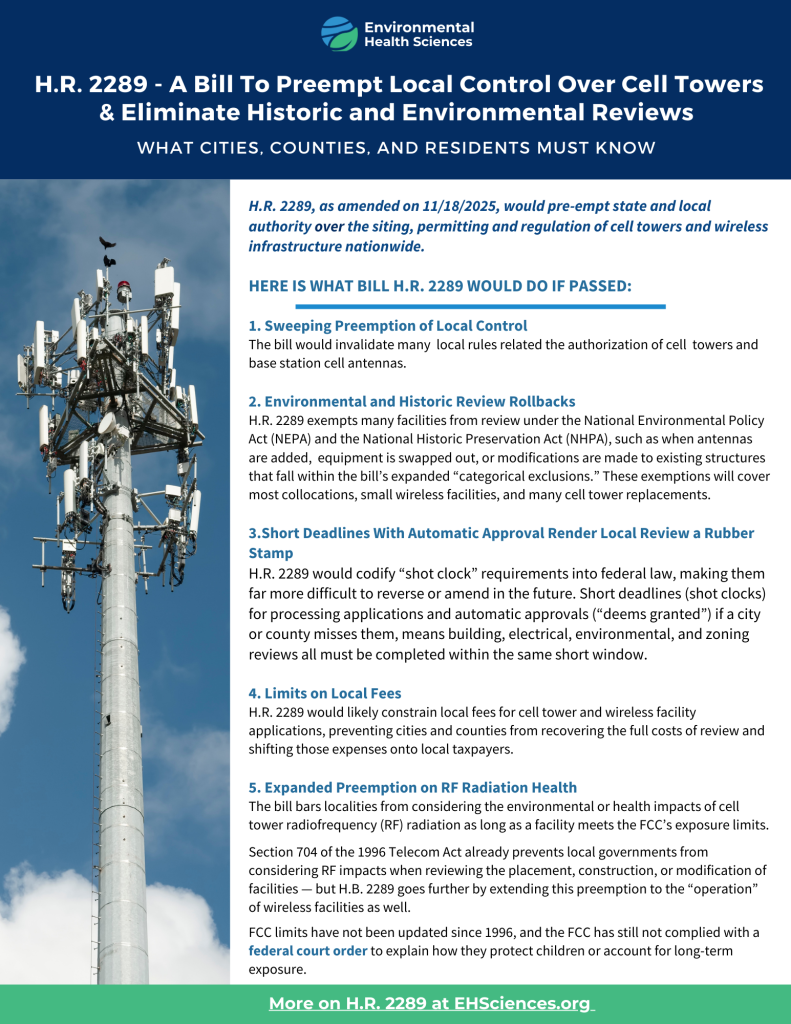
Here’s What H.R. 2289 Would Do
1. Preemption of Local Control
The bill would override many local government fees and tighten timelines with automatic approvals, as well as force local governments to approve cell tower and wireless modification and expansion requests without adequate reviews, impacting several types of wireless facility applications, regardless of historic impacts and health, environmental, and safety risks.
2. Environmental and Historic Review Rollbacks
H.R. 2289 effectively removes review under the National Environmental Policy Act (NEPA) and the National Historic Preservation Act (NHPA) for “eligible facilities requests,” allowing many modifications and expansions of existing wireless infrastructure to proceed without environmental and historic review.
Cell towers and wireless facilities impact the environment in numerous ways. As stated by former FCC lawyer and NEPA expert Erica Rosenberg in Environmental Procedures at the FCC: A Case Study in Corporate Capture, “the telecommunications industry leaves a significant environmental footprint: wetlands filled, viewsheds marred, cultural resources damaged, and habitat destroyed.” H.R. 2289 would further exacerbate the situation, dismantling the tools local governments have to protect their community.
3. Missed Deadlines and Automatic Approvals
H.R. 2289 would codify “shot clock” requirements (timelines for processing cell tower and wireless facility applications) into federal law, making them far more difficult to reverse or amend in the future and imposing automatic approvals (“deems granted”) if a city misses them. That means building, electrical, encroachment, environmental, and zoning reviews all must be completed within the same short window. Local governments cannot pause or slow applications, even during high-volume periods.
4. Limits on Local Fees
The Bill requests that the NTIA prepare a report for Congress detailing the fees that states/localities charge that exceed the limits in an earlier 2023 proposed bill, H.R. 3557, which had similar provisions. H.R. 2289 would likely constrain local fees for cell tower and wireless facility applications, preventing cities and counties from recovering the full costs of review and shifting those expenses onto local taxpayers.
5. Expanded Pre-emption for RF Health and Environmental Effects
The scientific evidence on cell tower health effects indicates that FCC limits do not protect human health or the environment from all impacts. Yet, HR 2289 does not fix the long-standing 1996 Telecom Act Section 704 federal “RF gag rule” that prevents local governments from considering the environmental or health effects of radiofrequency emissions when reviewing cell towers and wireless facilities. Instead, the HR. 2289 reaffirms and expands existing prohibitions on local governments.
Direct Quote from the H.R. 2289 (p. 15–16):
“No State or local government… may regulate the operation, placement, construction, or modification of personal wireless service facilities on the basis of the environmental effects of radio frequency emissions, to the extent that such facilities… comply with the Commission’s regulations.”
—H.R. 2289
What This Means:
The Bill states localities cannot consider cell tower RF radiation environmental impacts- which includes human health effects—as long as the wireless facility meets outdated FCC limits for allowable cell tower RF radiation exposure. This preemption applies to both placement and operation, eliminating one of the last remaining avenues for community control.
Essentially, it will force automatic approval of many wireless deployments without adequate review for harmful impacts. FCC limits have not been updated since 1996, and the FCC has still not complied with a federal court order to explain how they protect children or account for long-term exposure. Combined with the existing RF preemption in the Telecom Act, HR 2289 will leave communities with even fewer tools to protect environmentally sensitive areas or address health risks posed by cell antennas near homes and schools.
Opposition to Preemption by Local Governments
H.R. 2289 is essentially the same bill as H.R. 3357 that was proposed in 2023. It was halted due to widespread opposition, especially from local governments.
“As the level of government closest to the people, we oppose heavy-handed federal overreach into local land use, permitting, and franchise negotiation decisions. Congress has historically recognized these rights in Sections 224, 253, and 332 of the Telecommunications Act. These authorities are critical to conduct responsible stewardship of public property, protect public safety, and preserve the rights of residents as consumers of broadband services and neighbors to the infrastructure that makes connectivity possible.”
Watch the full House Committee Mark up December 3, 2025 here.