
A bill introduced in the U.S. Congress, H.R. 2289, would dramatically reduce the ability of cities and counties to properly oversee wireless, telecommunications—while granting sweeping advantages to industry. The bill rewrites federal law to override and basically steamroll local authority by limiting fees, tightening shot clocks, and removing reviews under the National Environmental Policy Act and the National Historic Preservation Act for modifying cell towers and wireless sites.
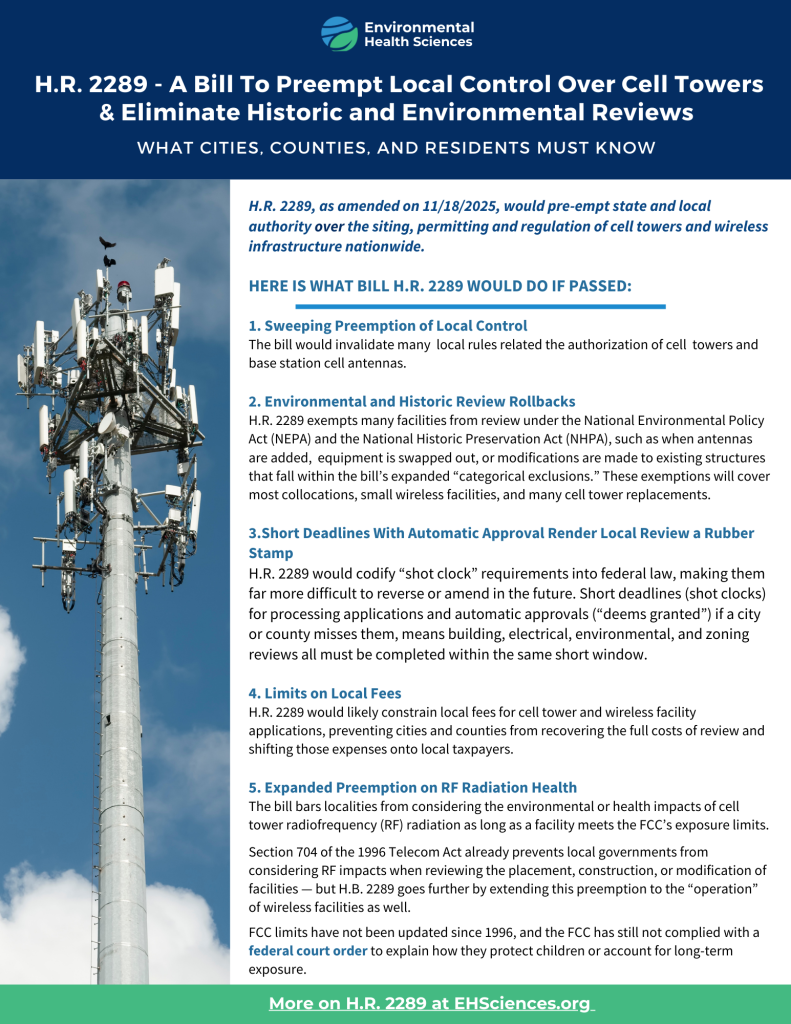
Download our Factsheeton H.R. 2289
Status of the H.R. 2289 Cell Tower Fast-Track Bill
H.R. 2289, the American Broadband Deployment Act, has been stalled.
This Is Only A Temporary Pause — Not A Victory
In Spring 2026 it was placed on the House Union Calendar (No. 532), meaning it cleared committee and is headed to the full House floor. The House Rules Committee was initially set to meet on April 20 at 4 PM to set debate rules, but it was abruptly postponed midday, likely due to the massive opposition by the majority of local governments in the country.
December 3, 2025: The House Energy and Commerce (E & C) Committee held a full committee markup of fifteen bills, including H.R. 2289, on Wednesday, December 3, 2025, where H.R. 2289 and the related telecom-backed bills passed out of the House Committee with H.R. 2289 advancing 26–24 along party lines. Watch the November 18 E &C Subcommittee meeting here.
Both the FCC NPRM 25-276 and Congressional Bill H.R. 2289 would fast-track cell towers near homes in neighborhoods nationwide, overriding local control and stripping cities and towns of their ability to enforce basic safeguards like setbacks, safety review, and community input. The Congressional bill would additionally expand federal preemption regarding radiofrequency radiation-related health effects. Government decision-makers at the local and state level should be educated on the proposals.
Strong opposition to H.R. 2289
Organizations Serving Over 80% of the U.S. Population State That H.R. 2289 Would Undermine Public Safety
On April 16, 2026, the National Association of Counties (NACo), the U.S. Conference of Mayors (USCM), the National League of Cities, and the National Association of Telecommunications Officers and Advisors (NATOA) wrote a letter to House leadership stating that HR 2289 “would undermine public safety, force local taxpayers to subsidize private corporations and disrupt the very broadband deployment progress it aims to accelerate.”
“H.R. 2289 creates a framework that prioritizes communication companies’ shareholder value at the expense of the safety and financial interests of the communities and the taxpayers they serve. Furthermore, by limiting cost-recovery mechanisms for application reviews, the bill effectively forces local taxpayers to subsidize private providers’ administrative expenses – a cost that falls entirely on the public.”
“ H.R. 2289 as written, would sacrifice local autonomy, impose unfunded mandates and disrupt deployment progress already underway.”
The National Association of Counties (NACo), representing counties serving more than 80 percent of the nation’s population, states that, “the preemption of local permitting authority will not lead to the expedited build-out of broadband infrastructure, but instead jeopardize the safety of the public.”
“These bills represent an unprecedented federal intrusion into established local decision-making processes, favoring large broadband, telecommunications, wireless, and cable companies at the expense of residents and taxpayers. These bills strip local governments of the ability to effectively manage the infrastructure built on local streets and in neighborhoods, while imposing no reciprocal obligations on providers.”
As currently drafted, H.R. 278 [included in H.R. 2298] would expand federal control over public power utility infrastructure in Alabama, creating serious safety concerns without any assurance that purported “savings” would be passed on to customers. While public power utilities strongly support expanding broadband access, I do not believe this legislation will achieve that objective.
Virginia Blue Ridge Power Agency
“As currently drafted, H.R. 278 [ included in H.R. 2289] would expand federal control over public power utility infrastructure, creating serious safety concerns without any assurance that purported “savings” would be passed on to customers.”
California Municipal Utilities Association
As currently drafted, Section 102 of H.R. 2289 (H.R. 278) would expand federal control over public power utility infrastructure, creating serious safety concerns without any assurance that purported “savings” would be passed on to customers.
Indiana Municipal Power Agency
“While public power utilities strongly support expanding broadband access, we do not believe this legislation will achieve that objective. As currently drafted, H.R. 278 [included in H.R. 2289] would expand federal control over public power utility infrastructure, undermining local authority and engineering safety without any assurance that purported ‘savings’ would be passed on to customers.”
City of Salem, Virgina, Electric Department
“Our members remain committed to supporting broadband deployment, but we do not believe the provisions in Section 102 of H.R. 2289 will advance that goal…As currently drafted, H.R. 278 [ in H.R. 2289] would expand federal control over public power utility infrastructure, creating serious safety concerns without any assurance that purported ‘savings’ would be passed on to customers. While public power utilities strongly support expanding broadband access, we do not believe this legislation will achieve that objective.”
Missouri River Energy Services
“Imposing federally mandated timelines and deemed-granted provisions, as envisioned in H.R. 278 [included in H.R. 2289], would shift risk and cost to electric customers and undermine utilities’ ability to meet safety, engineering, and staffing requirements.
Our members remain committed to supporting broadband deployment, some partner directly with providers or operate broadband networks themselves, but we do not believe the provisions in Section 102 of H.R. 2289 will advance that goal. Instead, they would preempt local authority and reduce the tools public power utilities need to manage their systems responsibly.”
Here’s What H.R. 2289 Would Do
1. Sweeping Preemption of Local Control
The bill forces local governments to approve cell tower and wireless modification and expansion requests without adequate reviews despite historic impacts and health, environmental, and safety risks. Specifically, the bill applies to requests to modify or replace an existing wireless cell tower or base station antenna site.
The Result: Local communities will lose meaningful power to decide on changes to wireless sites based on a transparent and adequate review process.
2. Environmental and Historic Review Rollbacks
H.R. 2289 effectively removes review under the National Environmental Policy Act (NEPA) and the National Historic Preservation Act (NHPA) for “eligible facilities requests,” allowing many modifications and expansions of existing wireless infrastructure to proceed without environmental and historic review. This change substantially weakens protections for a broad range of wireless deployments, from cell towers to 5G, 6G, and beyond.
Cell towers and wireless facilities impact the environment in numerous ways. As stated by former FCC lawyer and NEPA expert Erica Rosenberg in Environmental Procedures at the FCC: A Case Study in Corporate Capture, “the telecommunications industry leaves a significant environmental footprint: wetlands filled, viewsheds marred, cultural resources damaged, and habitat destroyed.” HB2289 would further exacerbate these impacts.
The Result: Projects move forward without adequate environmental, cultural, or historic protections.
3. Extremely Short Deadlines Render Local Review a Rubber Stamp
The bill imposes extremely short deadlines for processing cell tower and wireless facility applications and automatically approves (“deems granted”) applications if a city misses them. That means building, electrical, encroachment, environmental, and zoning reviews all must be completed within the same short window. Local governments cannot pause or slow applications, even during high-volume periods.
The Result: Industry receives approvals even when local governments cannot reasonably complete their reviews.
4. Severe Limits on Local Fees
Cities and counties may charge only direct processing costs, not fair market rates or fees for long-term oversight or public impact.
The Result: Local taxpayers absorb costs while industry gains inexpensive access to public property.
5. Expanded Pre-emption for RF Health and Environmental Effects
The scientific evidence on cell tower health effects indicates that FCC limits do not protect human health or the environment. Yet, HR 2289 does not fix the long-standing 1996 Telecom Act Section 704 federal “RF gag rule” that prevents local governments from considering the environmental or health effects of radiofrequency emissions when reviewing cell towers and wireless facilities. Instead, the HR. 2289 reaffirms and expands existing prohibitions on local governments.
Direct Quote from the H.R. 2289 (p. 15–16):
“No State or local government… may regulate the operation, placement, construction, or modification of personal wireless service facilities on the basis of the environmental effects of radio frequency emissions, to the extent that such facilities… comply with the Commission’s regulations.”
—H.R. 2289
What This Means:
The Bill states localities cannot consider cell tower RF radiation environmental impacts- which includes human health effects—as long as the wireless facility meets outdated FCC limits for allowable cell tower RF radiation exposure. This preemption applies to both placement and operation, eliminating one of the last remaining avenues for community control.
Essentially, it will force automatic approval of many wireless deployments without adequate review for harmful impacts. Combined with the existing RF preemption in the Telecom Act, HR 2289 will leave communities with even fewer tools to protect environmentally sensitive areas or address health risks posed by cell antennas near homes and schools.
The Result: Communities cannot address residents’ legitimate health and safety issues or restrict facilities near sensitive areas such as schools, homes or ecologically sensitive areas.
Statement on HR. 2289
by Theodora Scarato, Director of the Wireless and EMF Program at Environmental Health Sciences
Calling this bill a ‘power grab’ doesn’t go far enough. It’s a historic transfer of decision-making from communities to corporations, with virtually no guardrails, and the costs will be borne entirely by residents. It’s a radical shift that elevates industry speed over public safety and democracy. H.R. 2289 will allow many modifications and expansions of existing cell towers and wireless infrastructure to proceed without adequate environmental and historic oversight.
Congress isn’t the only one stripping local communities of their rights—the FCC is advancing the same agenda with the “Build America” Cell Tower Fast Track Plan in Docket 25-276. The FCC’s new proposal includes tightening “shot clock” deadlines with automatic approvals, capping local government fees, and pre-empting setbacks and common sense community protections. The FCC is also proposing to weaken NEPA reviews in yet another proposal that we commented on- Modernizing the Commission’s National Environmental Policy Act Rules, FCC WT Docket No. 25-217; FCC 25-47.
The American people are trapped in a regulatory catch-22: the 1996 Telecom Act prohibits local governments from considering health and environmental effects, federal agencies have cut off funding to study those effects, and the FCC still relies on outdated 1996 exposure limits for RF radiation while ignoring mounting scientific evidence of harm.
How can Congress and federal regulators- the FCC- mandate unlimited wireless expansion while simultaneously blocking communities from raising safety concerns, eliminating local oversight, and defunding the very research needed to protect the public and environment? This regulatory quagmire leaves families exposed, voiceless, and without any meaningful path to protection.
It is unacceptable for children, families, wildlife, and the environment to be placed at risk simply to advance corporate profits and accelerated deployment timelines. Cell towers bring numerous health, environmental and safety risks. Local communities have a right to enact common-sense protections and to properly review cell tower applications for impacts.
What the Public Must Do
The public must demand transparency and accountability before Congress rewrites national wireless policy in this way. Residents should contact their elected officials and speak out locally on the need for environmental, health, and safety protections.
What Policymakers Must Do
Policymakers must stop H.R. 2289 and reject FCC rules that further weaken local authority. Congress should update RF radiation exposure limits using current science and restore independent research funding. Section 704 of the Telecommunications Act must be amended. Lawmakers must preserve local authority, oversight, historic and environmental safeguards, putting public and environmental safety above industry speed.