
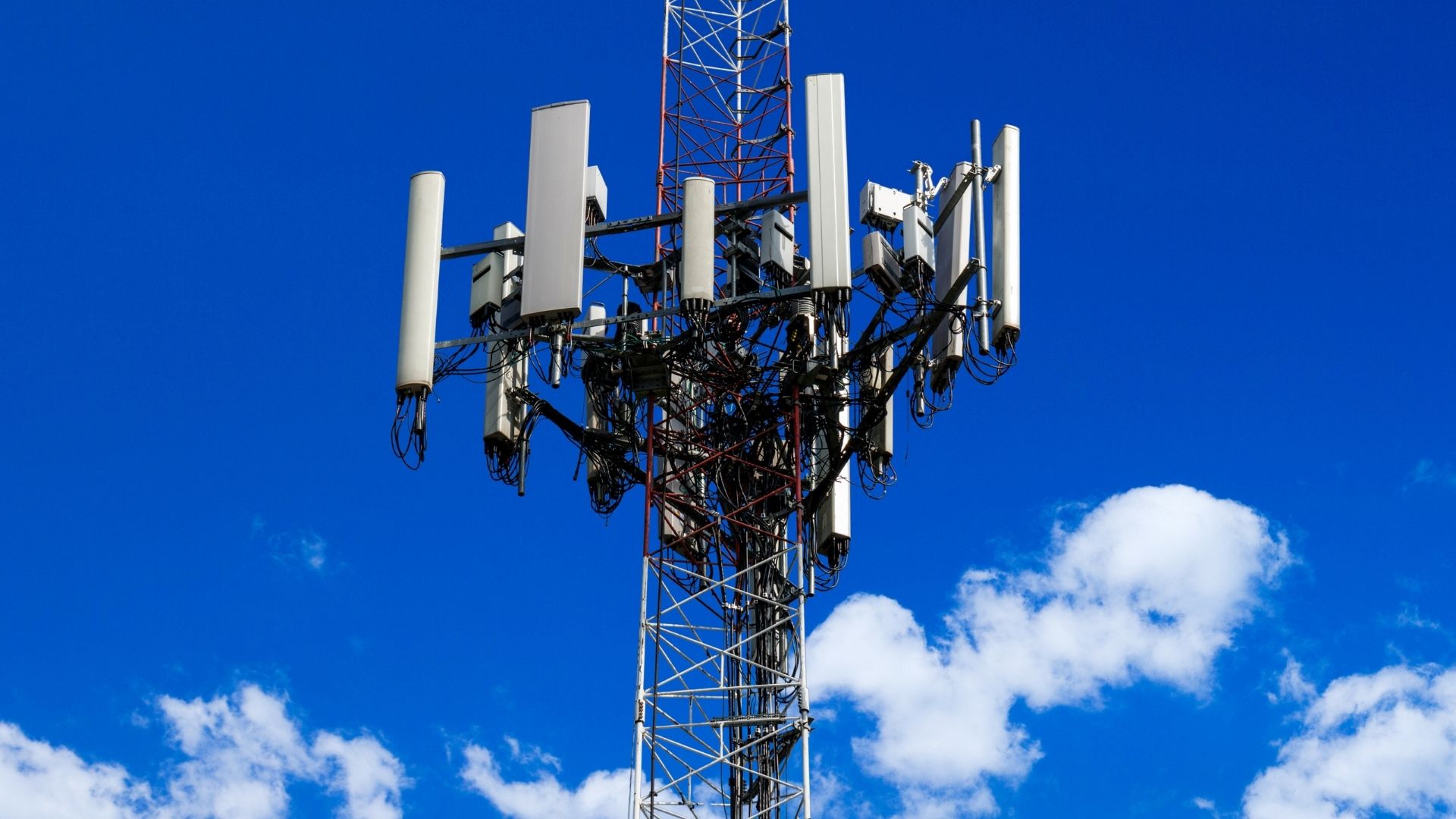
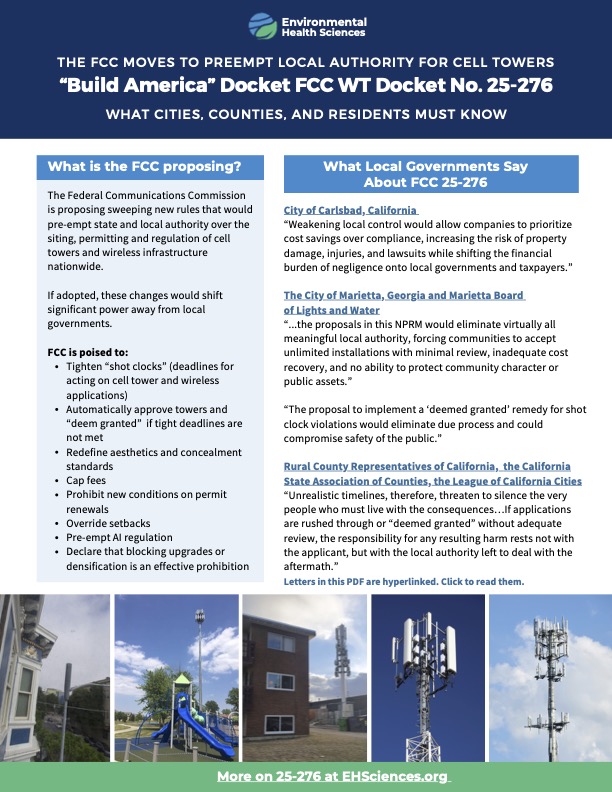
The Federal Communications Commission has proposed a sweeping new rulemaking in the Federal Register- WT Docket No. 25-276. These rules would pre-empt state and local authority for the siting, permitting and regulation of cell towers and wireless infrastructure nationwide.
The FCC’s Notice of Proposed Rulemaking (NPRM) is entitled Build America: Eliminating Barriers to Wireless Deployments. If adopted, these changes would shift significant power from local governments to the federal government, dramatically reducing community input, zoning protections, and the ability of cities, counties, and residents to shape where and how wireless facilities are deployed.
Cities and Counties Are Fighting the Federal Preemption
Major associations representing cities and counties—including the National League of Cities (NLC), National Association of Counties (NACo), U.S. Conference of Mayors (USCM), National Association of Telecommunications Officers and Advisors (NATOA), California State Association of Counties (CSAC), League of California Cities (Cal Cities), and the Rural County Representatives of California (RCRC)—have urged the FCC to withdraw or substantially revise the proposal. In official filings, they warn that accelerated timelines, federal preemption, and “deemed granted” approvals would erode local control, weaken public safety oversight, undermine democratic accountability, and shift liability, cost, and risk onto communities.
Take Action
Your officials need to be aware of this proposal. Although the initial comment period has been closed, the FCC has not taken action yet. There is still a lot they can do to stop it moving forward. Send a letter to your lawmaker now. They can pass a resolution and send a letter to the FCC.
Comments representing millions of Americans have been filed in opposition to the FCC proposal.
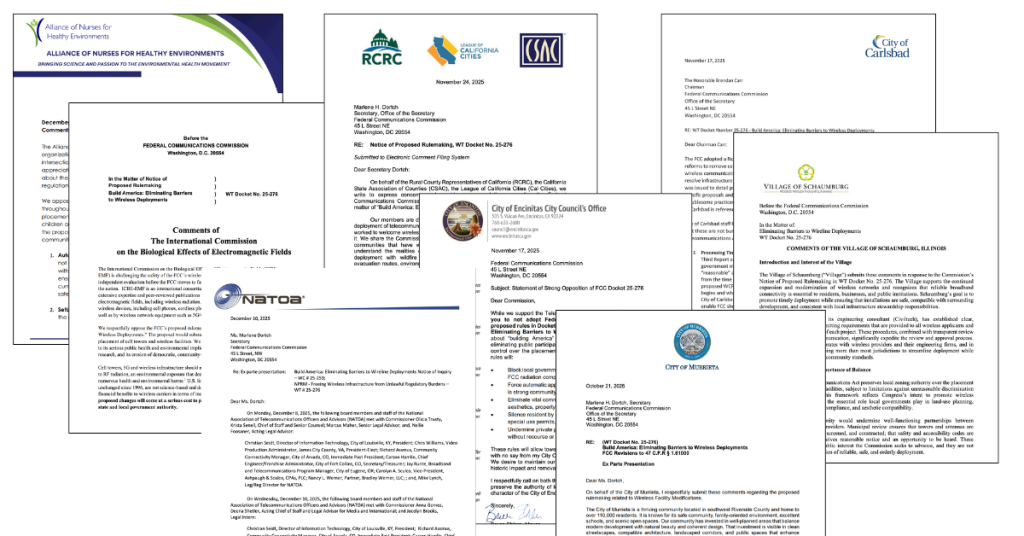
“America’s local government leaders willingly partner with federal agencies, state governments, and broadband providers to close the digital divide in all communities, for all residents. Expanding blanket impositions of one-size-fits-all regulatory overreach into local zoning and planning decisions does not accomplish that goal.”
The United States Conference of Mayors (USCM), the National League of Cities (NLC), the National Association of Counties (NACo) and the National Association of Telecommunications Officers and Advisors (NATOA) REPLY COMMENTS
“The proposals advanced by industry commenters go too far in restricting municipal
authority and fail to account for the real costs and complexities of infrastructure
management. The Commission should adopt a more balanced approach that preserves
essential local prerogatives.”
“We urge the Commission to:
● Preserve local aesthetic and placement authority,
● Recognize local governments are entitled to compensation which reflects the
full costs of wireless deployment, not an arbitrary national assessment of what
costs “should” be,
● Reject the creation of a “rocket docket,”
● Reject premature preemption of state and local AI regulations, and
● Facilitate industry and local cooperation rather than heavy-handed federal
mandates.”
Note: NLC, NACo, USCM and NATOA also filed Joint Comments on the FCC proceeding, Notice of Inquiry – Build America: Eliminating Barriers to Wireline Deployments, WC Docket No. 25-253 (which pre-empted local control related to wireline infrastructure) stating, “ As representatives of the level of government closest to the people, local leaders have worked hard to collaborate creatively with federal, state, and private sector partners to bring high-speed, affordable broadband and telecommunications services to all communities.
“The Local Government Associations strenuously object to the Commission’s depiction of local permitting as an obstacle to the provision of wireline telecommunications services. The parties suggesting this are seeking to strip local governments of their ability to responsibly manage public assets in the rights-of-way, while still expecting to have access to rights-of-way that are safe, well-planned, and conducive to technology-neutral competition.”
The City of Marietta, GA, and the Marietta Board of Lights and Water wrote to the FCC stating:
“…the proposals in this NPRM would eliminate virtually all meaningful local authority, forcing communities to accept unlimited installations with minimal review, inadequate cost recovery, and no ability to protect community character or public assets.
This represents a dramatic shift in the federal-state-local balance that Congress established.”
“The proposal to implement a “deemed granted” remedy for shot clock violations would eliminate due process and could compromise safety of the public.”
Key Areas of FCC Proposed Federal Preemption for Cell Towers
The FCC is actively asking for public comment on the following sweeping changes:
- Automatically Approve Cell Towers if Shot Clocks Are Missed: Under the proposal, if a local government fails to act within the shot-clock deadline, a tower application could be automatically approved or “deemed granted”—a major shift from current rules, where missing the shot clock deadline only constitutes a “failure to act” and allows the carrier to sue, but does not approve the application. Moving to automatic approvals would dramatically weaken local oversight, public input, and zoning protections
- Redefined aesthetics: The FCC is considering narrowing the meaning of concealment in ways that would significantly restrict communities’ ability to require towers to blend in, and maintain neighborhood character. Aesthetic and visual-impact conditions could no longer be used to regulate tower height, design, or location.
- Limits on Fees: The FCC wants to override and cap local governments current cost-recovery fees that fund safety inspections, notifications, and environmental compliance. This would lead to rushed approvals, impacting the ability for the locality to properly review applications and shift costs to taxpayers.
- Setback Preemption: The FCC refers to setbacks that distance towers from homes or schools as “regulatory impediments,” suggesting they may unlawfully restrict wireless deployment. The FCC then cites several cities that have setbacks but fails to note that many communities also include provisions that allow reduced setbacks when necessary, ensuring deployment is not hindered.
- Prohibit new conditions on permit renewals: The FCC proposes rules that would bar local governments from adding any new conditions when renewing permits for existing cell towers. This could prevent cities from updating and modernizing their standards or addressing new community concerns.
- No independent RF testing requirements: The FCC points to some cities’ requirements for RF radiation testing, asking if the requirement should be preempted, that the company test facilities regularly or pay for regular testing. This would remove a key safety assurance tool and leave communities to pay for the testing themselves.
- Declare that blocking upgrades or densification is an effective prohibition: The FCC would treat any local action that slows network upgrades as an “effective prohibition of service,” overriding zoning even when no coverage gap exists. This would be a massive shift, because carriers have historically been required to prove an actual gap in coverage before overriding local zoning.
- Pre-empt state and local authority regarding AI: In the Notice, the FCC explicitly asks about overriding state and local level AI regulations, and whether local rules ‘prohibit or have the effect of prohibiting wireless services and providers’ ability to use AI tools.
- “Rocket Docket” Fast-Track Preemption: The FCC is considering creating an accelerated “rocket docket” process to resolve cell tower siting disputes under Section 253 of the Telecommunications Act, which prohibits state or local laws that “prohibit or effectively prohibit” telecommunications service. The FCC is asking whether it should adopt a rapid preemption process—and what that process should look like—because no specifics were provided in the FCC NPRM. Such a system would likely move disputes from the courts to the FCC, giving the agency a new fast-track mechanism to override local zoning decisions.
U.S. and International Scientists Warn FCC Against Fast-Tracking Cell Towers
The International Commission on the Biological Effects of Electromagnetic Fields (ICBE-EMF), an international consortium of physicians and scientists, has formally cautioned the FCC in its comments that cell towers, 5G and wireless infrastructure should not be fast-tracked as this will increase public exposure to RF radiation, an environmental exposure that decades of scientific research has associated with numerous health and environmental impacts. The ICBE-EMF also wrote U.S. Senators ahead of the December 17 Senate Committee on Commerce, Science, and Transportation FCC oversight hearing, urging them to question the FCC’s continued reliance on outdated cell tower and wireless radiation limits and its failure to ensure adequate oversight, transparency, and enforcement.
The ICBE-EMF letter states, “the FCC’s exposure limits, unchanged since 1996, are not science-based and do not protect the public. They ignore decades of peer-reviewed research showing biological harm at levels far below those that cause heating.”
Where can I find the proposal?
“Build America: Eliminating Barriers to Wireless Deployments” is published in full in WT Docket No. 25-276 with a shorter, condensed version in the Federal Register.