
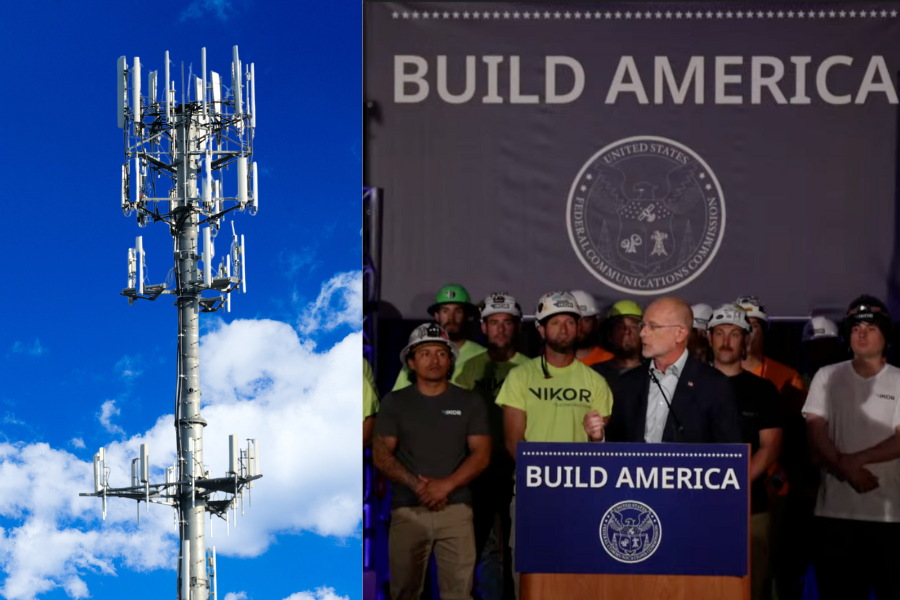
The Federal Communications Commission has just published a sweeping new rulemaking in the Federal Register – WT Docket No. 25-276 – proposing rules that would pre-empt state and local authority over the siting, permitting, and regulation of cell towers and wireless infrastructure nationwide.
The FCC’s Notice of Proposed Rulemaking (NPRM) is entitled Build America: Eliminating Barriers to Wireless Deployments. If adopted, these changes would shift significant power away from local governments to the federal government, dramatically reducing community input, zoning protections, and the ability of cities, counties, and residents to shape where and how wireless facilities are deployed.
Where can I find the proposal?
“Build America: Eliminating Barriers to Wireless Deployments” is published in full in WT Docket No. 25-276 with a shorter, condensed version in the Federal Register.
Hundreds have already filed in opposition to the FCC proposal
Although the NPRM was just published in the register, hundreds of people have filed in opposition, including several local governments. The City of Marietta, GA, and the Marietta Board of Lights and Water wrote to the FCC, stating:
“…the proposals in this NPRM would eliminate virtually all meaningful local authority, forcing communities to accept unlimited installations with minimal review, inadequate cost recovery, and no ability to protect community character or public assets.”
“This represents a dramatic shift in the federal-state-local balance that Congress established.”
“The proposal to implement a ‘deemed granted’ remedy for shot clock violations would eliminate due process and could compromise safety of the public.”
What is the timeline for comments?
Comments are due December 31, 2025. Reply Comments are due January 15, 2026. We urge everyone to submit individual comments to the FCC. Thousands of comments need to be on the record.
Key Areas of FCC Proposed Federal Preemption for Cell Towers
The FCC is actively asking for public comment on the following sweeping changes:
- Automatically Approve Cell Towers if Shot Clocks Are Missed: Under the proposal, if a local government fails to act within the shot-clock deadline, a tower application could be automatically approved or “deemed granted”—a major shift from current rules, where missing the shot clock deadline only constitutes a “failure to act” and allows the carrier to sue, but does not approve the application. Moving to automatic approvals would dramatically weaken local oversight, public input, and zoning protections
- Redefined aesthetics: The FCC is considering narrowing the meaning of concealment in ways that would significantly restrict communities’ ability to require towers to blend in, and maintain neighborhood character. Aesthetic and visual-impact conditions could no longer be used to regulate tower height, design, or location.
- Limits on Fees: The FCC wants to override and cap local governments current cost-recovery fees that fund safety inspections, notifications, and environmental compliance. This would lead to rushed approvals, impacting the ability for the locality to properly review applications and shift costs to taxpayers.
- Setback Preemption: The FCC refers to setbacks that distance towers from homes or schools as “regulatory impediments,” suggesting they may unlawfully restrict wireless deployment. The FCC then cites several cities that have setbacks but fails to note that many communities also include provisions that allow reduced setbacks when necessary, ensuring deployment is not hindered.
- Prohibit new conditions on permit renewals: The FCC proposes rules that would bar local governments from adding any new conditions when renewing permits for existing cell towers. This could prevent cities from updating and modernizing their standards or addressing new community concerns.
- No requirements or monies for independent RF testing: The FCC points to community requirements that companies pay for RF radiation testing of their RF radiation emitting towers or wireless antennas, asking if the requirement be preempted -removing a key safety assurance tool and leaving communities dependent solely on carrier self-reporting.
- Declare that blocking upgrades or densification is an effective prohibition: The FCC would treat any local action that slows network upgrades as an “effective prohibition of service,” overriding zoning even when no coverage gap exists. This would be a massive shift, because carriers have historically been required to prove an actual gap in coverage before overriding local zoning.
- Pre-empt state and local authority regarding AI: In the Notice, the FCC explicitly asks about overriding state and local level AI regulations, and whether local rules ‘prohibit or have the effect of prohibiting wireless services and providers’ ability to use AI tools.
- “Rocket Docket” Fast-Track Preemption: The FCC is considering creating an accelerated “rocket docket” process to resolve cell tower siting disputes under Section 253 of the Telecommunications Act, which prohibits state or local laws that “prohibit or effectively prohibit” telecommunications service. The FCC is asking whether it should adopt a rapid preemption process—and what that process should look like—because no specifics were provided in the FCC NPRM. Such a system would likely move disputes from the courts to the FCC, giving the agency a new fast-track mechanism to override local zoning decisions
What Can You Do?
Send a letter to your local officials requesting they send a letter to the FCC.
Statement by Theodora Scarato, Director of the Wireless and EMF Program at Environmental Health Sciences
“The FCC is proposing sweeping new rules that would fast-track cell towers into neighborhoods across the country, and they plan to do it by stripping away local control. Cities, counties, and states would lose much of their ability to ensure community driven protections like setbacks, aesthetic standards, environmental safeguards, and historic-preservation rules.
This is an unprecedented federal power grab. If these rules advance,cell towers could be automatically approved near homes and schools, even when residents, parents, and local officials overwhelmingly object. Local democracy is not a barrier to deployment, it is the foundation of accountable government. Community voices should never be treated as obstacles to be removed.
The FCC is even asking whether it should preempt state and local regulations on artificial intelligence, essentially claiming the authority to override AI rules that might affect wireless companies’ ability to use AI tools. That is far outside the agency’s traditional scope and raises enormous questions about accountability and public safety.
The proposal also seeks to narrow the definition of aesthetics, override zoning laws, cap local fees, and block communities from requiring independent radiation testing. This is an industry-driven wish list, one the wireless lobby has been pushing for years. It amounts to a corporate takeover of public spaces, giving telecom companies the power to decide what gets built, where it gets built, and who must live with the consequences.
People deserve a voice. Cell towers can reduce property values, increase fire risks, create liabilities, contain hazardous materials, and emit radiation that hundreds of scientists say is not safe. The United States hasn’t updated its radio-frequency radiation limits since 1996. Although a federal court ordered the FCC to explain how those cell tower radiation limits protect children from long-term health effects, the agency has yet to respond.
Children and families should not be treated as collateral damage in the race to fast-track cell towers. Communities are not opposed to technology, they simply want safe cell tower siting, modern health protections, transparent cell tower radiation monitoring, and the right to participate in decisions that affect their lives. We need science-based protections, oversight, accountability, and transparency, not industry-driven federal preemption.”
Take Action Now

Submit comments to the FCC
Our action tool prints your letter to properly submit it to the FCC record.
Read What Local Governments Are Saying
Below are excerpts from formal comments submitted to the FCC by state associations, cities, and public-interest groups.
“Unrealistic timelines, therefore, threaten to silence the very people who must live with the consequences…If applications are rushed through or “deemed granted” without adequate review, the responsibility for any resulting harm rests not with the applicant, but with the local authority left to deal with the aftermath.”
Village of Schaumburg, Illinois
“Local judgment and engineering review are indispensable to safe deployment.”
“Design standards protect visual quality, infrastructure function, and neighborhood character
The NPRM’s suggestion of applying the small-cell timelines and fee caps from the 2018 order to macro towers overlooks the substantial differences in engineering, safety, and environmental considerations between these facility types. Macro installations often require structural analysis, RF compliance review, fall-zone evaluation, FAA lighting review, and public hearings. Imposing uniform national shot clocks or “deemed granted” outcomes would be inconsistent with the level of scrutiny these facilities require.”
“Local governments have systems in place to ensure that businesses operate safely and meet public health standards, protecting residents and limiting liability since cities are often held responsible when harm occurs. These safeguards strengthen community trust and keep neighborhoods safe. Weakening local control would allow companies to prioritize cost savings over compliance, increasing the risk of property damage, injuries, and lawsuits while shifting the financial burden of negligence onto local governments and taxpayers. It would also reduce residents’ ability to raise concerns directly, ultimately driving up costs, delaying solutions, and eroding community trust and safety.”
The Surveillance Technology Oversight Project
“FCC should not preempt state and municipal AI regulations, because such regulations are critical to the safe and accountable development of AI. The FCC does not have authority under the Communications Act to preempt state and local AI regulations.
Even if the FCC had authority to preempt certain state and local AI regulations under Section 253(a) of the Communications Act, states would still be permitted to enact such regulations under the public safety and consumer protection exceptions in Section 253(b) of that same Act.“
“These rules will allow towers to be placed literally anywhere in Encinitas, with no say from my City Council nor our residents. This is unacceptable. We desire to maintain our control over their locations, aesthetic impact, historic impact and removal when no longer in use.”
Below is an example of earlier comments by local governments regarding the need for the FCC to address its outdated RF radiation limits
“The intense level of attention in the docket to regulation of RF emissions exposure is explained in large measure by the fact that some thirty-five years after adoption by the Commission—in the early days of wireless network deployments—the existing RF guidelines do little to quell public concerns about the safety in today’s world of ubiquitous wireless devices and antennas. The same level of intensity often finds its way to local hearings or meetings that last long into the evening or early hours of the morning, despite the prohibition on local officials’ consideration of the health and environmental effects of RF emission exposure as long as proposed facilities meet existing FCC guidelines. The Commission should heed the public’s call to institute proceedings to update its current RF guidelines.”
FCC 25276