
Internal documents released in 2023 found that the Federal Communications Commission (FCC) found some cell phones exceed the FCC’s own cell phone radiofrequency (RF) radiation limits when tested as if they were carried close to the body. The agency’s laboratory tests used a 2 mm distance position—similar to a phone in a pocket—measured RF radiation levels above federal limits, yet the findings were never disclosed to the public.
The FOIA documents reveal that the FCC had secretly tested several Apple, Samsung, Blu, and Motorola smartphone models for RF radiation exposure levels after the Chicago Tribune released an investigative report finding high radiation.
The FCC witheld tests results from the public
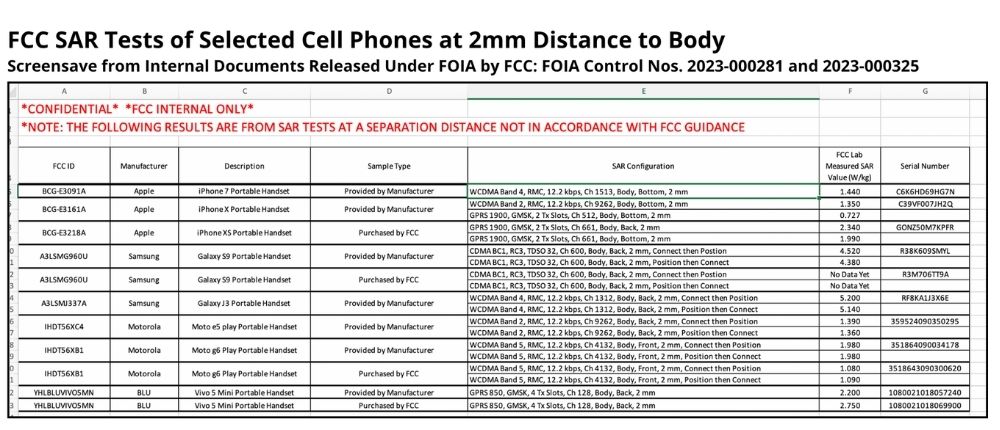
The FCC found that most of the phone models they tested in the pocket (2 mm) position exceeded the FCC’s cell phone radiation SAR limits. SAR is a measure of the rate of RF radiation absorption into tissue. However, the FCC labeled the cell phone radiation SAR findings in a spreadsheet as “confidential” and did not publicly share the results. The FCC even omitted its findings in numerous court proceedings that centered on the issue of RF radiation exposure to people when a phone is in the pocket or very close to the body.
Here is the FCC spreadsheet released to Theodora Scarato.
The FCC launched cell phone tests after the Chicago Tribune found high radiation
The FCC’s 2019 cell phone in the pocket radiation tests were conducted in response to an August 21, 2019, Chicago Tribune investigation that reported phones tested in close body contact (2 mm) exceeded FCC’s radiation limits several-fold. After the Chicago Tribune report was published, the FCC then tested the same cell phone models that the Tribune had tested in two usage positions:
1. As if the cell phone were in the pocket position (2 mm)
2. With the larger distance of 5, 10 or 15 mm, chosen by the cell phone company for premarket compliance.
The internal documents reveal that the FCC’s own tests found the 2 mm tests (as if the phone were in a tight pants pocket) violated FCC limits, whereas the FCC tests using larger distances (5 to 15mm) were compliant. Manufacturers have long been able to choose a separation distance for their SAR RF radiation tests as they are not required to test phones in body contact positions.
The FCC issued a report saying their cell phone radiation tests found no problem
The FCC then issued a December 19, 2019, report concluding that the FCC’s cell phone tests complied with all U.S. government regulations. However, the FCC report only shared the 5 to 15 mm test data, and omitted the FCC’s findings of cell phone SAR radiation levels that exceeded the limit, when tested in 2 mm pocket conditions.
The Chicago Tribune was sent the FCC’s report (which omitted the FCC’s 2mm cell phone test findings) and then the paper then ran a follow up article on December 20, 2019 stating that the FCC found “no evidence of violations of any FCC rules” for the safety limit.”
The Tribune story in 2019 ended by stating “the FCC’s recent study did not test phones at 2 mm distance” even though the FCC, had in fact, tested cell phones at 2mm distance. As far as we are aware, the FCC did not contact the Chicago Tribune to correct this statement, nor to send the 2mm test findings.
However, as the FCC’s letter to Theodora Scarato in 2023 states: “We observed that at a 2 mm separation distance, the FCC radiofrequency (RF) exposure limits were exceeded”. The FCC cell phone test results found cell phone radiation SAR levels as high as 5.2 W/kg -violating the FCC’s limit of 1.6 W/kg by over 3 times.
The FCC argues in its letter to Theodora Scarato that, “…we release our 2 mm separation distance test results with the caveat that the 2 mm separation distance test results are inconsistent with FCC practice, and are misleading because they reflect extreme conditions” and that “the RF exposure limit includes a significant safety margin, none of the results suggest there is any RF safety issue…” Scarato of Environmental Health Sciences counters that “no safety margin for long term exposure exists, because FCC human exposure limits only protect against short term effects,” She pointed to published studies that state FCC limits should be strengthened by over 200 times to protect children.
The FCC withheld the radiation tests from court filings
The FCC also did not include the 2 mm cell phone radiation SAR test findings in their court filings in the Apple v. Cohen case in which plaintiffs alleged that cell phones emitted excessive radiation. The FCC further omitted the 2mm test results in its filings for the Berkeley v. the CTIA case in which the Wireless industry CTIA sued the city of Berkeley for its Cell Phone Right to Know ordinance which informed people that phones could exceed radiation limits if not used with the separation distance.
The FCC also did not include their 2 mm radiation findings in their then open rulemaking on RF human exposure limits- which specifically requested comment on the cell phone SAR test procedures that allow manufacturers to use a separation distance.
The FCC inquiry asked, “Specifically, we seek comment on the feasibility of evaluating portable RF sources without a separation distance when worn on the body to ensure compliance with our limits under present-day usage conditions.”
But instead of transparently sharing the radiation levels, the FCC stated in their December 4, 2019 Human RF Exposure rulemaking that they were opposed to manufacturers premarket testing phones in body contact positions stating “Even though some parties claim that the RF exposure evaluation procedures for phones should require testing with a “zero” spacing – against the body – this is unnecessary.”
The FCC then proceeded to withhold test data from the subsequent federal case, EHT et al v. FCC, United States Court of Appeals for the District of Columbia, Case Nos. 20-1025; 20-1138 despite the fact that the issue of the cellphone test separation distance was central to the case.
The FCC continues to refuse to release cell phone radiation tests, including the Apple iPhone 12
Scarato, who has filed hundreds of FOIAs to U.S. agencies, has more recently filed FOIAs to the FCC on the cell phone tests it did for the Apple iPhone 12 and received several redacted documents. She recently filed an appeal to the FCC for its refusal to share the cell phone radiation test findings from its Apple iPhone 12, as well as an appeal regarding emails with FCC leadership.