
Modern Cars Expose People to EMF
Modern cars expose drivers and passengers to multiple types of electromagnetic fields (EMF), including electric and magnetic fields and wireless radiofrequency (RF) radiation. Hybrid and electric vehicles (EVs) contain high-voltage electrical systems, batteries, inverters, and motors that generate magnetic fields inside the cabin. In addition, many of today’s vehicles – not just EVs – are increasingly equipped with wireless technologies such as Bluetooth, Wi-Fi hotspots, cellular (4G/5G) connectivity, and keyless entry systems, creating multiple sources of EMF radiation within a confined space.
Using a Cell Phone in the Car Can Also Increase Your EMF Exposure
Using a cell phone or other wireless device inside a vehicle can increase RF radiation exposure compared to use outside. The metal frame of the car alters signal behavior, causing radiation to reflect within the enclosed space and increase RF absorption into the body.
Because of this, areas of higher exposure can form inside the cabin, particularly near devices or antennas. When one person uses a cell phone or wireless device in the car, nearby passengers are also exposed. Streaming video on a cell phone or wireless device creates higher intensity exposure than texting.
Research on EMF in Cars
In early 2025, Germany’s federal radiation protection authority, Bundesamt für Strahlenschutz (BfS) published the most comprehensive study on EMF exposure in cars to date, measuring EMF in fourteen vehicles (11 electric, 2 plug-in hybrids, and 1 gasoline vehicle) and finding that magnetic fields are present in all vehicles and vary by model and driving condition.
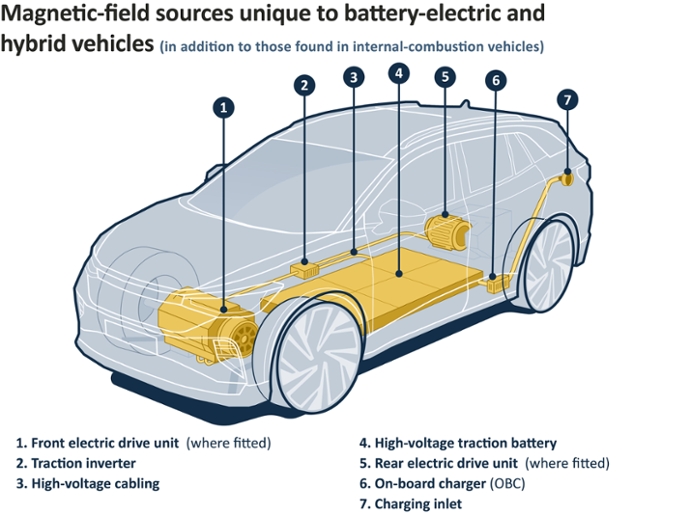
They found that in addition to the drive system, magnetic fields are also generated by other vehicle components,such as heated seats, window winders, or vehicle activation systems. In some cases, this exposure was higher than the fields caused by the propulsion system, with the highest values emitted when the car was started. Fortunately, much of this exposure can be mitigated with design. However, consumers need to put pressure on automakers so that they prioritize low EMF in vehicles.
An independent review by the European Commission concluded that electrified vehicles may show higher magnetic flux density than conventional vehicles under various conditions.
A 2025 measurement study by Fukui et al., 2025, published in Electronics found plug-in hybrids showed the highest measured EMF values among the vehicles tested.
The 2022 article Complex Electromagnetic Issues Associated with the Use of Electric Vehicles in Urban Transportation found that the strongest electromagnetic fields are recorded near direct current (DC) fast-charging installations.
While these studies found that car EMF exposures do not exceed limits set by the International Commission on Non-Ionizing Radiation Protection (ICNIRP), those limits are only designed to protect against short-term impacts and they do not consider the effects of long-term chronic exposure. Solutions exist to mitigate EMF exposures in cars through low-EMF design principles, but companies will only prioritize this with consumer pressure.
How to Reduce EMF Exposure in Cars
- Limit wireless device use inside the car: Avoid using your cell phone while in the vehicle whenever possible—especially for calls or streaming. Turn devices off or switch to airplane mode to reduce RF radiation exposure inside the enclosed cabin.
- Keep devices away from your body: Avoid carrying phones directly on your body (e.g., in pockets or bras) while in the car. Place them farther away from passengers.
- Avoid using devices in low-signal areas: Phones emit higher RF radiation when signal is weak (e.g., rural areas, underground parking, elevators). Limit use in these conditions or switch to airplane mode.
- Do not stream or download content while in the car: Streaming video, music, or large downloads increases RF emissions. Download content before your trip instead.
- Turn off unnecessary wireless features in your vehicle and devices when possible, including Bluetooth, Wi-Fi hotspots, radar-based systems, and other sensors. Even turning off one antenna helps reduce a layer of exposure. For example, if your car has a Wi-Fi hotspot or constant cellular connection, turn it off when not needed to reduce continuous RF exposure inside the cabin.
- Avoid sitting in EVs during charging, especially at fast-charging stations where electromagnetic fields can be higher. Do not remain close to the vehicle during charging.
- Measure EMF levels inside your car using an EMF meter: Electric and hybrid vehicles can produce higher magnetic fields, especially near the battery and floor areas. A magnetic field meter can help identify seating positions with lower exposure. Choose these seats for children, particularly during long or frequent car rides.
- Contact your vehicle manufacturer to raise concerns about EMF exposure and request lower-emission designs.
- Template: Sample Letter to Manufacturers
Dear [Manufacturer Name],
I am writing to request information regarding electromagnetic field (EMF) levels in your vehicles, including both low-frequency magnetic fields and radiofrequency (RF) radiation from onboard systems.
As a consumer, I am concerned about long-term health effects associated with EMF exposure in vehicles. I am writing to request detailed information on EMF measurements inside your vehicles under typical driving and charging conditions, including how these levels vary by seating position. Please include measurements for exposure in the front seat, passenger side, and back seat to the following forms of radiation:
RF Radiation
ELF magnetic fieldsIn addition, I would appreciate information on EMF levels during vehicle charging, particularly at fast-charging stations, as well as any steps taken to mitigate exposure during these conditions.
I also encourage your company to prioritize reducing EMF exposure through improved design. This may include strategies such as optimized component placement, shielding, and low-EMF engineering approaches to mitigate unnecessary exposure to drivers and passengers. Please share what you are doing in this regard.
As awareness of this issue grows, consumers will increasingly value transparency and proactive efforts to minimize EMF exposure in vehicle design. It is time to compete on safety.
Thank you for your time and consideration. I look forward to your response.
More Resources on Cars & EMF
The website CarsRadiation.org publishes information on EMF in cars.
Dr. Joel Moskowitz has a research page on the issue of EMF in cars.
Scientific References
J. S, A. M, P. M, N. D, M. S and S. S N, “Assessment of Electromagnetic Interactions in Electric Vehicle Wireless Charging Systems,” 2025 Fourth International Conference on Smart Technologies and Systems for Next Generation Computing (ICSTSN), Villupuram, India, 2025, pp. 1-6, doi: 10.1109/ICSTSN67075.2025.11397926.
Dong S, Lu M. Assessment of Electromagnetic Exposure Levels for Humans from Electric Vehicle DC Charging Stations. Sensors. 2025; 25(18):5735. https://doi.org/10.3390/s25185735
Fukui H, Minami N, Tanezaki M, Muroya S, Ohkubo C. Magnetic Field Measurement of Various Types of Vehicles, Including Electric Vehicles. Electronics. 2025; 14(15):2936. https://doi.org/10.3390/electronics14152936
Akdoğan, H., Tabatadze, V., Karaçuha, K., & Yaldiz, E. (2021). Several case studies on electric field distributions for two human bodies inside the car at 3.5 GHz–5G frequency band. International Journal of Applied Electromagnetics and Mechanics, 67(4), 507–520.https://doi.org/10.3233/JAE-210035
Clemens, M., Zang, M., Alsayegh, M., & Schmuelling, B. (2018). High Resolution Modeling of Magnetic Field Exposure Scenarios in the Vicinity of Inductive Wireless Power Transfer Systems. 2018 IEEE International Magnetics Conference (INTERMAG), 1–1.https://doi.org/10.1109/INTMAG.2018.8508403
Dhami, A.K., (2015). Studies on Cell-phone Radiation Exposure Inside a Car and Near a Bluetooth Device. Int. J. Environ. Res., 9(3), 977-980.
Dong, X., Sun, W., & Lu, M. (2022). Evaluation of electromagnetic fields in human body exposed to inverter of pure electric vehicle. Radiation Protection Dosimetry, ncac269.https://doi.org/10.1093/rpd/ncac269
Gryz, K., Karpowicz, J., & Zradziński, P. (2022). Complex Electromagnetic Issues Associated with the Use of Electric Vehicles in Urban Transportation. Sensors, 22(5), Article 5.https://doi.org/10.3390/s22051719
Pablo Moreno‐Torres, Marcos Lafoz, Marcos Blanco, & Jaime R. Arribas. (2016). Passenger Exposure to Magnetic Fields in Electric Vehicles. In Mohamed Amine Fakhfakh (Ed.), Modeling and Simulation for Electric Vehicle Applications (p. Ch. 3). IntechOpen.https://doi.org/10.5772/64434
Psenakova, Z., Gombárska, D., & Smetana, M. (2020a). Electromagnetic Field Measurement inside the Car with Modern Embedded Wireless Technologies. 2020 IEEE 21st International Conference on Computational Problems of Electrical Engineering (CPEE), 1–4.https://doi.org/10.1109/CPEE50798.2020.9238731
Psenakova, Z., Gombárska, D., & Smetana, M. (2020b). Electromagnetic Field Measurement inside the Car with Modern Embedded Wireless Technologies. 2020 IEEE 21st International Conference on Computational Problems of Electrical Engineering (CPEE), 1–4.https://doi.org/10.1109/CPEE50798.2020.9238731
Tognola, G., Bonato, M., Benini, M., Aerts, S., Gallucci, S., Chiaramello, E., Fiocchi, S., Parazzini, M., Masini, B. M., Joseph, W., Wiart, J., & Ravazzani, P. (2022). Survey of Exposure to RF Electromagnetic Fields in the Connected Car. IEEE Access, 10, 47764–47781.https://doi.org/10.1109/ACCESS.2022.3170035
Vassilev, A., Ferber, A., Wehrmann, C., Pinaud, O., Schilling, M., & Ruddle, A. R. (2015). Magnetic Field Exposure Assessment in Electric Vehicles. IEEE Transactions on Electromagnetic Compatibility, 57(1), 35–43.https://doi.org/10.1109/TEMC.2014.2359687Winiarz, J. (2022). Comparison of the value of the magnetic component of the electromagnetic field in the cabins of electric and hybrid cars. PRZEGLĄD ELEKTROTECHNICZNY, 1(2), 189–192.https://doi.org/10.15199/48.2022.02.43