
Cell towers do not belong on school properties.
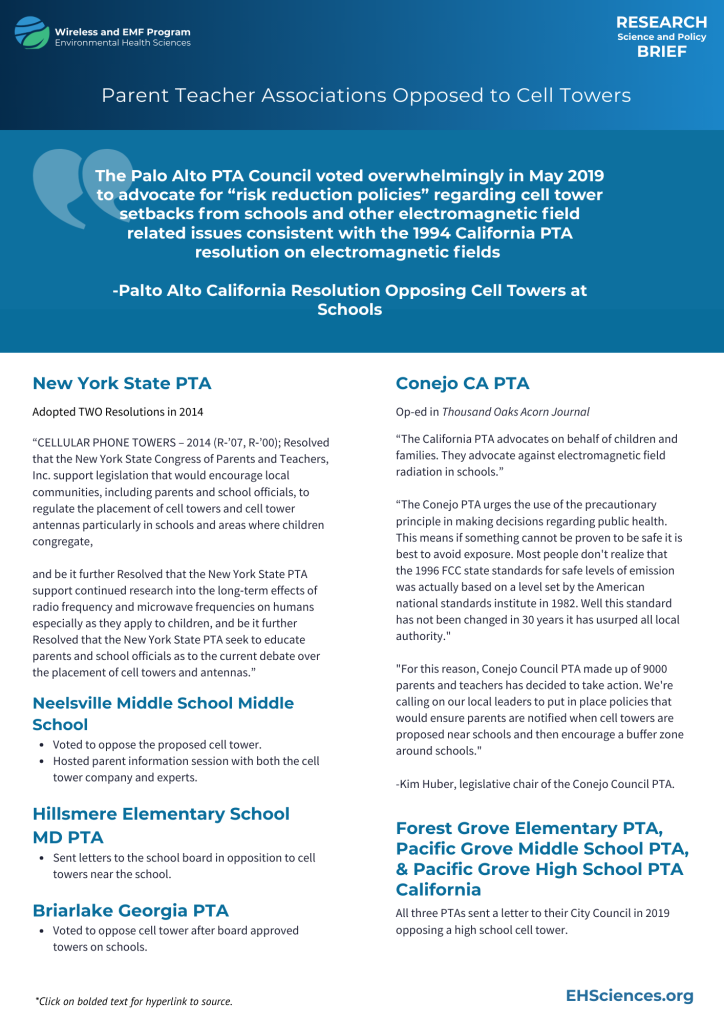
Across the United States — and around the world — school districts and governments have taken action to restrict or prohibit cell towers at schools. From California to Virginia, decision-makers have recognized that schools are places for learning, not commercial industrial infrastructure. Nationwide, parent-teacher organizations have strongly opposed cell towers, and many have successfully stopped towers from being built on school property.
Even if your child’s school does not have a cell tower today, that does not mean one will not be proposed in the future. Telecom companies regularly approach school districts with lease offers, often presenting them as easy revenue opportunities.
Without a clear district policy in place, towers can be approved with limited community awareness. Protecting children starts locally — and it starts with informed parents.
This webpage hosts our toolkit for parents and officials to address cell towers at schools.
Jumplinks:
- Action Steps
- If Your School Already Has a Cell Tower
- Cell Tower Fact Sheets & Briefings
- School Cell Tower Safety Q&A
- What Does Science Say About Cell Towers And Health Effects??
- Additional EHS Cell Tower Resources
Why Focus on School Property?
School districts have a legal and ethical duty to protect student health, safety, and long-term liability exposure. Children are considered more vulnerable to cell tower emissions because studies find they absorb higher levels of cell tower radiofrequency (RF) radiation, and their developing brains are more sensitive. While federal law limits local governments from regulating wireless facilities solely based on RF radiation health concerns, school districts can control what happens on property they own. That includes:
- Refusing to lease land for cell towers
- Declining to renew existing leases
- Requiring independent RF radiation assessments
- Establishing stricter leasing standards
District-level policy action is one of the most effective strategies available to parents.
The best time to act is before a proposal is on the table. Proactive policies protect schools from future installations. Every school district should have a clear policy prohibiting new leases for cell towers.
In order to protect your community, parents can act now.
Here’s how.
Step 1: Get informed
Start by researching your school district. Determine whether the district currently leases land or rooftops for cell towers. You may need to submit a public records request to obtain the list of schools with cell towers. In addition, gather credible information about health, safety, liability, and insurance considerations so you can approach the issue with accurate, well-documented facts. EHS has key resources, briefings, and fact sheets here.
Step 2: Build Informed Community Support
Build a coalition of parents, teachers, and local residents. Stay professional and focused on children’s welfare. You can also host a community meeting, write an op-ed, and hand out resources at your local farmers market.
Many parents start petitions and get the local news to cover their campaign.
Environmental Health Sciences has a letter-writing campaign aimed at educating your state and federal elected officials. Please take a moment for action at this link and share the link in your community.
Step 3: Advocate to Your School Board
Find out the date and time when your school board meets and present your request as a public comment. Prepare a clear testimony explaining the issue, emphasizing the district’s authority over its own property, raising safety, liability, and insurance concerns, formally requesting policy review, and submit written materials for the record while following up with individual board members afterward.
Be clear: Ask for a written policy prohibiting new cell towers on school grounds.
Step 4: Stay Engaged
Follow up with board members and administrators in writing after meetings, and formally request that the issue be placed on the agenda for a vote or resolution. Policy change requires persistence and continued community involvement. While districts must comply with federal law, their hands are not tied when it comes to decisions about leasing their own property — and they need to hear clearly and consistently from parents.
Keep the focus on student welfare and responsible governance.
You can also raise community awareness by drafting a clear, factual press release and sending it to local news outlets. A simple follow-up phone call to the newsroom can significantly increase the likelihood of coverage and help bring public attention to this important issue.
If Your School Already Has a Cell Tower:
If a cell tower already exists on school property, or if your district is not ready to adopt a full prohibition, parents can advocate for stronger oversight and transparency requirements.
Federal regulations require wireless facilities to remain within FCC exposure limits. However, ongoing monitoring is often handled by the carrier, not the school district. The regular monitoring of RF radiation levels on school campuses ensures accountability. Children’s health and safety should never depend on assumptions. Verification matters.
Even if a district is not prepared to ban towers outright, requiring yearly independent compliance reports and annual monitoring is a practical and immediate step toward greater protection and transparency.
Safety Oversight Requirements
Some school districts publicly post detailed information about which schools have cell towers and the results of RF radiation compliance reports. However, many do not. In those cases, parents often must work extensively to access lease terms, RF compliance reports, and monitoring data.
Establishing formal monitoring and disclosure requirements helps ensure accountability, informed decision-making, and ongoing verification.
At minimum, districts should adopt a formal policy requiring:
- Independent RF radiation real-world pre-activation and post-deployment testing
- Annual third-party RF radiation compliance reports
- Radiation testing after any equipment upgrades or antenna modifications
- Public posting of all compliance reports on the district website
Immediate notification to parents if exposure levels change
You may also request:
- Clear setback standards requiring a minimum distance from classrooms, playgrounds, and athletic fields
Transparency Requirements
School districts should publicly disclose all wireless infrastructure located on school property in a clear, dedicated section of their website. Transparency builds trust, strengthens accountability, and ensures parents and community members remain fully informed.
The school district website should include:
- A complete list of all cell towers and rooftop- or building-mounted antennas on school property, and date of school board vote.
- All carriers and leases with start dates and expiration dates
- A summary of any equipment modifications made since installation
- All RF compliance reports, including:
- Pre-activation testing results
- Post-installation verification reports
- Annual RF radiation monitoring reports (for all years the tower has operated)
- A clear description of the approval process used to place towers on school property, including alll steps from a school being approached to deployment:
- Community input opportunities (PTA, neighborhood etc)
- Public notice requirements
- Board review procedures
- Permits needed and other agencies or deprartments involved.
Providing publicly accessible links to RF radiation compliance reports for all operational years ensures long-term transparency, allows independent review, and demonstrates responsible oversight of infrastructure located on school campuses.
Top Resources
Click here to send a letter to your school board:
- Template: Letter to School Board Requesting Policy on Cell Towers
Template: Letter to School Board Requesting Policy on Cell Towers
Dear Members of the School Board,
I am writing to formally request that the Board adopt a comprehensive policy addressing cell towers and wireless antenna facilities on school property.
Schools are places for learning, safety, and child development , not commercial industrial infrastructure sites. Across the United States and internationally, school districts have restricted, declined, or prohibited cell towers on school grounds after reviewing health, safety, liability, financial, and governance concerns. Proactive policy action protects both students and the district.
The district maintains full authority over whether it leases or permits telecommunications infrastructure on property it owns. Your hands are not tied regarding district-owned land.
Accordingly, I respectfully request that the Board take the following actions:
- Prohibit New Installations
Adopt a written district-wide policy prohibiting new cell towers, rooftop antennas, and wireless base station facilities on school property. - Non-Renewal of Existing Leases
Decline renewal of existing tower leases upon expiration and avoid entering into master lease agreements that market multiple schools as potential tower sites. - Independent RF Monitoring and Verification
For any existing facilities, require:
- Independent, third-party real-world RF radiation testing prior to activation
- Post-deployment verification testing
- Annual third-party RF radiation compliance reports
- Additional testing after any equipment upgrades, antenna changes, power increases, or technology modifications
- Immediate written notification to parents and staff if exposure levels change
Ongoing monitoring should not rely solely on carrier-submitted reports.
- Full Public Transparency
Establish a dedicated section of the district website that includes:
- A complete list of all schools with cell towers or rooftop antennas
- Date of original board approval and vote
- All carriers operating at each site
- Lease start and expiration dates
- Copies of lease agreements
- Summary of equipment modifications since installation
- All RF compliance reports, including pre-activation, post-installation, and annual reports for every operational year
- Description of the full approval process, including public notice requirements, PTA and neighborhood input opportunities, board review procedures, permits required, and agencies involved
Transparency builds trust and ensures informed community participation.
- Setback and Siting Standards
Adopt clear setback standards from classrooms, playgrounds, athletic fields, and areas where children spend extended periods of time. - Liability and Insurance Review
Conduct a formal review of:
- Insurance exclusions related to RF radiation and electromagnetic fields
- Indemnification clauses in existing leases
- Long-term liability exposure
- Financial cost-benefit analysis including administrative time, legal review, compliance oversight, and potential litigation risk
Major insurers classify RF-related exposure as a high-risk liability and frequently exclude coverage. Telecom companies themselves disclose RF-related legal risks in shareholder filings.
- Public Governance Safeguards
Require:
- Formal board vote for any future telecommunications agreement
- Advance public notice and hearing
- Periodic board review of any active lease agreements
- Disclosure of any master lease agreements that bind future boards
Long-term leases of 30+ years can restrict future school boards, complicate renovations and expansion projects, and limit district flexibility.
School-based towers present numerous operational and safety risks, including fire hazards, hazardous material storage (diesel backup systems and batteries), herbicide and chemical spraying, structural fall zones, property value impacts, and more.
Scientific research on RF radiation is ongoing. Numerous peer-reviewed studies report biological effects at levels below current 1996 FCC limits. The World Health Organization’s International Agency for Research on Cancer classifies RF radiation as a Group 2B possible carcinogen. Many scientific reviews recommend precautionary setbacks of approximately 500 meters (1,500 feet) from homes and schools. Given the evolving science and the age of current federal limits, precaution and transparency are reasonable governance measures.
This request is grounded in student safety, responsible stewardship of public property, fiscal prudence, and long-term risk management.
I respectfully request that this matter be placed on an upcoming Board agenda for formal discussion and action. I also request written confirmation of the district’s current policies, existing leases, monitoring procedures, and insurance coverage related to telecommunications facilities.
Please see key research studies here.
Thank you for your service and your commitment to protecting students and maintaining public trust.
Sincerely,
- Prohibit New Installations
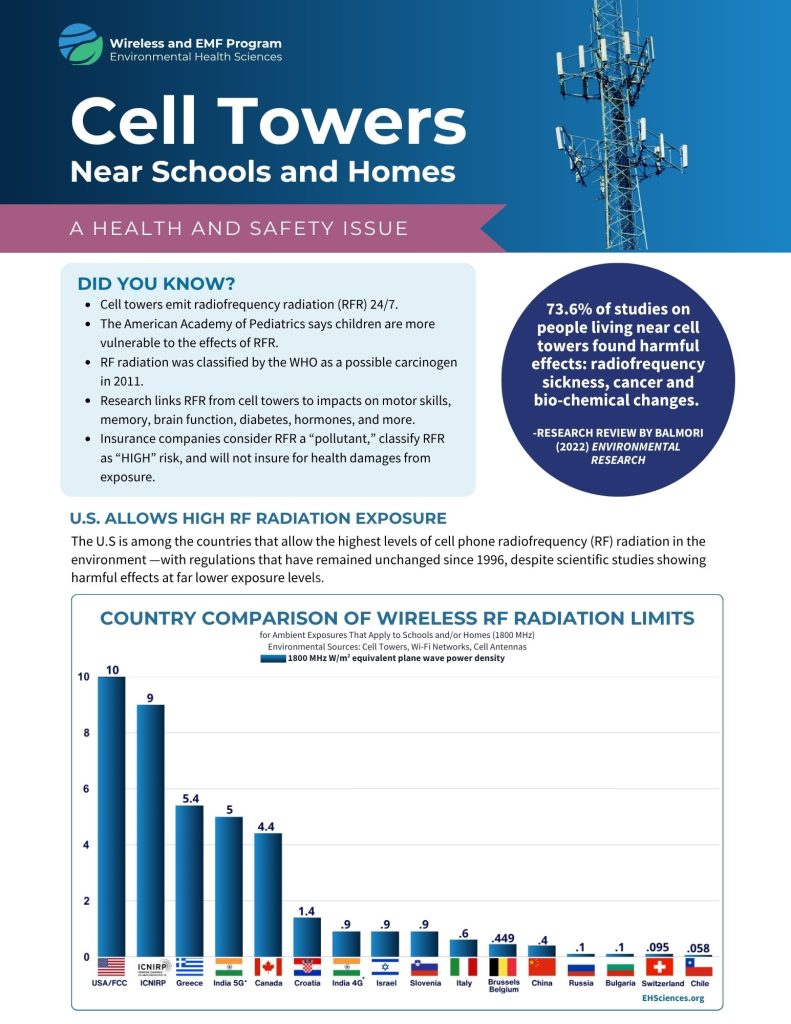
Fact Sheets and Briefings on Cell Tower Health and Safety Issues
Note: These can be emailed and placed on the official record of school boards because they include hyperlinks to scientific studies.

School Cell Tower Safety Q & A
What health and safety risks are associated with cell towers on school property?
Beyond RF radiation exposure, school-based cell towers present multiple operational, safety, financial, and liability risks.
These risks include:
- Fire Risk: Equipment can overheat and battery systems can ignite vegetation or structures.
- Hazardous Materials: Diesel backup generators, fuel storage, and lead-acid batteries are classified as HAZMAT risks.
- Herbicide and Chemical Use: Cell tower companies routinely spray toxic herbicides and fire-retardant chemicals around tower bases to control vegetation and reduce fire risk.
- Fall Zone Hazard: Risk from structural collapse, falling equipment, or ice shedding.
- Property Value Impact: Studies document 4–20% reductions in nearby home values.
- Transparency Issues: Limited notice and public participation in decision-making.
- Increased RF Exposure: Elevated exposure levels in close proximity to antennas.
- Insurance Gaps: RF radiation is commonly excluded from general liability policies.
- Insurance Risk Classification: Major insurers classify RF radiation from cell towers as a high-risk liability—comparable to asbestos and lead—and commonly exclude EMF-related damages from coverage.
- Shareholder Risk Warnings: Telecommunications companies warn investors that RF-related lawsuits and regulatory changes could materially harm their business.
- Long-Term Lease Lock-In: 30+ year agreements limiting future school board authority.
- Development Conflicts: Towers interfering with renovations or expansion projects.
- Environmental Justice Concerns: Disproportionate siting in lower-income and minority communities.
READ MORE ABOUT THE SAFETY ISSUES OF CELL TOWERS
What does science say about cell towers and health effects?
A substantial body of peer-reviewed studies reports biological effects at exposure levels below current FCC, IEEE and ICNIRP limits. Reviews of populations living within 500 meters of base stations have documented increased reports of headaches, sleep disruption, neurological symptoms, oxidative stress, and in some studies, higher cancer incidence.
The World Health Organization’s International Agency for Research on Cancer (IARC) classified RF radiation as a Group 2B “possible carcinogen.” Numerous scientific reviews recommend commonsense setbacks of 500 meters (approximately 1,500 feet) from homes and schools.
Which schools have passed policies restricting cell towers?
Numerous countries prohibit cell towers on school grounds. In the U.S., many school districts have adopted bans, restrictions, or non-renewal policies. Examples include Los Angeles Unified (CA), Palo Alto Unified (CA), Temecula Valley Unified (CA), and Loudoun County School Board (VA). Dozens of cities have ordinances to distance cell towers away from school property.
Have any school districts declined from renewing contracts of existing cell towers?
- The Sutherland Elementary School Local School Council in Illinois unanimously voted against renewing two contracts for cellular equipment installed on a smokestack at the school.
- The San Jose Diocese halted new contracts with telecommunications companies for schools and churches.
- Prince George’s County Maryland Board of Education decided not to renew a cell tower master leasing agreement that had allowed over 60 schools to be marketed as cell tower sites. They were joined in opposition by local governments such as the Greenbelt City Council.
- In December of 2019, Roanoke County School Board terminated a master leasing agreement they had signed with Milestone Communications in 2016 that allowed their schools to be marketed as cell tower sites. They also reversed their decision to move forward with 100 foot cell towers at a high school and middle school that they had unanimously voted to pursue just a few months earlier.
Have communities moved to stop cell towers near schools?
- Numerous communities have local laws to ensure cell towers are distanced from schools with setbacks from 250 to 3,000 feet.
- Douglas School Board denied a Verizon cell tower on Douglas High property.
- Fauquier County School Board shot down a proposal for a cell tower at Liberty High School, despite an existing partnership with cell tower school developer Milestone Communications.
- A proposal to install a 75-foot telecommunications tower on the campus of St. John’s College was rejected.
- The School Board committee rejected a cell tower at Claude Thompson Elementary.
- The Hunter Mill District Land Use Committee (Virginia) voted 3-2 to deny an application to build a cellphone tower on Crossfield Elementary School (an affluent area) after widespread opposition.
Have cell towers ever been removed after community opposition?
- The Newport School Committee, Rhode Island voted to remove the cell tower at Rogers High School after long standing community concerns.
- Two towers adjoining Valentine Elementary and Huntington Middle schools, and at San Marino High School were relocated.
- In Montgomery County Maryland, a longtime cell tower at Woodward High School cell tower ended up nixed during renovations amidst strong community opposition which prompted the Board to decline from authorizing any type of relocation of the tower.
- A cell tower was removed in Tarrytown, New York after residents protested placement near a public housing complex and playground.
- 5G poles erected in Point Pleasant Beach are coming down after they did not match the agreement.
- In Dewey Beach, Delaware Verizon agreed to relocate beachfront cell towers after residents filed a lawsuit and founded the Save Dewey Beach Foundation.
- A cell tower was removed from a Ripon, California elementary school after four students and three teachers were diagnosed with different forms of cancer.
- In Long Beach California, a couple halted a 5G site built in front of their home after numerous appeals.
- The Lakeway City Council withdrew its application to build a cell tower on city property near an elementary school after several residents expressed concerns.
Have communities denied poorly sited cell towers?
- The Village of Flower Hill, New York denied the installation of 18 “small cell” 4G wireless antennas in public rights-of-way and then won a federal lawsuit after the company sued the village.
- Numerous 5G towers have been paused in New York City due to issues surrounding proper federal reviews and 16 community boards issued opposition and moratoriums.
- Lawton City Council, Oklahoma approved a motion to revoke a permit for a U.S. Cellular cell tower after the deployment of wireless facilities sparked multiple complaints from the community
- A cell tower network along a bike path in the wealthy La Jolla California neighborhood was halted after the community protested and brought in experts to present on health effects.
- Folsom City, California officials agreed to move the location of a cell tower which was initially proposed near homes after “a mobilized army of neighborhood opposition.”