
Data centers require massive electrical infrastructure to operate. This means new high-voltage powerlines and substations, industrial facilities built close to homes and schools, that will increase electromagnetic field (EMF) exposure to people. Research links this type of EMF exposure to childhood leukemia and other serious health and environmental impacts. However, the U.S. government lacks safety regulations to protect against health effects from chronic exposure to the EMFs from power lines and electrical infrastructure.
Risk mitigation, measurements, and full transparency are needed.
What kind of EMF radiation exposures do data centers and their powerlines create?
The electronic components within data centers, including power distribution systems, servers, cooling systems, and networking equipment, generate non-ionizing electromagnetic fields (EMFs) as a part of normal operation. In addition, large data centers require extensive electrical infrastructure build-outs, including high-capacity substations, transformers, switchgear, and transmission corridors (new powerlines). The new and expanded electrical transmission towers and power lines often cut through neighborhoods, parks, and conserved land.
Thus, as data center energy demand grows, so does the scale of the surrounding electrical infrastructure, increasing community exposure to EMFs.
Data centers can therefore increase environmental levels of EMFs through both external electrical infrastructure and internal operational equipment. The types of EMF include:
- Extremely Low Frequency (ELF) Magnetic and Electric Fields: Generated by transmission lines (powerlines), transformers, and electrical distribution systems supplying the data center.
- Power Quality Distortion, Harmonics, and High-Frequency Voltage Transients, (AKA Electromagnetic Interference and Dirty Electricity): from large electrical loads, switching power supplies, power inverters, variable frequency drives (VFDs), cooling systems, and high-frequency power conversion equipment.
- Radiofrequency (RF): by wireless communication systems, networking equipment, and telecommunications/cellular infrastructure supporting data center operations.
While the specific health effects of electromagnetic fields (EMFs) from data centers specifically have not been extensively studied due to the relative novelty of this infrastructure, the broader health impacts of non-ionizing EMF exposure have been researched for decades. Non-ionizing EMFs have been linked by credible, peer-reviewed published scientific studies to childhood leukemia, central nervous system tumors, brain cancer, breast cancer, Alzheimer’s disease, cognitive dysfunction, miscarriage, ADHD, obesity, asthma, oxidative stress, free radical formation, and DNA damage. Hundreds of scientists have called for risk mitigation measures to reduce public exposure to non-ionizing EMFs.
As data centers expand and require significant electrical grid build-out, public exposure to these EMFs must be carefully evaluated and appropriately mitigated.
Does Power Line Non-Ionizing EMF Impact Health? What the Science Says
Several decades of scientific research have examined health effects associated with long-term exposure to elevated ELF-EMF magnetic fields and the majority has found effects. Peer-reviewed studies have reported cancer, miscarriage, and increased Alzheimer’s. Epidemiological studies have consistently found associations between chronic residential exposure to power line magnetic field EMFs and an increased risk of childhood leukemia.
However, industry and international guidelines for ELF EMF primarily address short-term, acute effects (such as nerve stimulation), and are set far above the exposure levels associated with childhood cancer in long-term epidemiological studies. In 2001, the WHO’s International Agency for Research on Cancer (IARC) determined that ELF-EMF magnetic fields are “possibly carcinogenic” to humans, prompting several countries to implement policies to reduce children’s exposure.
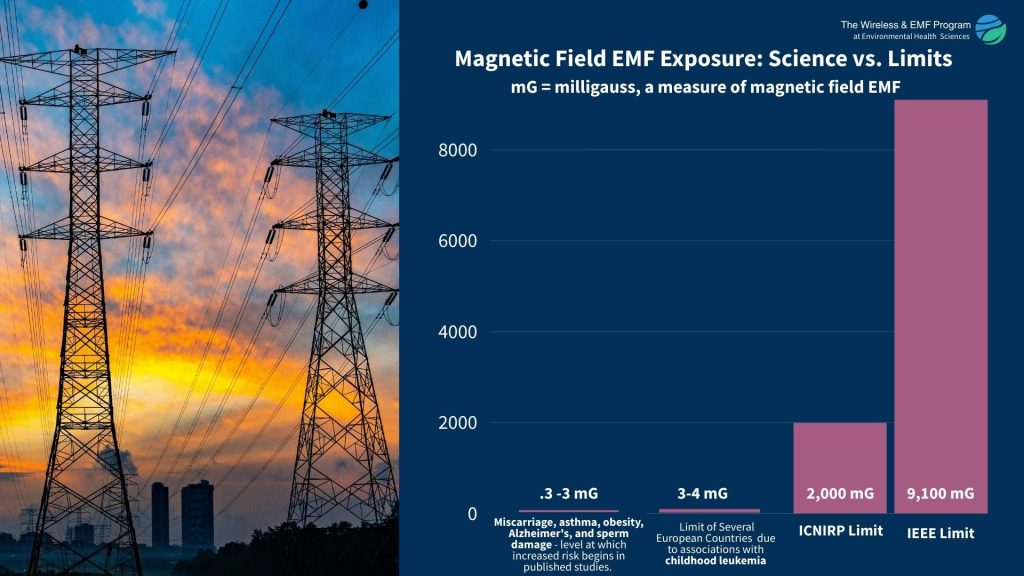
Although the U.S. does not have federal safety limits for ELF exposure, the often cited International Commission on Non-Ionizing Radiation Protection (ICNIRP) and Institute of Electrical and Electronics Engineers (IEEE) exposure limits for ELF fields for 60 Hz fields are 2,000–9,000 milligauss. . However, the levels where epidemiologic studies have reported associations with childhood leukemia are 3–4 milligauss, thousands of times lower than these limits. People living in homes very close to powerlines can be exposed to 3-4 milligauss due to proximity to the electrical transmission equipment and it is perfectly legal. No laws have been broken, because no federal laws exist.
As transmission corridors with powerlines expand and electrical loads intensify near residential areas and schools, measures to mitigate EMF exposure due to the health risks should be a part of the broader public health discussion.
Data Centers and Power Quality: Understanding the Impact of Harmonics
A Bloomberg report documented more than three-quarters of highly distorted power readings in the U.S. occur within 50 miles of large data center activity, showing a strong link between proximity to data centers and worsening harmonics. More than half of the households experiencing the worst distortions were located within 20 miles of significant data center activity. (AI Needs So Much Power, It’s Making Yours Worse– Bloomberg; AI data centers causing “distortions” in US power grid – Data Center Dynamics).
This issue is in need of increased accountability and ongoing research as current regulations are woefully inadequate. While industry would argue that it is subject to regulations, pointing to IEEE 519 Standard (Recommended Practice and Requirements for Harmonic Control in Electric Power Systems) which states that Total Voltage Harmonic Distortion (VTHD) should not exceed 5.0%, and individual voltage harmonics should not exceed 3.0% at the Point of Common Coupling (PCC), these these standards are not consistently monitored, enforced, or independently verified in practice in neighborhoods surrounding data centers. Moreover, compliance measurements are limited in scope. Standard industry measurement tools do not capture the full spectrum of harmonic distortion and radiated emissions associated with high-load facilities such as data centers, as supraharmonics (2–150 kHz) are rarely measured.
Examples of Peer Reviewed Studies on EMF Exposure That Have Reported Increased Cancer and Other Health Effects
- A 2022 systematic review by Brabant et al. in Reviews on Environmental Health found that long-term exposure to ELF EMF magnetic fields above 0.4 µT (4 milligauss) was associated with increased risk of childhood leukemia, particularly acute lymphoblastic leukemia.
- A 2021 meta-analysis of 33 studies concluded a significant association between powerline ELF exposure and childhood leukemia, with possible dose-response effects.
- A study of children in Mexico City by Correa‐Correa et al. 2025 found children exposed to 4 milligauss (ELF-EMF) in their homes had a significantly increased risk of central nervous system tumors.
- Kaiser Permanente studies reported that prenatal ELF-EMF magnetic field exposure was associated with increased miscarriage risk and also ADHD, obesity, and asthma.
David Carpenter, MD, Director of the Institute for Health and the Environment at the University at Albany, published a research review in Environmental Research concluding that a study’s source of funding affects its findings, stating that:
“When one allows for bias reflected in source of funding, the evidence that magnetic fields increase risk of cancer is neither inconsistent nor inconclusive. Furthermore adults are also at risk, not just children, and there is strong evidence for cancers in addition to leukemia, particularly brain and breast cancer.”
The Majority of Research Studies Find EMF Health Effects
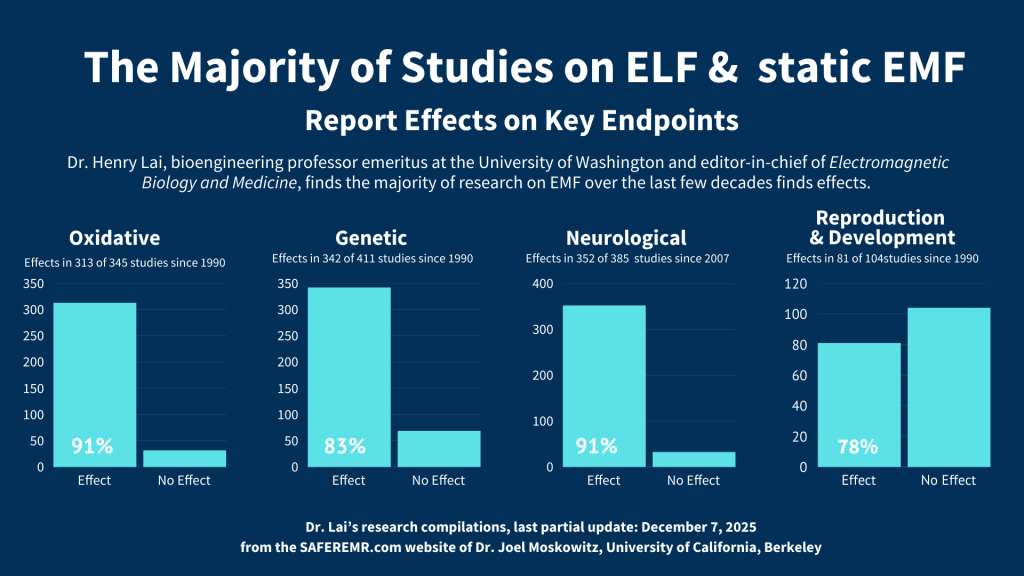
Dr. Henry Lai, Professor Emeritus at the University of Washington, Editor Emeritus of the journal Electromagnetic Biology and Medicine, and an emeritus member of the International Commission on the Biological Effects of EMF, has compiled summaries of the research on the biological effects of exposure to radiofrequency (RF) radiation, extremely low frequency (ELF), and static electromagnetic fields (EMF). His set of abstracts, which covers the period from 1990 through November 2025, constitutes a comprehensive collection of the peer-reviewed research.
Dr. Lai reports that the preponderance of research has found that exposure to RF or ELF-EMF produces oxidative effects or free radicals, and damages DNA. This information is posted on Dr. Joel Moskowitz’s website SaferEMR.com.
Power line EMF Exposure is Linked to Alzheimer’s Disease and Cognitive Effects
Studies have found higher rates of Alzheimer’s disease and other types of dementia close to high voltage powerlines.
A National Institute on Aging, National Institutes of Health supported study of high occupational ELF-EMF exposure reported associations with cognitive dysfunction and dementia, likely due to amyloid beta accumulation and reduced melatonin.
“The results of this study indicate that working in an occupation with high or M/H MF exposure may increase the risk of severe cognitive dysfunction. Smoking and older age may increase the deleterious effect of MF exposure.”
As another example, a large 18-year nationwide cohort study published in Environment International (2026) found effects beginning around 0.5 milligauss (mG) of exposure, with stronger associations observed in the 1–3 mG range, a range commonly found in homes close to electrical grid infrastructure.
Does the US Have Federal EMF Safety Standards? The Truth About Failed Public Health Regulation
The U.S. does not have safety standards for exposure to EMF from powerlines, data centers, or substations. Although the U.S. once had a strong EPA research program actively working on setting safety standards for public EMF exposure, it was defunded.
Before research was terminated, the EPA and other expert groups had concluded that safety was not necessarily assured as a mounting number of studies were indicating effects at low levels of exposure. As an example early drafts of EPA reports evaluating potential health risks from EMF exposure in the 1990’s recommended classifying power-frequency EMFs as “probable human carcinogens” and radiofrequency radiation as “possible human carcinogens.” These reports became controversial and were later removed in subsequent revisions. Although the draft assessments were reviewed by the EPA Science Advisory Board and other federal agencies, the EPA reports were never finalized and were ultimately shelved. One of the revised EPA draft documents (with the probable carcinogen removed), which was never formally adopted, remains publicly available online here.
In 1999, the National Institute of Environmental Health Sciences (NIEHS) issued a report that concluded that extremely low frequency (ELF) magnetic fields should be classified as a “possible human carcinogen.”
A major 2002 California State Health and Human Services report “An Evaluation of the Possible Risks From Electric and Magnetic Fields (EMFs) From Power Lines, Internal Wiring, Electrical Occupations and Appliances” concluded that EMFs may increase risks of childhood leukemia, brain cancer, ALS, and miscarriage. There have even been out-of-court settlements for EMF exposure, such as one in Massachusetts where high magnetic fields in a child’s bedroom were linked to leukemia. However, in contrast to numerous other countries, the U.S. has no ongoing activities to create federal safety limits or ensure public health protection. Thus, despite increasing exposures, the U.S. does not have any federal regulations for allowed exposure to ELF-EMF or associated magnetic fields based on an up-to-date review of the scientific research on health effects.
IEEE and ICNIRP EMF Guidelines vs. Biological Safety: Why Industry Standards Fall Short
The exposure limits established by the International Commission on Non-Ionizing Radiation Protection (ICNIRP) and the Institute of Electrical and Electronics Engineers (IEEE) are frequently cited in discussions of ELF electromagnetic fields. However, these limits have important limitations when applied to environmental health, land-use planning, and long-term community exposure as they are only designed to prevent short-term, acute biological effects, such as nerve or muscle stimulation, and these limits are not based on a risk assessment with robust review of scientific evidence related to long-term or lifetime exposure. ICNIRP and IEEE adopt a threshold-based approach focused on acute effects and are often misused as “proof of safety,” which can obscure the need for risk mitigation.
ICNIRP and IEEE limits are set at exposure levels thousands of times higher than those associated with cancer and other adverse biological effects.
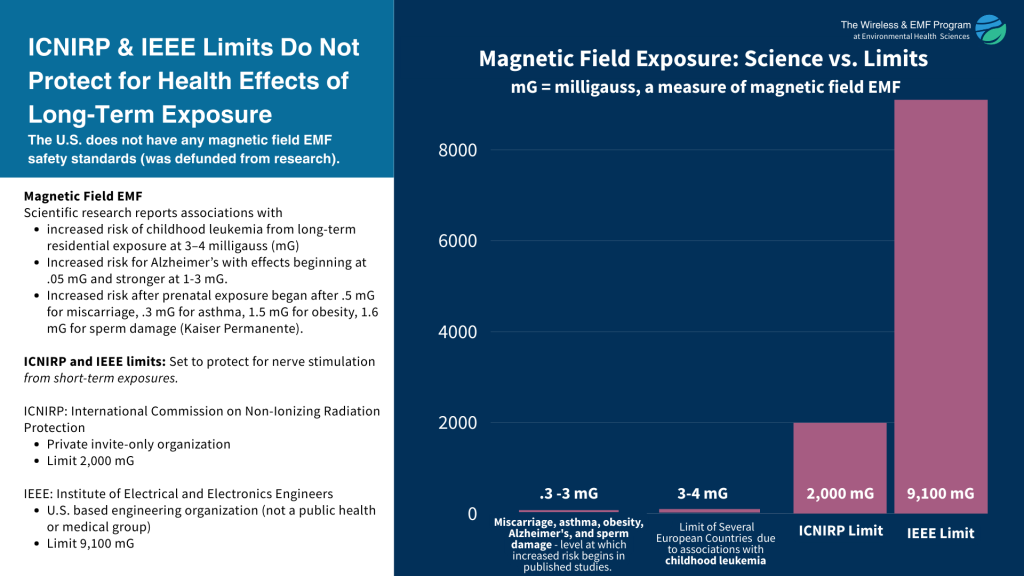
The ICNRP and IEEE guidelines do not address proximity to homes or schools, duration of exposure, or opportunities to reduce exposure through design. In addition, they do not account for infrastructure-related factors such as grounding quality, neutral return paths, load variability, or stray currents, meaning compliance with the limits alone does not ensure good engineering practice or minimization of avoidable exposure.
Which Countries Have the Strictest EMF Safety Standards? A Global Comparison
In contrast to the U.S., numerous countries have policies to mitigate EMF exposure at levels hundreds and thousands of times lower than IEEE and ICNIRP ELF magnetic field limits.
- The Netherlands: Since 2005, policies have been in place to reduce ELF-EMF in homes, schools, and kindergartens. In 2013, houses under 380–220 kV power lines were bought out by the government due to the ELF exposure. A 2018 Health Council report reaffirmed links to cancer and recommended reducing ELF-EMF.
- United Kingdom: Government promotes a precautionary policy to reduce EMF including optimum phasing for high-voltage overhead power lines and a series of engineering measures designed to reduce net currents, and encourages substations be sited away from homes. For low-voltage distribution networks (132 kV and below), precautionary best practice measures to reduce EMF are set out in Engineering Recommendation G92 published by the Energy Networks Association.
- Germany: A 2013 Ordinance requires all feasible measures to minimize ELF-EMF exposure. 220 kV lines cannot be erected over buildings intended for long-term human occupancy.
- Israel: The maximum permissible ELF-EMF exposure in schools and residences is 4 mG, per recommendations of the Ministry of Environment and the Ministry of Health.
- French Polynesia: A government-run public awareness campaign advises maintaining at least 1–1.5 meters from induction stoves and other EMF-generating appliances.
- France: Ministerial guidance discourages new hospitals, maternity wards, and childcare facilities near power lines, cables, and transformers where fields exceed 1 µT. The grid operator must monitor EMF emissions near power lines, and citizens can request measurements via local authorities.
- Slovenia: ELF limits are set at 10% of the EU reference value for new or modified installations near residences, schools, kindergartens, hospitals, playgrounds, parks, and public buildings.
- Denmark: Utilities must measure magnetic fields at new installations; annual averages should not exceed 4 mG, and no kindergartens or new buildings may be built near high-voltage lines.
- Switzerland: The Non-Ionizing Radiation Protection Act establishes precautionary EMF exposure limits for new installations. The country also measures, monitors, and reports EMF levels.
- Croatia: Reduced ELF-EMF limits apply to sensitive areas, including homes, offices, schools, playgrounds, kindergartens, maternity wards, hospitals, and care facilities.
- Luxembourg: Ministerial recommendation prohibits new living spaces within 20 meters of 65 kV power lines and 30 meters of 100–220 kV lines.
- Finland: The radiation authority STUK advises avoiding permanent residences where magnetic flux density continuously exceeds ~0.4 µT.
- Norway: A 0.4 µT “investigation level” applies to new homes, schools, kindergartens, and power lines; if exceeded, exposure-reduction measures are evaluated and implemented if reasonable.
- Italy: The 2017 Environment Ministry Decree recommends minimizing indoor ELF-EMF exposure; a precautionary “attention value” applies to 24-hour median exposure in homes, schools, playgrounds, and other spaces where people spend over 4 hours.
- Belgium: In Flanders, new power lines should be avoided near schools and childcare centers, and exposure over homes should be minimized. Year-averaged exposure near new schools and childcare centers should not exceed 4 mG. In Brussels, transformers near areas where children under 15 may be present must maintain a 24-hour average below 4 mG.
The United Kingdom, Guidelines for best practice in relation to electric and magnetic fields (EMFs) in the design and management of low voltage distribution networks, Engineering Recommendation G92 Issue 2 2018 states:
“4.1 Siting “DNOs should make reasonably practicable efforts not to site new final-distribution substations directly against living areas of homes etc (this is intended to cover homes, other residential properties, schools, libraries, and other public spaces with similar levels of occupancy).”
Yet in the US, there are no policies to ensure people are protected. This must change.
Radiofrequency (RF) Radiation: Are Wireless Antennas on Data Centers Safe?
Large buildings, including data centers, may host telecommunications antennas such as cellular base station antennas, cell towers, microwave transmitters, or other wireless network infrastructure. These wireless communications systems emit radiofrequency (RF) electromagnetic radiation and can increase environmental RF radiation exposures in nearby areas, particularly when antennas are mounted on rooftops or elevated structures. Equinix (one of the largest global data-center operators) explicitly details how it provides rooftop space for RF emitting antennas.
When new electrical transmission corridors are built to supply power to large facilities, RF emitting antennas may also be installed on transmission towers or other structures within the corridor. Because these corridors often pass near homes, schools, and parks, such installations could introduce additional radiofrequency (RF) emissions in nearby communities.
Current U.S. Federal Communications Commission (FCC) limits for radiofrequency (RF) radiation were established in 1996 and are based on preventing short-term heating effects of short term exposures. The limits are not designed to address cancer or other health effects reported in studies at exposure levels much lower than FCC limits. Numerous scientists and medical organizations have called for updated exposure guidelines and policy approaches that reduce RF radiation exposure to mitigate health risk, especially near homes, schools, and other sensitive locations.
How to Reduce EMF in Data Centers: Top Safety Recommendations
1. Full Transparency in Electrical Infrastructure and EMF Projections
The full scope of required electrical infrastructure for the facility should be publicly disclosed and incorporated into the application process. Applications should include projected electromagnetic field (EMF) modeling at the property boundary and at nearby sensitive locations (e.g., homes, schools, parks) under both typical and peak load conditions. EMF levels should be audited and monitored ongoing after construction.
All EMF data should be presented in a clear, publicly accessible, and easy-to-understand format.
- Disclose whether the facility will include high-voltage substations, major transformers, and new or upgraded transmission or distribution lines.
- Conduct baseline EMF measurements prior to energization.
- Perform post-energization verification EMF measurements under both typical and peak electrical loads.
- Require ongoing monitoring and periodic verification testing of EMF levels after construction.
- Require additional measurements if data center equipment is updated or changed, as well as if electrical demand increases or electrical infrastructure is expanded.
- Publicly post all EMF measurement results—including locations, dates, load conditions, equipment used, and applicable standards—in clear, easy-to-understand formats on publicly accessible websites.
- If wireless telecommunications antennas or microwave transmitters are installed on the facility, radiofrequency (RF) emissions should also be disclosed and evaluated, including projected exposure levels at nearby homes, schools, and public areas.
2. Setback and Corridor Planning to Mitgate EMF
At a minimum corridor planning should:
- Separate high-voltage corridors from schools and residences.
- Avoid routing major feeder lines directly near or beneath schools, playgrounds or child-occupied structures
- Incorporate structural buffer zones
3. Magnetic Field (EMF) Risk Mitigation Measures
Magnetic field EMF exposure from data centers and associated electrical infrastructure should be minimized through infrastructure design, configuration, and siting decisions. Because magnetic fields penetrate most common building materials and are not effectively blocked by shielding, reducing exposure at the source is essential. Priority should be given to burial of transmission and distribution lines, application of established EMF mitigation techniques, and site design practices that limit off-site magnetic field exposure.
- Ensure the ambient magnetic field <= 0.5 mG
- Powerlines should be buried.
- Design electrical infrastructure to mitigate EMF exposure and minimize unnecessary current flow near occupied spaces.
- Incorporate established power line EMF mitigation techniques (e.g., phase configuration, line spacing optimization).
- On-site dedicated power generation is ideal to reduce reliance on expanded high-voltage transmission corridors.
- Mitigation measures should be fully disclosed, and any decision not to bury lines or implement additional EMF reduction steps should be clearly justified and publicly documented.
4. Harmonic Mitigation
Applicants for new data center construction should provide disclosure of harmonic modeling associated with on-site electrical systems and utility interconnections, including total harmonic distortion (THD) and planned mitigation measures.
While harmonics are often discussed in terms of harmful impacts on appliances and electronics, such as lower energy efficiency and equipment that ages faster, these electrical issues can also impact the health of people in their homes via EMF exposure.
- Ensure the grid complies with the National Electrical Safety Code (NESC), including proper neutral return paths.
- Applicants should submit harmonic impact studies as part of the utility interconnection review process.
- Power quality should be monitored to ensure data centers do not introduce or “leak” harmonic distortion or dirty electricity onto the surrounding electric grid. Total Voltage Harmonic Distortion (VTHD) levels at the Point of Common Coupling (the location where the facility connects to the utility grid) should be regularly measured and publicly reported.
- Independent power quality measurements should also be conducted at nearby residential distribution feeders and schools.
- Facilities should measure and monitor supraharmonic emissions.
- Harmonic distortion should be mitigated to the lowest feasible levels through engineered solutions.
5. RF Radiation Mitigation
- The potential for RF-emitting antennas to be placed within electrical transmission corridors should be disclosed at the beginning of the application process.
- If antennas are installed on the facility, applicants should disclose the equipment type, operating frequencies, and projected RF exposure levels at the property boundary and at nearby homes, schools, and public spaces.
- To reduce exposure, antenna installations should follow prudent siting practices, including locating antennas away from residential areas where feasible, avoiding placement near schools and child-occupied buildings, and maintaining appropriate setbacks.
- RF compliance modeling and post-installation verification measurements should be conducted, and results should be publicly available to ensure transparency and regulatory compliance.
Additional Key Environmental Issues of Data Centers
Data Centers Increase Air Pollution
Data centers increase air pollution, and are expected to contribute to 1,300 premature deaths every year in the U.S. by 2030, disproportionately affecting certain low-income communities according to a report by Caltech and University of California Riverside. One of the researchers stated that “the findings reveal that the total public health burden of U.S. AI data centers in 2030 is valued at up to more than $20 billion per year.”
Virginia Commonwealth University research found data center air pollution in Northern Virginia has increased significantly as the number of facilities has grown, with emissions such as carbon monoxide and nitrogen oxides rising sharply between 2015 and 2023. While current emissions are still a small share of total regional pollution, they can create localized pollution hotspots near clusters of data centers, and permitted emissions levels indicate pollution could increase substantially in the future if data centers operate up to their full permitted limits.
Air pollution from data centers comes from both on-site diesel backup generators and the fossil fuels burned to produce the electricity they consume. Diesel generators emit fine particulate matter (PM2.5), nitrogen oxides (NOₓ), and other toxic pollutants that can penetrate deep into the lungs and increase the risk of heart disease, asthma, and other respiratory problems. In addition, when data centers draw electricity from power plants that burn coal, oil, or natural gas, those facilities release pollutants into the air. These emissions contribute to smog, acid rain, climate change, and both short- and long-term health risks, particularly for children, older adults, and people with existing lung conditions.
Learn More about Air pollution from Data Centers
Sierra Club: Unconstrained Demand Virginia’s Data Center Expansion and Its Impacts
The Unpaid Toll: Quantifying and Addressing the Public Health Impact of Data Centers
UC Riverside News: AI’s deadly air pollution toll
NBC4: Report links data center to rare cancers, raising questions about central Ohioans’ safety
Pitt, D., Suen, E., and Plisko, E. (2026). VCU Institute for Sustainable Energy and Environment. “Localized Air Pollution Impacts from Data Centers in Northern Virginia.”
Data Centers Impact Water Quality By Concentrating Contaminants
According to the Lincoln Institute of Land Policy, data centers significantly impact water quality by using millions of gallons daily for evaporative cooling and then discharging concentrated wastewater (“blowdown”). A 2025 CERES Report found annual water use tied to data center electricity consumption is projected to rise by as much as 400% in the coming years, while water used directly for cooling operations could increase by up to 870%.
U.S. data centers consumed about 17 billion gallons of water in 2023 – with hyperscale and colocation facilities using the lion’s share (84%) – according to estimates in the 2024 Berkeley Lab report.
An investigation by residents and local officials featured in Rolling Stone documented how the nitrate-contaminated groundwater near an Amazon data center in Oregon was associated with increased cancers and miscarriages. The report describes how when nitrate-laden aquifer water is used for cooling, some evaporates, but the nitrates remain and become even more concentrated.
Excessive, unregulated groundwater extraction can also drop water tables, leading to increased sediment, contaminants, and lower water quality in local wells. Overall, rapid data center growth could raise water stress in already strained basins by up to 17% annually, with even sharper increases during peak demand seasons.
Read More
CERES Report: Drained by Data: The Cumulative Impact of Data Centers on Regional Water Stress
BBC: ‘I can’t drink the water’ – life next to a US data centre
The water use of data center workloads: A review and assessment of key determinants – ScienceDirect? Rolling Stone ‘The Precedent Is Flint’: How Oregon’s Data Center Boom Is Supercharging a Water Crisis
Data Centers Increase Noise Pollution
Data centers can increase environmental noise exposure in surrounding communities due to the continuous operation of machines, including fans, pumps, and backup generators. These machines often operate 24 hours a day and produce persistent, continuous low-frequency noise and hum that travels farther than typical urban sounds. Some report noise even at 2 miles or even up to 4.5 miles away in quiet areas. The noise is often described as a constant, high-pitched whine or drone that causes significant disruption, migraines, and sleep issues for residents
Because low-frequency sound penetrates walls and building materials more easily than higher-frequency noise, residents living near large data-center campuses often experience this background noise both outdoors and inside homes.
The Washington Post: As data centers expand in Northern Virginia, some are noisy neighbors – The Washington Post featured a family’s situation:
“Carlos Yanes believes he can tell when the world’s internet activity spikes most nights. It’s when he hears the sounds of revving machinery, followed by a whirring peal of exhaust fans that are part of the computer equipment cooling system inside an Amazon Web Services data center about 600 feet from his house. The sound keeps him awake, usually while nursing a headache brought on by the noise, and has largely driven his family out of the upstairs portion of their Great Oaks home, where the sound is loudest.”
Some of the sound produced by the industrial-scale cooling systems and mechanical equipment occurs in the low-frequency and infrasonic range (below ~20 Hz). Infrasound is generally not perceived as a conventional sound by humans but may be experienced as pressure, vibration, or rumbling. Research on environmental infrasound and low-frequency noise from industrial infrastructure has linked chronic exposure to sleep disturbance, stress responses, headaches, and reduced quality of life in some communities. These frequencies can propagate long distances and may be experienced even when conventional noise limits appear to be met.
To reduce potential impacts, data-center planning should include noise and low-frequency sound assessments during the permitting process, including modeling of nighttime conditions and cumulative effects from multiple facilities. Mitigation strategies may include several miles of setbacks from residential areas, acoustic enclosures for mechanical equipment, vibration isolation for large fans and compressors, quiet cooling technologies, and ongoing monitoring of low-frequency noise and infrasound. Transparent reporting and community engagement is important.
Learn More
New Jersey 101.5 (New Jersey): NJ neighbors furious as giant AI data center hums 24/7 — and that’s not all
NBC10 Philadelphia (Pennsylvania): Vineland residents say loud humming noise coming from AI data center
Mississippi Free Press (Mississippi): Amazon’s Canton AI Data Center Brings Dust, Noise and Pollution Fears for Neighbors
Richmond Times-Dispatch (Virginia): Our community’s 24/7 battle against data center noise and air pollution | Guest column
BBC: A humming annoyance or jobs boom? Life next to 199 data centres in Virginia
The Washington Post: As data centers expand in Northern Virginia, some are noisy neighbors
Datacenters Behaving Like Acoustic Weapons: Data Centers Are Making People Sick, by Benn Jordan
Chaban, Ryan et al. “Negative effect of high-level infrasound on human myocardial contractility: In-vitro controlled experiment.” Noise & health vol. 23,109 (2021): 57-66. doi:10.4103/nah.NAH_28_19
Chaban, Ryan et al. “Negative effect of high-level infrasound on human myocardial contractility: In-vitro controlled experiment.” Noise & health vol. 23,109 (2021): 57-66. doi:10.4103/nah.NAH_28_19
Key EMF and Health Studies
Asthma
Li, D.-K. et al. (2011). Maternal Exposure to Magnetic Fields During Pregnancy in Relation to the Risk of Asthma in Offspring. Archives of Pediatrics & Adolescent Medicine
Obesity
Li, D.-K et al.(2012). A Prospective Study of In-utero Exposure to Magnetic Fields and the Risk of Childhood Obesity. Scientific Reports
Miscarriage
Li, D. et al. (2017). Exposure to Magnetic Field Non-Ionizing Radiation and the Risk of Miscarriage: A Prospective Cohort Study. Scientific Reports
Sperm Quality
Li D et al. (2010) Exposure to magnetic fields and the risk of poor sperm quality. Reproductive Toxicology
Li D et al. (2002) A population-based prospective cohort study of personal exposure to magnetic fields during pregnancy and the risk of miscarriage. Epidemiology
Alzheimer’s
Sandoval-Diez et al. (2016) Long-term residential magnetic field exposure and neurodegenerative disease mortality: An 18-year nationwide cohort study in Switzerland Environment International
Oxidative Stress
Schuermann, D., & Mevissen, M. (2021). Manmade Electromagnetic Fields and Oxidative Stress—Biological Effects and Consequences for Health. International Journal of Molecular Sciences, 22(7), 3772.
Industry Influence
Carpenter, D. O. (2019). Extremely low frequency electromagnetic fields and cancer: How source of funding affects results. Environmental Research, 178, 108688.
Cancer
Correa-Correa V et al. Extremely Low-Frequency Magnetic Fields (ELF-MF) and Radiofrequency: Risk of Childhood CNS Tumors in a City with Elevated ELF-MF Exposure. Environ Research
Brabant et al. (2024) Effects of extremely low frequency magnetic fields on animal cancer and DNA damage: a systematic review and meta-analysis. Prog Biophys Mol Biol.
Carpenter, D. O. (2013). Human disease resulting from exposure to electromagnetic fields. Reviews on Environmental Health
Seomun, G et al. (2021). Exposure to extremely low-frequency magnetic fields and childhood cancer: A systematic review and meta-analysis. PLOS ONE
Sun, J et al. (2023). Effects of extremely low frequency electromagnetic fields on the tumor cell inhibition and the possible mechanism. Scientific Reports
Wang X, Ye Y, Zuo H, Li Y. Neurobiological effects and mechanisms of magnetic fields: a review from 2000 to 2023. BMC Public Health. 2024 Nov 8;24(1):3094. doi: 10.1186/s12889-024-18987-9. PMID: 39516768; PMCID: PMC11545338.
Malavolti M et a. Residential exposure to magnetic fields from transformer stations and risk of childhood leukemia. Environmental Research
Núñez-Enríquez, J. C. et al. (2020). Extremely Low-Frequency Magnetic Fields and the Risk of Childhood B-Lineage Acute Lymphoblastic Leukemia in a City With High Incidence of Leukemia and Elevated Exposure to ELF Magnetic Fields. Bioelectromagnetics
Belyaev, I., et al. (2016). EUROPAEM EMF Guideline 2016 for the prevention, diagnosis and treatment of EMF-related health problems and illnesses. Reviews on Environmental Health,
Bandara, P., & Carpenter, D. O. (2018). Planetary electromagnetic pollution: It is time to assess its impact. The Lancet Planetary Health,
Key Reports and Resources on Data Centers
Data Center Report by the Greater Edwards Aquifer Alliance—a nonprofit dedicated to protecting the Edwards and Trinity aquifers, their springs, watersheds, and the Texas Hill Country. The report outlines policy recommendations to guard against potential harms, including improved data collection and planning at the state and local levels, fair cost allocation, stronger local regulatory tools, limits on incompatible land use, increased transparency, and reductions in energy use, water consumption, pollution, and public health impacts. It also urges data center operators to adopt practices that conserve potable water, reduce strain on local water supplies, and limit reliance on fossil fuel–based energy.
Sierra Club: Unconstrained Demand Virginia’s Data Center Expansion and Its Impacts
The Unpaid Toll: Quantifying and Addressing the Public Health Impact of Data Centers