
Learn about smart meter health issues and options to opt-out of installment so you can make informed decisions about safety in your home.
Jumplinks:
- What is a smart meter?
- Are children more vulnerable to smart meter radiation?
- Do all scientists believe smart meters are safe?
- How often do smart meters transmit?
- Are smart meter radiation levels allowed to exceed government limits?
- Does smart meter radiation go into the home?
- What studies have been conducted on smart meters?
- Smart meters are creating a future E-waste challenge
- Smart meters are not shown to reduce energy consumption
- Do consumers have a choice to opt out?
- Practical steps to protect your family
- Resources
What is a smart meter?
Smart meters are digital utility meters for electricity, gas, or water that record usage and transmit data wirelessly to utility companies using radiofrequency (RF) radiation. Companies are replacing traditional analog meters with smart meters, often without advance notice. Many residents are opposed to smart meters due to the safety, fire, privacy, and health risks.
Do smart meters emit radiation?
Yes. Most smart meters transmit data in short powerful pulses of RF radiation, an artificial type of non‑ionizing electromagnetic radiation. Smart meters often operate as part of a wireless mesh network, meaning each meter not only sends out its own data but also chats back and forth with and relays data to neighboring meters. This design contributes to continuous, cumulative environmental RF radiation exposure within homes and across neighborhoods.
How often do smart meters transmit pulses of RF radiation?
Contrary to utility companies’ claims that exposure is minimal, utility records show that smart meters can transmit thousands of intense millisecond pulses a day. As an example, the Pacific Gas & Electric company told the California State’s Public Utilities Commission its meters could average 9,600 pulses a day with a maximum of 190,000 transmissions a day (page 5 of Pacific Gas & Electric company response to the administrative law judge). Companies often state smart meters only transmit for under a minute, omitting the reality of the thousands of intense RF radiation bursts a day.
Importantly, smart meters are not a health risk due to the RF emissions only. Smart meters also introduce “dirty electricity” (high-frequency voltage transients) into a home’s wiring, contributing to significant non-ionizing electromagnetic exposure. This is why an analogue meter is the safest meter.
Are children more vulnerable to smart meter radiation?
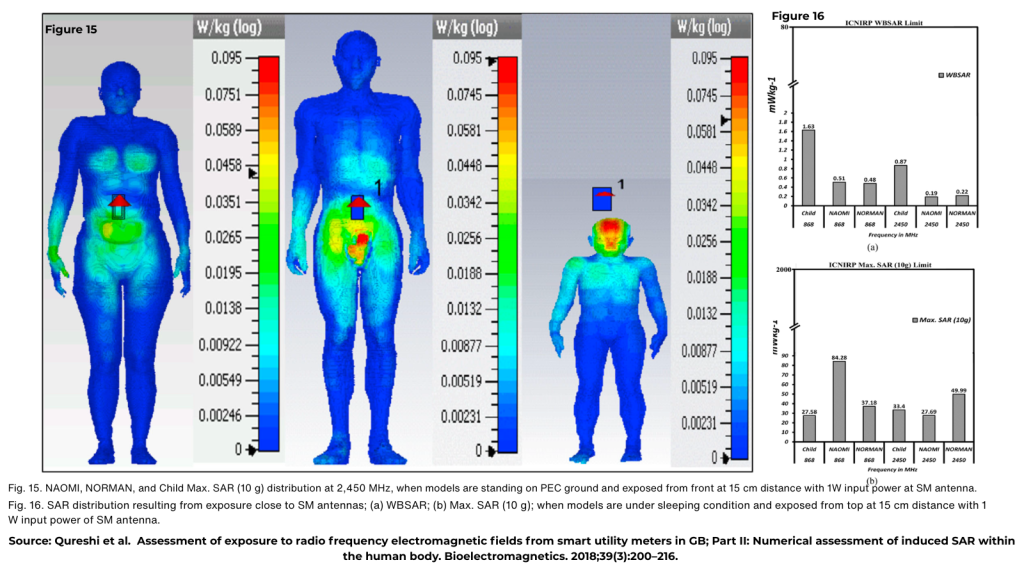
Yes. Research on various RF radiation emitting sources consistently shows that RF radiation penetrates deeper into children’s bodies and brains. Modeling studies specific to smart meters demonstrate that children absorb RF radiation more rapidly and at higher whole‑body levels than adults. The American Academy of Pediatrics recognizes children as more vulnerable to RF radiation exposure and has long called for an update to U.S. FCC limits for human exposure.
Study Highlight: Smart Meter Radiation Exposure into Child and Adult
A 2018 peer-reviewed study by Qureshi et al. used anatomically realistic computer models of adults and a child to simulate RF radiation exposure from smart meters and found that the highest whole-body specific absorption rate (SAR) consistently occurred in the child model. The color-mapped images from the study here visually show greater and more concentrated energy absorption rates in the child’s body.
Do all scientists believe smart meters are safe?
No. Hundreds of scientists and medical professionals from dozens of countries have signed international appeals calling for reduced exposure to RF radiation and updated safety limits. A 2014 paper “Self-Reporting of Symptom Development From Exposure to Radiofrequency Fields of Wireless Smart Meters in Victoria, Australia: A Case Series,” documented that the most commonly reported symptoms from exposure to wireless smart meters were: insomnia, headaches, tinnitus, fatigue, cognitive disturbances, dysesthesias (abnormal sensation), and dizziness. Further, the research highlights that “smart meters may have unique characteristics that lower people’s threshold for symptom development.
In 2012, when smart meters were first being deployed and a letter published in the Montreal Daily claimed that wireless smart meters posed no risk to public health, more than fifty international scientists and health professionals penned a letter “Smart Meters: Correcting the Gross Misinformation” cautioning that “wireless smart meters typically produce atypical, relatively potent and very short pulsed RF/microwaves whose biological effects have never been fully tested.”
They further stated:
“Even though RF/microwaves don’t have the energy to directly break chemical bonds, unlike ionizing radiation such as X-rays, there is scientific evidence that this energy can cause DNA damage indirectly leading to cancer by a combination of biological effects. Recent publications have documented the generation of free radicals, increased permeability of the blood brain barrier allowing potentially toxic chemicals to enter the brain, induction of genes, as well as altered electrical and metabolic activity in human brains upon application of cell phone RF/microwaves similar to those produced by smart meters.”
In 2012, Dr. De-Kun Li of Kaiser Permanente filed testimony before the Maine Public Utility Commission. When asked if smart meters were safe, he stated, “No. As stated above, at this point, the safety of RF EMF exposure is uncertain, largely due to a lack of research effort. Given the ubiquitous RF EMF exposure and its potential impact on large populations, the resources for studying RF EMF health effect are relatively limited. In fact, emerging reports, though still limited, are starting to show possible links to adverse health outcomes, especially with long-term exposure.”
Since then, numerous medical organizations and scientific appeals have been issued emphasizing the need for public health protection and calling to reduce RF radiation exposure to the public. The EMF Scientist Appeal was first released in 2015 and is now signed by over 259 scientists from 41 countries who have published peer-reviewed publications on electromagnetic fields.
Many organizations have joined the scientific call for safety. In a formal resolution, the League of United Latin American Citizens (LULAC) called for a moratorium on RF “smart” meter installations until safety, health, and privacy concerns are resolved, and supported a no-cost opt-out for affected residents.
“BE IT FURTHER RESOLVED that we support a Moratorium on the installation of RF/‘smart’ meters until such time that we determine that all safety, health, and privacy concerns have been resolved to the satisfaction of this organization.”
-League of United Latin American Citizens
Are smart meters considered safe under government standards?
Utilities claim smart meters comply with Federal Communications Commission (FCC) RF radiation exposure limits. However, FCC limits are based on outdated science and only address short‑term thermal (heating) effects, not long‑term biological effects. Numerous peer‑reviewed studies show adverse biological impacts from pulsed radiofrequency radiation at levels far below current FCC limits.
As stated by Dr. David Carpenter MD (a physician and environmental health researcher and former Director of the Institute for Health and the Environment University at Albany) along with Dr. Hardell, Dr. Havas, Dr. Milham, and Dr. Herbert in a letter to the Public Utilities Commission of Ohio:
“The Federal Communications Commission’s safety standards do not apply to low-intensity RFR. There is no safe level of exposure established for RFR. People around the world are suffering from low-intensity RFR exposure, being at increased risk of developing both cancer and EHS.”
Do smart meters emit more or less RF radiation than a smartphone?
It depends on how exposure is measured.
Smartphones typically operate at higher peak power levels when actively transmitting and are often held directly against the head or body. Because of this close proximity, localized exposure from a cell phone to certain tissues can be higher than the exposure from a smart meter mounted outside a home.
However, smart meters transmit in short, intermittent bursts. Numerous experts have noted that these transmissions are continuous and expose the full body.
In a letter to the North Carolina Utilities Commission, Dr. David Carpenter MD explained:
“Smart meters operate with much more frequent pulses than do cell phones, increasing the potential for adverse health impacts.
Smart meter pulses can average 9,600 times a day, and up to 190,000 signals a day. Cell phones only pulse when they are on.
Cell phone RFR is concentrated, affecting the head or the area where the phone stored, whereas smart meter RFR affects the entire body.”
Are smart meter radiation levels allowed to exceed government safety limits?
Yes. Smart meters are allowed to exceed the FCC’s radiofrequency reference level, but because compliance tests average emission levels, they are still considered compliant.
The FCC’s regulatory framework is based solely on preventing short-term tissue heating and does not address long-term, biological, or non-thermal effects. Under FCC rules, RF radiation exposure is allowed to be time-averaged, meaning the radiation is measured and averaged over several minutes rather than evaluated at the moment it is emitted. In practice, this means brief but intense radiation bursts are mathematically “smoothed out” when calculating compliance.
According to Pacific Gas & Electric’s sworn testimony to the California Public Utilities Commission, smart meters operating in the 900 MHz band emit instantaneous peak RF pulses of up to 2,500 milliwatts (2.5 watts) of effective radiated power, while the FCC reference level used for compliance comparisons is 1,000 milliwatts (1 watt). This means the peak emissions reach approximately 2.5 times the FCC reference level. Utilities nonetheless claim compliance by averaging these high-power pulses over a 30-minute period, which obscures the true peak intensity, frequency of emissions, and realistic residential exposure conditions, leaving residents uninformed about the actual magnitude of radiation entering their homes.
Do companies inform consumers about RF radiation?
Most consumers are unaware that smart meters emit radiofrequency (RF) radiation, even though safety language appears in technical manuals and FCC filings.
Smart meters are tested for compliance with FCC RF exposure limits at a minimum separation distance of 20 cm (approximately 8 inches) between the meter’s antenna and a human body model. This means the device is evaluated assuming a person is at least 20 cm away during operation.
“Warning: To satisfy FCC RF exposure requirements for transmitting devices, a separation distance of 20 cm or more should be maintained between the antenna of this device and persons during device operation. To ensure compliance, operations at closer than this distance is not recommended.”
–FLEXGE100 Utility Meter Electric Smart meter
Compliance with FCC limits only indicates the device meets FCC 1996 human exposure limits; it does not constitute a separate guarantee of absolute safety under all conditions of use.
Does smart meter EMF radiation go into the home?
Yes. Smart meters are installed directly on homes and along the exterior walls of apartments and condominiums. Because these meters are mounted on building walls, the pulsed RF radiation they emit can penetrate into interior living spaces, often near bedrooms, living areas, and workplaces.
In many apartment and condominium buildings, smart meters are installed in banks of dozens of meters clustered together along a single wall. In these cases, individual apartments may have bedrooms or living spaces located directly on the other side of the meter bank, resulting in continuous indoor exposure to repeated RF pulses from multiple meters operating simultaneously. Residents typically have no control over the number or placement of these meters and are rarely informed that multiple transmitting devices may be installed just inches from occupied indoor spaces.
Digital smart meters can also inject high-frequency electrical transients, commonly called “dirty electricity,” into a home’s wiring, allowing these conducted emissions to spread throughout electrical and metal systems indoors.
Why do smart meters generate high-frequency electrical noise?
Smart meters use a switch-mode power supply (SMPS) to convert incoming AC electricity into the low-voltage DC power needed to operate internal components such as microprocessors and communication radios.
Switch-mode power supplies operate by rapidly switching electrical current on and off at high frequencies (typically in the kilohertz range). This switching process can generate:
- Voltage transients (brief electrical spikes)
- High-frequency harmonics
- Electrical noise superimposed on the standard 60 Hz household current
As a result, some high-frequency components in the kilohertz (kHz) range may be present on a home’s electrical wiring system. This is sometimes described as “conducted emissions,” meaning electrical noise that travels along wiring rather than through the air.
An engineering report submitted in litigation before the Supreme Court of Pennsylvania stated:
“Any meter with a switch mode power supply will create RF frequencies in the kilohertz range that enter the electrical wiring system of the house. Smart meters and digital meters inject significant levels of RF onto the home’s electrical distribution system.”
The report also noted:
“Most people are unaware that their meter has been switched or is in the process of being switched from an analogue meter to a digital ‘smart’ meter. If your home or building already had a meter, it was probably an analogue meter (used for decades), but the replacement meter is likely a digital meter—a ‘smart’ meter.”
What studies have been conducted on smart meters?
Most studies are measurement studies that ultimately conclude the meters meet government regulations. To date, there are no large-scale, long-term epidemiological studies specifically examining health outcomes from smart meter exposure alone. Most research on health effects has focused more broadly on radiofrequency radiation exposure from wireless devices in general.
However, some researchers have examined symptoms reported in association with smart meters.
The case series Self-reporting of symptom development from exposure to radiofrequency fields of wireless smart meters in Victoria, Australia “found the most frequently reported symptoms from exposure to smart meters were (1) insomnia, (2) headaches, (3) tinnitus, (4) fatigue, (5) cognitive disturbances, (6) dysesthesias (abnormal sensation), and (7) dizziness. The effects of these symptoms on people’s lives were significant.”
Do smart meters expose wildlife and the environment?
Yes. Scientific studies have found that RF radiation can negatively affect bees, birds, insects, trees, and other wildlife. Documented effects include disrupted navigation, reduced reproduction, behavioral changes, and physical damage to plants and trees. No U.S. environmental agency has established safety standards to protect wildlife from chronic RF radiation exposure.
What is a “mesh network,” and why does it matter?
Smart meters transmit in short millisecond intense bursts via a “mesh network” architecture, meaning that each that individual meter communicates with and through other nearby meters. The data then ultimately reaches a collector unit, which aggregates all the data and then transmits to the utility company, typically via a longer-range communication method such as cellular, fiber, licensed radio, or another backhaul connection. The collector meter serves multiple meters and it may transmit more frequently or at higher power than a single residential meter. The collector meter is often placed on a utility pole, streetlight, commercial building, or occasionally on a centrally located home. The only way to know for sure if you have a collection meter is to contact your utility company.
This means every meter functions as a transmitter, increasing cumulative environmental RF radiation exposure.
Do smart meters pose fire risks?
Beyond radiation exposure, smart meters have been associated with electrical fires, explosions, and damage to home wiring and appliances. Certified fire investigators and electrical engineers have documented cases in which smart meters appear to initiate or intensify fixed wiring fires, often occurring within months to two years after installation and within 15–25 feet of the meter, inside walls, ceilings, and attics where no human activity is present.
Investigators report that these fires frequently involve continuous sections of branch-circuit wiring. As a result, many of these fires are officially classified as “undetermined,” even when a clear pattern emerges following smart meter installation.
Some experts state that the high-frequency voltage transients and electrical noise from digital smart meters could potentially contribute to resistive heating, insulation breakdown, arc tracking, and fire risk over time.
In The Discovery and Science of Smart Meter Fires, certified fire investigator Jim Brown, CCAI-CFI, along with Dr. Robert Armstrong, PhD, P.E., and Dr. Vytenis Babrauskas, PhD, presented the findings of a forensic investigation into smart-meter-related fires, concluding, “The investigation into the increase in fixed wiring electrical fires followed accepted scientific methodology and identified a repeatable fire pattern that was not observed prior to the deployment of smart meters. Conventional ignition sources were systematically ruled out, leaving RF-related degradation of wiring insulation as a probable contributing factor.”
Additional safety concerns related to smart meters are documented in multiple expert reports. The paper Overview: Fire and Electrical Hazards from “Smart”, Wireless, PLC, and Digital Utility Meters examines how electric, gas, and water AMI/AMR and digital meters can pose fire and electrical hazards, drawing on analysis from engineers, fire investigators, and utility experts in the United States and Canada. These findings are further supported by the comprehensive 173-page report Analysis: Smart Meter and Smart Grid Problems – Legislative Proposal, released in 2012, which compiles extensively referenced state, national, and international evidence detailing the known risks, failures, and safety issues associated with smart meter and smart grid programs at that time. Most of the smart meter risks identified in these reports remain unresolved and relevant today.
Smart meters are creating a future E-waste challenge
Smart meter deployment has surged globally from 23.5 million in 2010 to over 729 million by 2019, with plans to reach around 1.4 billion installations worldwide. Thus, hundreds of millions of meters could enter electronic waste streams within the next decade.
Smart meters do not last as long as analogue meters
While analogue meters can last 30 to 50 years, smart electric meters are touted as lasting 20 years despite no data supporting such statements. Many report they are in service about 5 years. Congressional testimony by an industry spokesman said smart meters’ actual service life is only 5 years, and companies continually report smart meters failing after a few years.
Companies put forward a business case of benefit over cost based on meters with a 20-year or more service life. As an example, in Kentucky, they said the service life of Landis & Gyr meters was 20 years, but when asked for proof, they used a 2-word email from their vendor as their only evidence.
The paper “Global sustainability, innovation and governance dynamics of national smart electricity meter transitions” by Sovacool et al. (2021) published in the journal Global Environmental Change analyzed 102 smart meter programs across 47 countries, using a large global dataset covering both national and subnational deployments and concludes that current systems are not fully prepared for this scale of e-waste, and they recommend improved recyclability, reuse, and waste management as rollout continues. They state:
“The fact that more smart meters have been installed already than will be installed in the future based on current targets bodes well for transition dynamics, but it also creates a significant challenge in moving beyond installation to after sales service, maintenance, repair, care, and end of life. There will be hundreds of millions of smart meters and their in-home displays entering electronic waste and recycling streams within the next decade, requiring major improvements in waste management systems. With roughly another 700 million meters still to be deployed, there remains an important opportunity to design future systems that are more recyclable and better suited for reuse or dismantling.”
Cost–benefit models for smart meters tend to focus on short-term, projected gains, many of which are not realized, while overlooking the full lifecycle impacts that unfold over decades. Smart meter roll-outs fail to account for sustainability issues, resource use, long-term energy demand, and the growing burden of electronic waste at end of life.
Smart meters are not shown to reduce energy consumption
Companies say smart meters will save money and reduce energy usage, but in fact, rates keep going up, and the evidence that smart meters help reduce energy usage is scant. The smart meter analysis by Sovacool et al. (2021) also states that, “the transformative effect of smart meters may be oversold.” They found limited and inconsistent evidence that smart meters lead to reduced electricity consumption. To start, energy savings data were available in only 26 of 102 programs, and overall evidence linking smart meter deployment to efficiency gains or carbon reductions is described as weak.
“Energy savings data was present in only a small number of programs … a striking conclusion given that smart meter programs are often implemented on the grounds that they will improve the efficiency of household energy consumption.”
“Users have in most cases paid… for an infrastructural intervention, but few measures guarantee that benefits will accrue to them.”
“Over time people tend to engage less with (and perhaps care less for) their smart meters…”
Smart meters don’t deliver benefits just by being installed. The analysis found that the biggest gains occur in communities with clear government policies, utilities actually using the data, and programs that help people change how they use energy (because simply having a smart meter does not impact behavior change). In areas without such coordination, the meters function as little more than digital replacements for old meters, with far fewer real-world benefits. So whether a town sees meaningful improvements depends less on having smart meters and more on how well the system around them is designed and utilized.
Do consumers have a choice to opt out?
Many communities oppose mandatory smart meters and have opt‑out programs, moratoriums, or bans. Several U.S. states and municipalities allow residents to retain or reinstall analog meters, sometimes at no cost. In multiple cases, residents have successfully challenged opt‑out fees through regulatory and legal action.
What states have smart meter opt-outs?
Municipalities within states can differ among participating utilities. In 2012, the California Public Utilities Commission (CPUC) approved opt-out programs for customers of PG&E, Southern California Edison, and San Diego Gas & Electric after widespread public opposition. Initial opt-out fees were later reduced in certain cases.
- Smart Meter Opt-Out FAQ – San Diego
- SmartMeter™ opt-out PG & E program
- Smart Meter Info | Maine Office of Public Advocate
The National Conference of State Legislatures has a website page on Smart Meter Opt-Out Policies, last updated in 2019, but still relevant for most states.
StopSmartmeters BC has a comprehensive list of states with each utility last updated in 2024 here.
What can you do to protect your family?
Experts state that the lowest-exposure option is a traditional analog (non-digital) utility meter.
If you currently have an analog meter and wish to retain it, first, formally notify your utility that you do not consent to its replacement. In many areas, once an analog meter is removed, it may be difficult or impossible to have it reinstalled.
Where analog meters are no longer available, a non-transmitting digital meter (sometimes called a “non-RF” or “radio-off” option) may be offered through an opt-out program. These do not emit RF radiation but they can introduce dirty electricity into the home. This is why you want to keep your analogue if you have it.
Here are practical steps you can take if you have a smart meter:
1. Check for Opt-Out Options
Contact your utility company or state public utility commission to determine whether a smart meter opt-out program is available. Ask about fees, alternative meter options (analog or non-transmitting digital), and written policies.
2. Submit Written Requests
If you wish to opt out or request accommodations, submit your request in writing and keep copies of all correspondence.
3. Connect with Local Support and Take Action
Connect with a local smart meter awareness group or safe technology organization to learn about your options and coordinate community efforts. Every state has one. Residents may need to educate decision-makers and request a no-fee opt-out, advocate for policy changes, or petition regulators to pause or reconsider deployment in their area. Public utility commissions hold hearings and accept public comments, giving citizens the opportunity to submit testimony and advocate for protections.
“Take Back Your Power”: An In Depth Documentary Questioning the Smart Meter Rollout
Take Back Your Power is a documentary film that exploring key issues around smart meters, including health, privacy, and utility practices, through interviews with activists, experts, and affected individuals.
Expert Presentations & Resources on Smart Meters
Key Websites to Learn More About Smart Meters
Virginians for Safe Technology Factsheets
Expert letters
Letter to the Public Utilities Commission of Ohio by Dr. David Carpenter MD (a physician and environmental health researcher and former Director of the Institute for Health and the Environment University at Albany), along with Dr. Hardell, Dr. Havas, Dr. Milham, and Dr. Herbert.
Letter to the North Carolina Utilities Commission
Dr. David Carpenter’s presentation to the WSSC water authority on smart meters health and safety
Dr. David O. Carpenter, University at Albany (NY) School of Public Health
- Video of presentation to the WSSC Water Authority on smart meters
- PDF of Dr. Carpenter’s presentation slides on Smartmeters to WSSC
- Dr. Carpenter’s comments on Smartmeters, RF, health and safety submitted to WSSC regarding a report authored by an industry-connected scientist
Dr. Ronald Powell’s research & policy analysis
- Ranking Electricity Meters for Risk to Health, Privacy, and Cyber Security
- Symptoms after Exposure to Smart Meter Radiation
- Symptoms Resulting from Exposure to Radiofrequency/Microwave Radiation from Smart Meters
- The Health Argument for Replacing Wireless Smart Meters with a Safe Metering Technology in Maryland
- A Ratepayer’s View of Maryland’s Bill of Rights for the Maryland Electric Power Companies that
- Implement Wireless Metering Systems
- You May Want to Ask Your Electric Power Company about Wireless Smart Meters
- FCC Maximum Permissible Exposure Limits for Electromagnetic Radiation, as Applicable to Smart Meters
Legal and testimony
Maine Coalition to Stop Smart Meters
Testimony Filed With the California Council on Science and Technology (CCST)
De-Kun Li, MD, Ph.D., Senior Reproductive and Perinatal Epidemiologist, Division of Research, Kaiser Foundation Research Institute, Kaiser Permanente
Magda Havas, B.Sc., Ph.D., Environmental & Resource Studies, Trent University, Peterborough, Canada
Research on RF radiation health, safety, and how FCC limits are not protective
Scientific evidence invalidates health assumptions underlying the FCC and ICNIRP exposure limit determinations for radiofrequency radiation: implications for 5G by the International Commission on the Biological Effects of Electromagnetic Fields. Environmental Health (2022).
A scoping review and evidence map of radiofrequency field exposure and genotoxicity: assessing in vivo, in vitro, and epidemiological data by Weller et al. Frontiers in Public Health (2025).
The roles of intensity, exposure duration, and modulation on the biological effects of radiofrequency radiation and exposure guidelines by Lai & Levitt. Electromagnetic Biology and Medicine (2022).
Effects of non-ionizing electromagnetic fields on flora and fauna, part 1. Rising ambient EMF levels in the environment by Levitt et al. Reviews on Environmental Health (2021).
Planetary electromagnetic pollution: It is time to assess its impact by Bandara et al. The Lancet PlanetaryHealth (2018).
Risks to Health and Well-Being From Radio-Frequency Radiation Emitted by Cell Phones and Other Wireless Devices by Miller et al. Frontiers in Public Health (2019).
Role of Mitochondria in the Oxidative Stress Induced by Electromagnetic Fields: Focus on Reproductive Systems by Santini et al. Oxidative Medicine and Cellular Longevity (2018).
The assumption of safety is being used to justify the rollout of 5G technologies by McCredden et al. Frontiers in Public Health (2023).
Effects of non-ionizing electromagnetic fields on flora and fauna, Part 2 impacts: How species interact with natural and man-made EMF by Levitt et al. Reviews on Environmental Health (2021).
Effects of non-ionizing electromagnetic fields on flora and fauna, Part 3. Exposure standards, public policy, laws, and future directions by Levitt et al. Reviews on Environmental Health (2021).
Evidence for a health risk by RF on humans living around mobile phone base stations: From radiofrequency sickness to cancer by Balmori. Environmental Research (2022).