
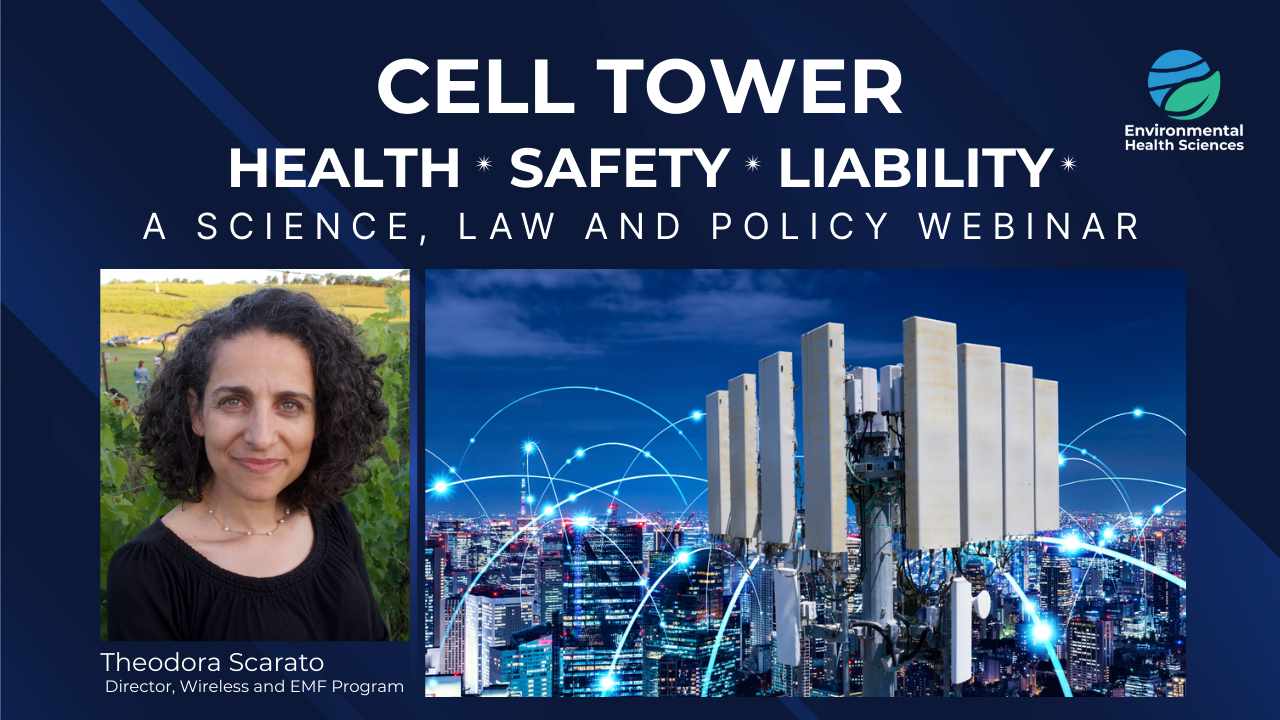
Learn the basics in this expert webinar with Theodora Scarato, MSW, Director of the Wireless & EMF Program at Environmental Health Sciences.
What You Need To Know To Protect Your Community
Cell towers near homes and schools bring many health, safety, and liability risks. From fire to the fall zone, property value devaluation and increased RF radiation exposure, Theodora Scarato will cover the key issues that communities need to understand when a cell tower is proposed in their neighborhood or near their child’s school.
With the federal government proposing unprecedented rulemakings that would dismantle existing local government safeguards, it’s more critical than ever to understand what’s at stake for local communities and families.
To learn more about the health and safety risks of cell towers:
Click on the link to access information.
- The Science on Cell Tower Radiation
- Top 10 Health, Safety, and Liability Risks of Cell Towers Near Schools and Homes
- Cell Towers Drop Property Values
- Cell Towers Bring Liability and Risk
- FACTSHEETS on Cell towers and more.
About Theodora Scarato, MSW, Director of the Wireless and EMF Program at Environmental Health Sciences.
Theodora Scarato is Director of the Wireless and EMF Program at Environmental Health Sciences (EHS) and a nationally recognized expert in environmental health policy related to cell towers, wireless radiation, and electromagnetic fields (EMF). She has co-authored several scientific papers on EMF, health, and environment, and also serves as a Special Expert to the International Commission on the Biological Effects of Electromagnetic Fields (ICBE-EMF).
Having previously long served as Executive Director of Environmental Health Trust, Scarato played a lead role in its landmark federal case against the FCC in which the court mandated the agency explain how its 1996 cell tower radiation exposure guidelines were adequate. She has filed 1000 scientific submissions to the FCC and is involved in current efforts to get the FCC to respond to the 2021 DC Circuit Court mandate, as she is also an individual petitioner in the lawsuit.
Her 2025 paper, “U.S. policy on wireless technologies and public health protection: regulatory gaps and proposed reforms,” published in the journal Frontiers in Public Health, is a foundational paper on how U.S. guidelines were developed and why U.S. policy on cell towers and cell phone radiation is inadequately protective. She chronicles how the EPA lost funding and safety standards were never developed decades ago, and then documents the current lack of regulatory oversight and accountability. The paper details some of her hundreds of Freedom of Information requests to U.S. government agencies, which revealed the FCC had withheld its laboratory findings that cell phones exceed limits at body contact and that CDC webpages were drafted with the help of a wireless industry consultant. She also provides an overview of key regulatory deficiencies, such as the lack of pre-market safety testing and post-market medical surveillance with key recommendations for reform.