
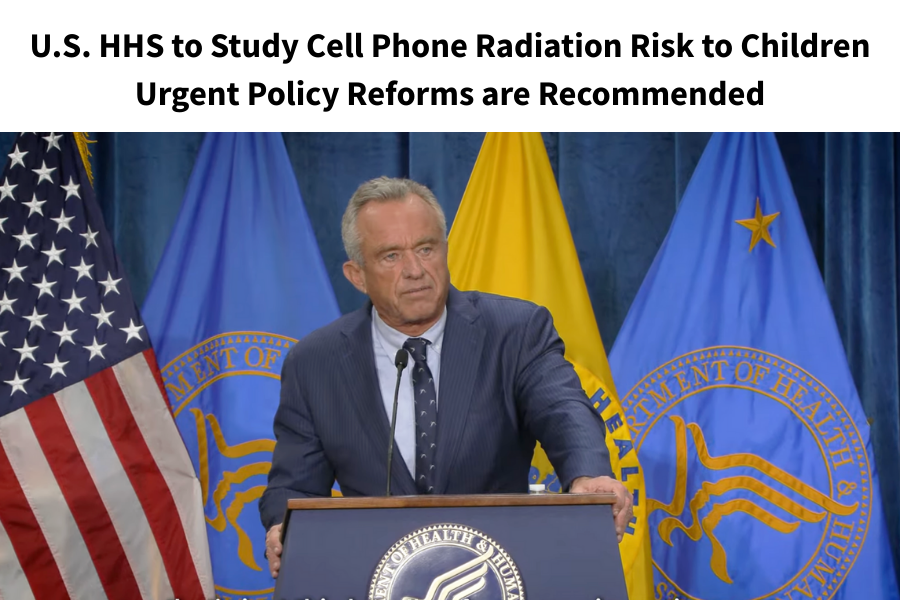
Statement by Theodora Scarato of Environmental Health Sciences
In order to fully address the issue of cell tower and cell phone wireless radiation health risk, an overhaul of the U.S. regulatory framework is needed. Scientists have been studying this issue for decades while facing well-financed industry attacks to their findings and heavy industry influence to policy across both Democratic and Republican administrations. The public health issue of children’s exposure to cell towers and cell phone radiation has remained largely non-partisan, one of the few public-health issues that still crosses political lines.
I noticed changes to the FDA cell phone radiation webpages on December 9, 2025. The previous FDA webpage rewrite was in 2020, when the website was scrubbed, and content downplaying the cancer findings of the National Toxicology Program Studies was posted.
As I detail in my latest publication on U.S. policy, cell tower radiation is an environmental pollutant that has been ignored for far too long by the U.S. government. Hundreds of scientists and physicians are calling for stronger safeguards to protect children, based on an ever-growing body of scientific evidence pointing to cell tower and cell phone radiation health risks, particularly to the nervous system, reproductive organs, and immune system. Children are more vulnerable, as not only do they absorb more cell tower and cell phone radiation compared to adults, but their brains are still in development and more sensitive to impacts.
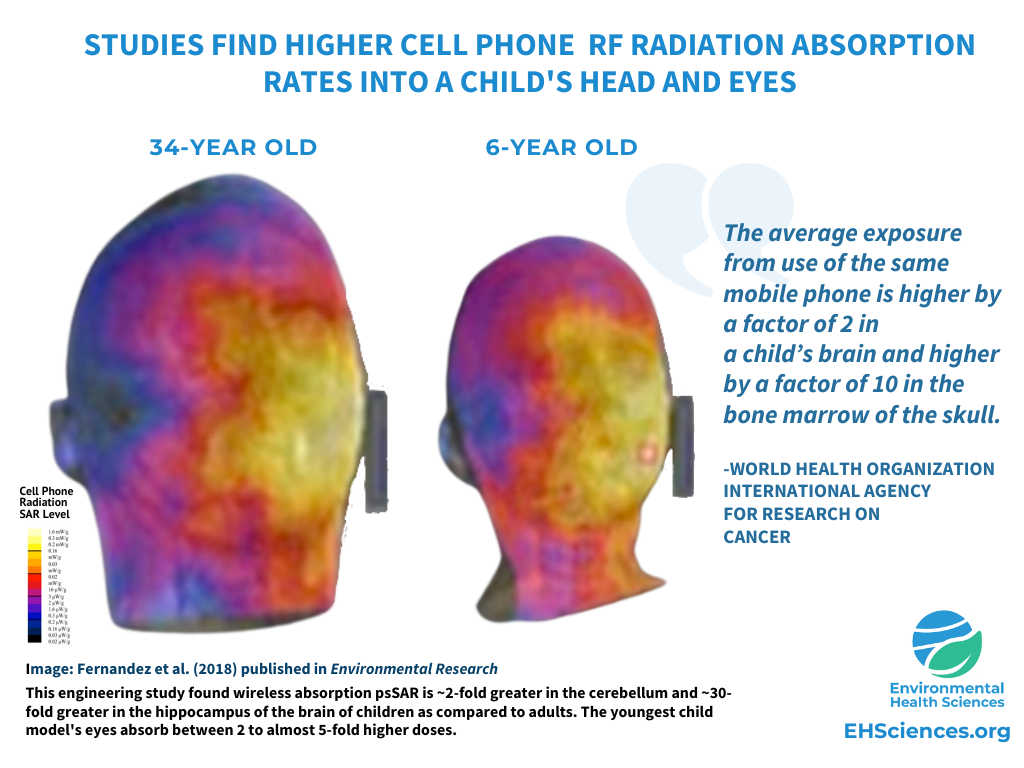
Yet for over two decades, the US has dropped the ball. Federal agencies one might expect to be studying the issue have conducted little meaningful research, health-risk evaluation, or oversight for this increasing exposure. Current U.S. exposure limits for cell towers and cell phones date back to 1996. They are designed only to protect against short-term heating effects, not the long-term, cumulative exposures our children experience today. In 1996, who could imagine that children, let alone babies, would be using cell phones daily; yet antiquated cell phone limits are still the law of the land. Now our children are exposed to far more than cell phones as there are dozens of Wi-Fi, Bluetooth and “smart” devices in our homes and schools, along with a cell tower outside.
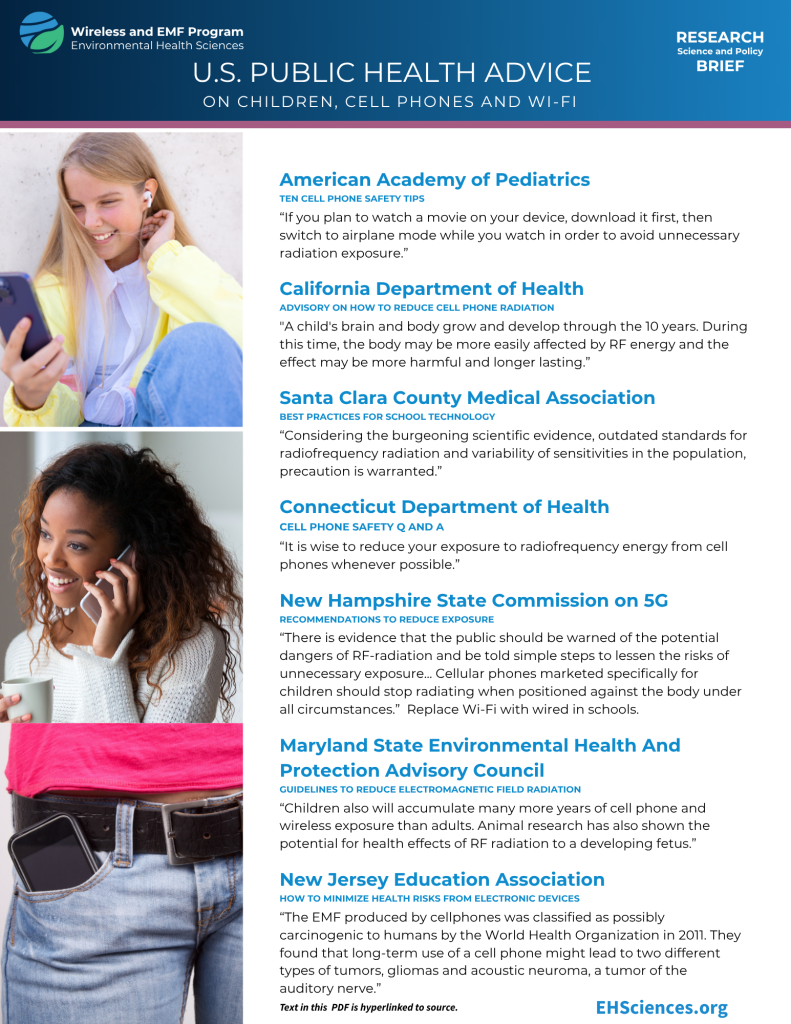
In 2019, a joint order of the French Health and Finance Agencies ordered cell phone consumer information to include several specific ways to reduce RF exposure to the brain, minimizing frequency and duration of cell phone use. In addition, the cell phone information includes “Keep radio equipment away from the belly of pregnant women,” and “away from the lower abdomen of adolescents.”
Why has the United States not adopted comparable consumer guidance?
Download a factsheet with medical and public health guidance in the USA and worldwide.
While Health and Human Services (HHS) is moving to investigate the issue of EMFs, the FCC and Congress are moving in the opposite direction, proposing to fast-track cell towers nationwide by stripping away local city and state control. This will lead to unprecedented increases in cell tower RF radiation environmental exposure. More research is not the answer. The existing scientific evidence and court rulings already require immediate policy action. Safety guidelines must be updated to reflect today’s continuous, real-world exposures, and enforceable safeguards must be put in place now to protect children. Parents and caretakers must be educated about this issue so they can reduce exposure at home.
In the landmark federal lawsuit against the FCC, the D.C. Circuit, a federal court just below the Supreme Court, ordered the FCC to specifically address children’s unique vulnerability to cell phone radiation, finding that the FCC had failed to adequately explain how its cell tower and cell phone radiation limits protect children.
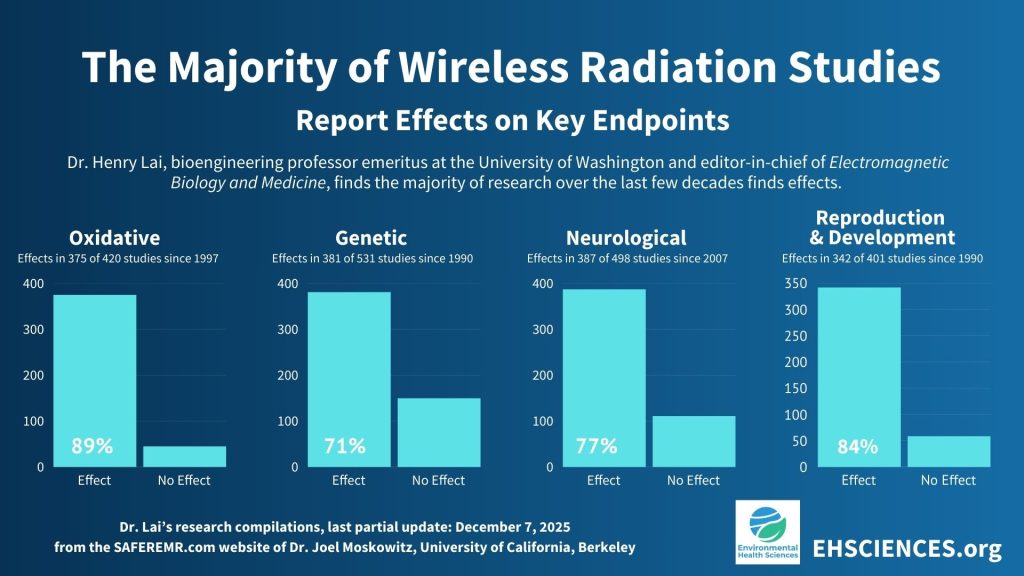
A recent study by Yale researchers found that wireless exposure at Bluetooth exposure levels – 4,000 times lower (0.025%) than the U.S. limits- interfered with neurodevelopment and increased the expression of autism-related genes in laboratory models of the fetal brain. Earlier animal experimental studies at Yale found that prenatal cell phone radiation exposure damaged memory and increased hyperactivity. Their human studies found associations with thyroid cancer. The majority of studies over the last few decades have reported effects. The majority of research studies over the last few decades have reported effects.
Since the court order in 2021, I have submitted thousands of scientific research studies to the FCC. Yet, five years later, the FCC has still not responded to the court order. This is unacceptable.
The International Commission on the Biological Effects of Electromagnetic Fields (ICBE-EMF), an international consortium of physicians and scientists with expertise in the field, sent a letter to Congress just last week, informing our nation’s officials that U.S. wireless radiation limits are outdated, flawed, and scientifically unable to protect the public. They also sent members of U.S. Congress their landmark publication which documented how “adverse effects observed at exposures below the assumed threshold SAR include non-thermal induction of reactive oxygen species, DNA damage, cardiomyopathy, carcinogenicity, sperm damage, and neurological effects, including electromagnetic hypersensitivity. Also, multiple human studies have found statistically significant associations between RFR exposure and increased brain and thyroid cancer risk.”
Further, as detailed in my recently published U.S. policy review paper and EHS’s letter to Congress, the FCC has withheld safety data, refused to release iPhone radiation test results, failed to monitor or enforce real-world exposures. There is no premarket safety testing, no post-market health or compliance surveillance, and research has shown people can be exposed to levels well above our antiquated cell phone limits when the phone is held close to the body.
This situation represents a profound failure of governance. It is time for a change.
To rectify the current situation, government oversight must balance industry power. A strong regulatory framework must be built that rests on transparency and science, free of industry influence. Prevention is the cornerstone of public health, and the U.S. needs to move toward a risk mitigation approach.
The consequences of ignoring the growing science will likely be severe, not only for irreversible health impacts, but also for economic impacts, worker productivity, educational outcomes, and environmental damage. The U.S. should take a leadership role in technology safety by putting children and environmental protection at the center of our decision-making process.
Here are my recommendations to Health and Human Services:
Label cell phones. The RF radiation levels of all cell phones and wireless devices should be publicly posted with clear, easily accessible labels at the point of sale and online. Labels should disclose radiation measurements obtained under real-world use conditions, including body-contact positions. Information on operating frequencies, maximum power output, antenna number and location should also be publicly available. In addition, consumers must be provided with clear, practical guidance on how to reduce RF radiation exposure at the time of purchase and during device setup.
Include special warnings for vulnerable populations: Require clear, prominent black box warnings for children, during pregnancy and for people with medical implants, electronic medical devices, or metal in the body. Warnings should explain the science on health risks, children’s vulnerability, plus the elevated RF exposures from metal on, in, or near the body (from piercings and jewelry to metal implants).
Establish a comprehensive post-market RF radiation surveillance system for cell phones and wireless devices to verify ongoing compliance with RF radiation exposure limits. All radiation measurement data should be posted online in a publicly accessible format for consumers. Devices that exceed RF radiation limits should be taken off the market until corrective action is taken.
Test cell phones and wireless devices in body contact positions: Cell phones and wireless devices should be tested in real-world body-contact positions, not with unrealistic separation distances, as they are now. Radiation compliance tests should reflect how people, especially children, actually use and carry devices. Tests must also account for cumulative exposure from multiple devices and sources operating simultaneously, as real-world RF radiation exposure is additive.
Require pre-market safety testing: Fifth-generation (5G) technology was introduced without such testing, despite its higher frequencies and changes in antenna design. Cell phones that once used one or two antennas now contain five or more, yet phones are still not evaluated for health effects before being sold. All wireless devices, including cell phones, should undergo independent safety testing for long term health effects prior to market approval, and further cell tower expansion should be halted until comprehensive safety testing is completed.
Evaluate FCC’s 1996 cell phone and wireless human exposure limit with a rigorous scientific review of the totality of the evidence on biological and non-thermal effects. The FDA has never done this. A public health approach to developing safety guidelines is needed.
Develop policies for schools to practically implement to reduce wireless exposure in classrooms: This would mean wired Ethernet internet connections networks, cell phones off and away all day, and a ban on cell towers on or near school property.
Require transparent monitoring and disclosure: Mandate routine RF radiation measurements in schools and homes and require public disclosure of exposure levels to parents, educators, and residents. If a cell tower is proposed nearby, all of the community must be notified with a change for meaningful participation.
Educate the public: Update the FDA, CDC, and other HHS website pages with the latest scientific research and clear information on how to reduce cell phone, Wi-Fi, and other wireless radiation. Post simple steps for devices such as cell phones, Wi-Fi laptops and tablets, wireless earbuds, and other wireless connected devices at home. Develop education programs for parents, caretakers, and students.
About Theodora Scarato, MSW
Director of the Wireless and EMF Program at Environmental Health Sciences.
Scarato is a leading expert in environmental health policy related to cell towers. She has co-authored several scientific papers and serves as a Special Expert to the International Commission on the Biological Effects of Electromagnetic Fields (ICBE-EMF).
Her most recent, Frontiers in Public Health publication is “U.S. policy on wireless technologies and public health protection: regulatory gaps and proposed reforms.” Having previously long served as Executive Director of EHT, Scarato played a lead role in the D.C. Circuit federal case against the FCC in which the court mandated the agency explain how its 1996 cell tower radiation exposure guidelines were adequate with regards to children’s vulnerability, long term exposure and wildlife impacts. The court also ordered the FCC to respond as to how its compliance tests, which do not test phones at body contact, were relevant.
She also co-authored a review on impacts to wildlife with several distinguished experts, Flora and fauna: how nonhuman species interact with natural and man-made EMF at ecosystem levels and public policy recommendations. The paper concludes with policy recommendations specifically aimed at protecting nature and ecosystems.
She is involved in current efforts to get the FCC to respond to the 2021 DC Circuit Court mandate as she is a petitioner in the case and has filed numerous scientific submissions to the FCC over the years. Most recently she submitted over 200 filings regarding the FCC’s cell tower fast-track proposals.
About Environmental Health Sciences
Environmental Health Sciences (EHS) is a scientific nonprofit organization focused on environmental health issues. The EHS Wireless and EMF Program works to create and disseminate knowledge resources that increase understanding of the health and ecological risks posed by wireless and other non-ionizing EMF exposures, counter industry misinformation, promote safer technology, and support meaningful policy change.