
The current scientific evidence increasingly indicates that wireless radiation and other non-ionizing electromagnetic fields (EMFs) emitted by power lines, mobile phones, cell towers, and wireless infrastructure can harm wildlife, including bees and other key insect pollinators that are essential to ecosystem function and agriculture.
Rapid build-outs of cell towers and wireless networks will increase environmental exposures and introduce higher frequencies that can be expected to worsen / magnify impacts. Wildlife biologists are urgently calling for updated regulations that safeguard flora and fauna.
Jumplinks:
- The Scientific Evidence
- Insect Pollinators Are Uniquely Vulnerable
- Wireless and EMFs Are Considered a Driver of Colony Collapse Disorder and Insect Decline
- Scientific Research Reports Harm to Plants and Trees
- Governments Lack Safeguards to Protect Wildlife
- Recommendations to Protect Flora and Fauna from Increasing EMF
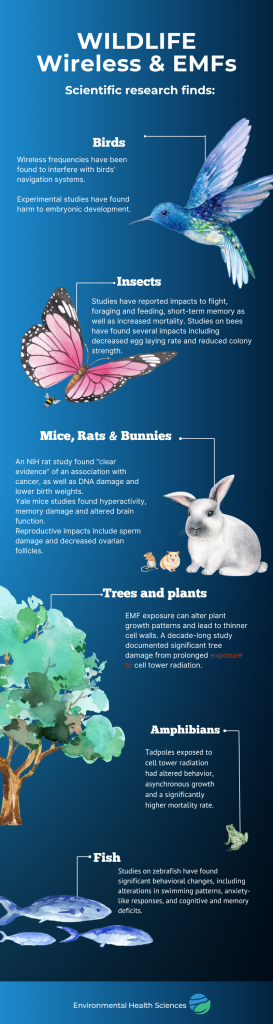
Download our factsheet on wildlife and wireless radiation. This PDF is designed to be emailed with hyperlinks to scientific research in the text. We also have an infographic to share on social media at this link.
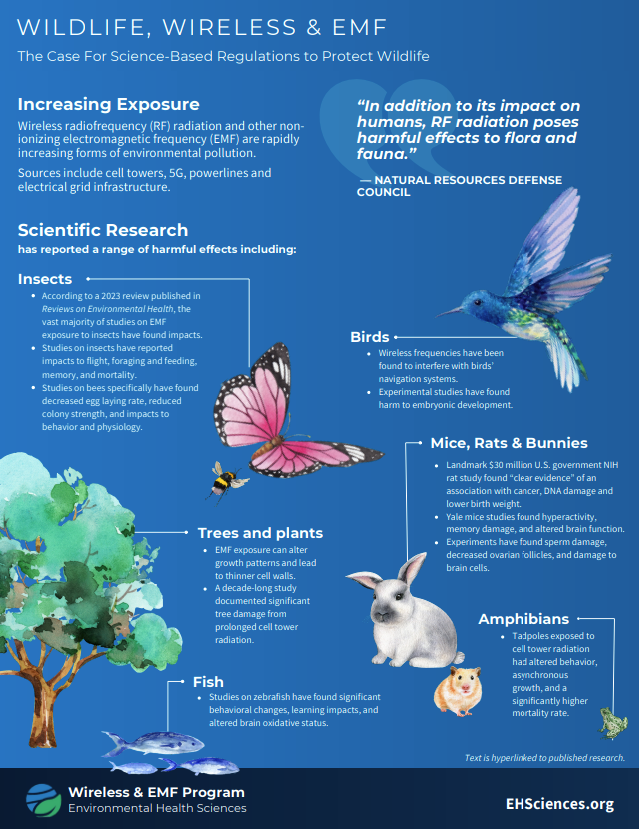
Wildlife, Wireless & EMF Fact Sheet
Growing Scientific Evidence on Impacts to Flora and Fauna
Numerous peer-reviewed studies report adverse effects from wireless and non-ionizing EMF radiation exposure on birds, bees, and other insects. Scientists state that EMFs should be considered a contributing driver of global insect decline, acting synergistically with pesticides, habitat loss, invasive species, and climate change.
A landmark three part research review of non-ionizing EMF’s impacts to flora and fauna citing more than 1,200 scientific references (Levitt et al. 2021a, Levitt et al. 2021b, Levitt et al. 2021c) found a broad range of impacts in all species studied:
Numerous studies across all frequencies and taxa indicate that current low-level anthropogenic EMF can have myriad adverse and synergistic effects, including on orientation and migration, food finding, reproduction, mating, nest and den building, territorial maintenance and defense, and on vitality, longevity and survivorship itself. Effects have been observed in mammals such as bats, cervids, cetaceans, and pinnipeds among others, and on birds, insects, amphibians, reptiles, microbes and many species of flora.
-Blake Levitt, Henry Lai and Albert Manville in “Effects of non-ionizing electromagnetic fields on flora and fauna, Part 2 impacts: How species interact with natural and man-made EMF” Reviews on Environmental Health (2022)
A 2025 follow-up review by the same authors, “Flora and fauna: how nonhuman species interact with natural and man-made EMF at ecosystem levels and public policy recommendations” updates the body of evidence drawing on newer insect exposure data, ecological measurements documenting how “today’s exposures are capable, even at very low intensities, of disrupting critical fauna/flora functions.” They caution that exposure regulations written exclusively for humans “completely miss the point of nonhuman species’ unique physiologies and extreme sensitivities.”
Insect Pollinators are Uniquely Vulnerable to Wireless Radiation
Insect pollinators are uniquely vulnerable to wireless radiation because higher-frequency signals—now rapidly expanding with 5G—are absorbed by insects at much higher levels than signals used in earlier technologies. Studies show that insects, including honey bees, absorb significantly more radiation from 5G frequencies than from 2G and 3G, as the shorter wavelengths more closely match insects’ body size, creating a resonance effect that increases energy absorption.
Even when cell antenna power levels remain the same, shifting to higher frequencies dramatically increases the amount of radiation absorbed by insects—particularly in the brain and other vital organs.
In the first study to examine this, researchers modeled four species—the Australian stingless bee, western honey bee, beetle, and locust—and found a consistent pattern: as frequencies increased toward each insect’s resonant range, absorbed power rose sharply. The researchers concluded this “could lead to changes in insect behavior, physiology, and morphology over time.”
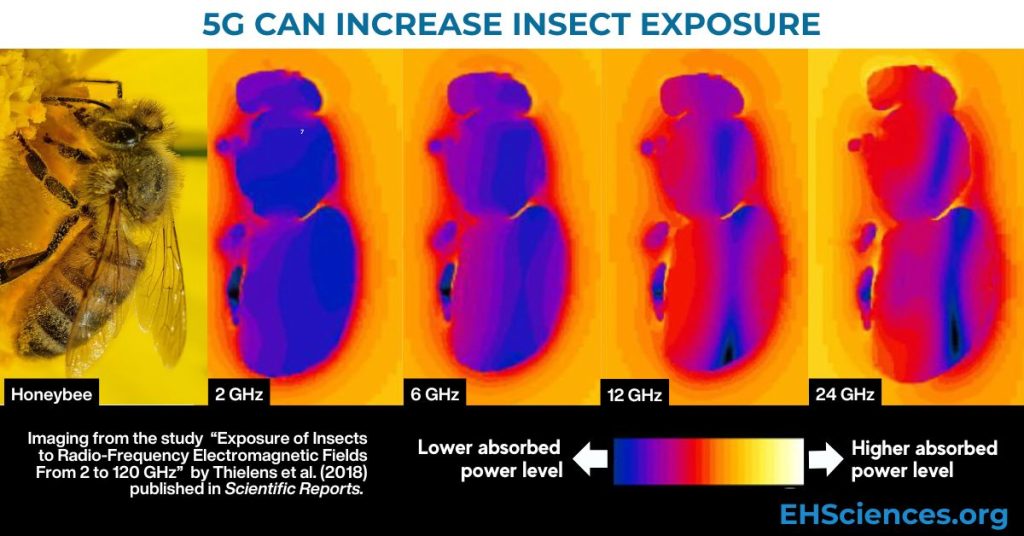
Follow-up scientific modeling of honey bees across their full life cycle, combined with real-world exposure data near beehives, found that shifting just 10% of environmental radiation to frequencies above 3 GHz—commonly used in 5G—could increase absorbed power by 390% to 570%.
More recent studies have found significant increases in energy absorption in bee brains and vital organs at specific high frequencies used in modern technologies. A 2025 study published in the International Journal of Radiation Biology examined how 5G and next-generation wireless radiofrequency (RF) radiation frequencies are absorbed into 4 different insects – the honeybee, wasp, ladybug, and praying mantis, and found sharp increases depending on several variables, including the waves’ frequency and polarization, and the insect’s size, structure, and morphology.
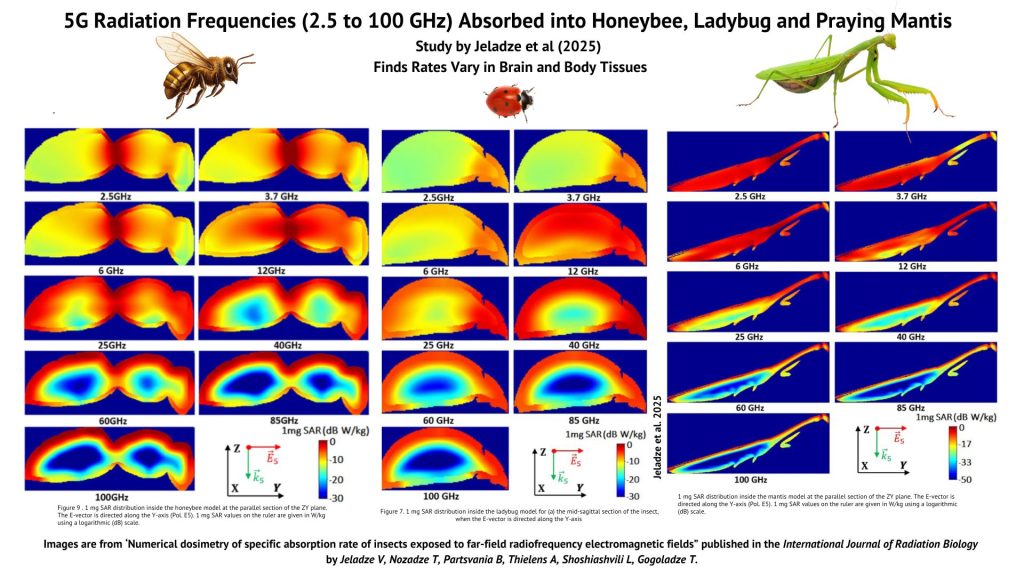
Maximal RF absorption into the insects’ brain and inner tissues was found at 6, 12, and 25 GHz, except the brain tissue of a ladybug (max at 60 GHz) due to its smaller head. However, absorption into insects’ cuticles (their hard outside covering) increased with frequency; for instance, the ladybug cuticle’s rate rose from 0.1 W/kg at 2.5 GHz to 11.9 W/kg at 100 GHz – 119 times higher. Yet, the wireless revolution is increasing environmental wireless exposures at an unprecedented scale without regard for animal impacts.
Wireless Radiation and EMFs Are Considered Drivers of Colony Collapse Disorder and Insect Decline
Biologists are warning that this exposure is likely a key contributor to colony collapse in bee populations. A review by wildlife biologist Alfonso Balmori published in Science of the Total Environment entitled “Electromagnetic radiation as an emerging driver factor for the decline of insects” found “sufficient evidence” that electromagnetic radiation impacts insects and concludes that “electromagnetic radiation should be considered seriously as a complementary driver for the dramatic decline in insects, acting in synergy with agricultural intensification, pesticides, invasive species and climate change.”
Some of the harmful impacts to bees from power-frequency and wireless EMF sources referenced by Balmori included:
- Loss of queen cells
- Changes to weight gain of hive
- Poor survival in winter
- Changes to flight, foraging, and feeding
- Impacts to short-term memory
- Induction of worker piping signals which can mean disturbance or preparation for swarming
- Reduced egg-laying speed of queen
- Decline in honey production
- Decreased honeycomb weight
- Increased mortality
A field study published in Insects found that combined exposure to pesticides and non-ionizing EMFs significantly worsened bee health, increasing disease prevalence, mortality, behavioral abnormalities, and biochemical disruptions. Under these multi-stress conditions, three of four colonies collapsed, supporting a causal role in hive depopulation and colony collapse disorder (CCD).
A 2023 systematic review and meta-analysis on insects and EMFs published in Reviews on Environmental Health reported that the vast majority of studies identified harmful biological effects of non-ionizing EMFs on insects, often at exposure levels below those currently considered safe for humans. Documented effects include disrupted navigation, reduced reproduction and fertility, altered flight dynamics, immune dysfunction, mitochondrial damage, and DNA strand breaks.
Based on an assessment of the overall study situation on insects, we must warn against a careless deployment of further mobile telephony infrastructure, as harmful effects on insect populations would be likely, especially if interactions with other noxious agents are taken into account (including high-voltage power lines and artificial lighting). This might lead to further declines of already dwindling populations of pollinators, and would thereby entail costs for humanity.
-Alain Thill, Marie-Claire Cammaerts and Alfonso Balmori in “Biological effects of electromagnetic fields on insects: a systematic review and meta-analysis.” Reviews on Environmental Health (2023)
Powerline EMF Impacts to Bees
Research has documented that the EMFs generated by high-voltage transmission lines can negatively affect pollinators, particularly honeybees, by interfering with navigation, foraging, learning, stress physiology, and pollination efficiency. Because honeybees rely on highly sensitive electrical, magnetic, and sensory cues to locate flowers and communicate within colonies, researchers have raised concerns that chronic exposure to power line-associated EMFs and electric fields could contribute to pollinator decline.
As just one example, a study published in Science Advances by Molina-Montenegro et al. (2023) on honeybees and EMFs from high-voltage transmission towers found that the EMF exposure increased stress-related gene expression, reduced honeybee flower visitation, impaired pollination efficiency, and even decreased seed production and plant community richness near the power lines.
Scientific Research Reports Harm to Plants and Trees
Multiple reviews examining wireless radiation’s impacts to plants report biological effects, with sensitivity varying by species and frequency (Halgamuge 2017; Kaur 2021; Panda 2024). Documented impacts include altered growth and development, thinner cell walls, changes in gene expression, and disrupted metabolic activity.
A nine-year field study of more than 100 trees found significant, asymmetric canopy damage near cell tower antennas, beginning on the side of the tree most exposed to wireless radiation from nearby cell antennas. Experimental research on aspen seedlings similarly found reduced leaf and shoot growth and biochemical changes following wireless radiation exposure, while shielded seedlings showed no effects.
Governments Lack Safeguards to Protect Wildlife
Despite rising environmental levels of wireless radiation, there are no safety standards for ambient environmental wireless radiation that take into account impacts to flora and fauna. Instead, government “safety” limits are only set to avoid overheating and interference between electromagnetic devices, but not for biological impacts to animals and their habitat. Most wireless infrastructure projects are exempted from environmental review, preventing assessment of cumulative, ecosystem-level impacts.This is a critical regulatory gap. Animals and their habitat must be protected with federally developed science-based limits.
In 2021, the DC Circuit of the U.S. Court of Appeals stated that the Federal Communications Commission (FCC) had “completely failed even to acknowledge, let alone respond to, comments concerning the impact of RF radiation on the environment,” highlighting a U.S. Department of Interior letter which detailed published studies showing wireless radiation impacts to birds.
The letter states that “There is a growing level of anecdotal evidence linking effects of non-thermal, non-ionizing electromagnetic radiation from communication towers on nesting and roosting wild birds and other wildlife.“ It further stated, “the electromagnetic radiation standards used by the Federal Communications Commission (FCC) continue to be based on thermal heating, a criterion now nearly 30 years out of date and inapplicable today.”
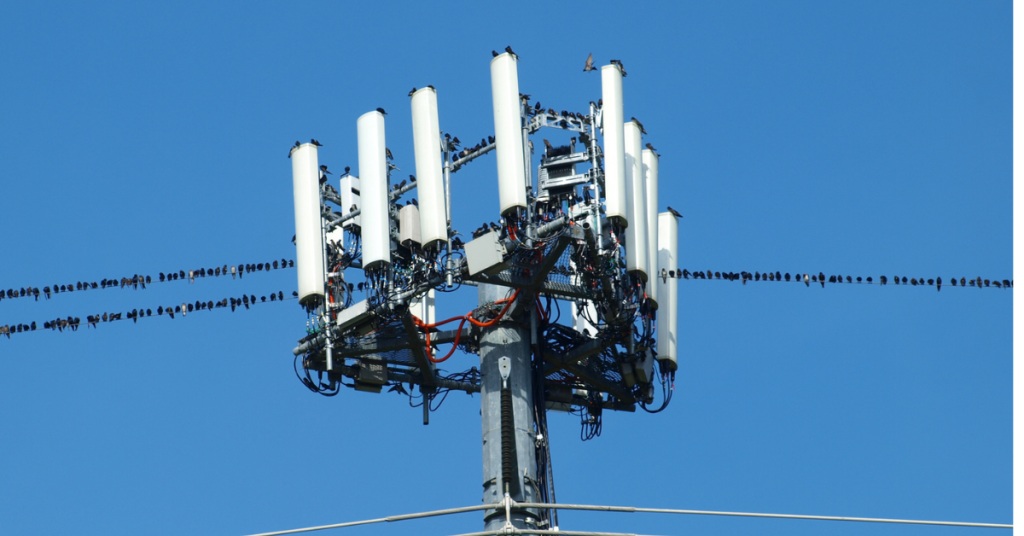
Regulatory loopholes allow wildlife to be exposed to cell tower wireless radiation at levels higher than federal limits. In addition to irrelevant wireless radiation exposure limits, government cell tower and wireless compliance procedures fail wildlife as cell towers and base station antennas are allowed to have non-compliance zones that extend sometimes over 50 feet, creating hazardous exposures for animals that inhabit the air or trees near the infrastructure.
Recommendations to Protect Flora and Fauna from Rising EMF
As outlined by numerous experts, current environmental governance has failed to keep pace with the rapid expansion of wireless technologies. A systematic approach to regulating artificial wireless and non-ionizing EMF is an essential next step. Government regulations should safeguard plants and wildlife.
“Wildlife loss is often unseen and undocumented until tipping points are reached. A robust dialogue regarding technology’s high-impact role in the nascent field of electroecology needs to commence.”
-Blake Levitt, Henry Lai and Albert Manville in “Effects of non-ionizing electromagnetic fields on flora and fauna Part 3: Exposure standards, public policy, laws, and future directions.” Reviews on Environmental Health (2021)
“Flora and fauna: how nonhuman species interact with natural and man-made EMF at ecosystem levels and public policy recommendations” provides a comprehensive set of recommendations synthesized briefly below:
Develop Environmental Non-ionizing EMF Exposure Limits for Wildlife:
Regulatory agencies should establish science-based EMF exposure limits designed to protect flora and fauna, not just humans, recognizing that nonhuman species can be impacted by non-ionizing EMF at far lower thresholds.
Recognize and Treat Wireless and Other Non-ionizing EMF as Environmental Pollution:
As recommended by Levitt et al., EMF should be regulated “like other pollutants,” with airspace formally designated as habitat so exposures that affect flying, nesting, and arboreal species are not ignored. Given documented biological effects, policy should err on the side of protection, particularly for threatened species and sensitive habitats. An ecosystem framework is needed to address impacts across interconnected biological systems, from microbiota to plants, insects, birds, and mammals, rather than evaluating species in isolation.
Address Non-Thermal and Signal-Specific Effects:
Regulations must move beyond assumptions of thermal heating as the only harm from wireless radiation exposure and account for biologically active exposure characteristics such as modulation, pulsing, polarization, and signal variability.
Account for Chronic and Cumulative Exposures:
Agencies should evaluate long-term, low-intensity, cumulative EMF exposures that now occur continuously across landscapes and ecosystems.
Require Premarket Safety Testing:
New wireless technologies, frequencies, and antenna systems should undergo robust pre-deployment testing for impacts on wildlife and vegetation, instead of being introduced first and studied later.
Implement Policies to Mitigate Environmental EMF Today:
Decision-makers should prioritize exposure reduction rather than defaulting to ubiquitous wireless deployment. Ecologically sensitive areas such as forests, parks, wildlife refuges, migration corridors, and pollinator habitats should include low- or no-EMF zones. Where feasible, wired and fiber-optic systems should be installed, because they deliver connectivity without emitting wireless radiation into the environment.
As stated by Froidevaux et al. (2023) in “Addressing Wildlife Exposure to Radiofrequency Electromagnetic Fields: Time for Action”:
“Pending further evidence, we strongly recommend the implementation of complementary measures aimed at reducing wildlife exposure to RF-EMF, particularly for species of major conservation concern. First, we advocate for strategic spatial planning by aiming the emissions from mobile phone masts away from areas of wildlife conservation significance, such as optimal foraging and nesting sites. Second, emission limitation strategies should be employed, particularly for mobile phone masts that create exposure in these sensitive areas. Third, technical adjustments such as optimizing antenna orientation and installation height and implementing shielding, discouraging, or obstruction mechanisms could further contribute to reducing wildlife exposure to RF-EMF, albeit their effectiveness should first be tested. These measures should ideally be accompanied by a systematic monitoring of wildlife exposure to RF-EMF.”
Halt High-Risk Deployments:
Deployments of 5G millimeter- and sub-millimeter-wave technologies should be paused, especially in sensitive wildlife habitats, until adequate regulatory frameworks ensure safety.
Reform Environmental Review Under NEPA:
Wireless infrastructure approvals should undergo meaningful environmental review that considers cumulative impacts, alternatives, and mitigation—rather than relying on categorical exclusions. Radiofrequency compliance reports, environmental assessments, and exposure data should be transparent, centralized, and easily available to the public.
Establish Nationwide Environmental Monitoring and Surveillance:
Agencies should implement long-term EMF monitoring programs, with special attention to emissions in forests, parks, and wildlife habitat, to track real-world exposure trends as well as the health of plants and animals.
Integrate EMFs Into Wildlife Protection Laws:
Impacts from non-ionizing EMFs should be explicitly considered under the Migratory Bird Treaty Act and Endangered Species Act, including “take” provisions.
Scientific Research on Impacts to Flora and Fauna
Click on these drop-down links to access some key scientific research studies on the impacts of wireless radiation and powerline EMF on animals and their habitat. These are only a few of the published studies clearly indicating environmental risk.
- Reviews & Policy Recommendations
Comprehensive Reviews by Levitt et al.
Flora and fauna—How nonhuman species interact with natural and man-made EMF at ecosystem levels and public policy recommendations by Levitt et al. Frontiers in Public Health (2025).
Effects of non-ionizing electromagnetic fields on flora and fauna, part 1. Rising ambient EMF levels in the environment by Levitt et al. Reviews on Environmental Health (2021).
Effects of non-ionizing electromagnetic fields on flora and fauna, Part 2 impacts: How species interact with natural and man-made EMF by Levitt et al. Reviews on Environmental Health (2021).
Effects of non-ionizing electromagnetic fields on flora and fauna, Part 3. Exposure standards, public policy, laws, and future directions by Levitt et al. Reviews on Environmental Health (2021).
Radio tracking systems
Health and environmental effects to wildlife from radio telemetry and tracking devices—state of the science and best management practices by Manville et al. Frontiers in Veterinary Science (2024).
Radio-tracking systems emit pulsed waves that could affect the health and alter the orientation of animals by Balmori. Journal for Nature Conservation (2024).
Key Review Papers
Electromagnetic radiation as an emerging driver factor for the decline of insects by Balmori. Science of the Total Environment (2021).
Anthropogenic radiofrequency electromagnetic fields as an emerging threat to wildlife orientation by Balmori. Science of The Total Environment (2015).
Electrosmog and species conservation by Balmori. Science of The Total Environment (2014).
Radiotelemetry and wildlife: Highlighting a gap in the knowledge on radiofrequency radiation effects by Balmori. Science of The Total Environment (2016).
Electromagnetic pollution from phone masts. Effects on wildlife by Blamori. Pathophysiology (2009).
The incidence of electromagnetic pollution on wild mammals: A new “poison” with a slow effect on nature? by Balmori. Environmentalist (2010).
A review of the ecological effects of radiofrequency electromagnetic fields (RF-EMF) by Cucurachi et al. Environment International (2013).
Addressing Wildlife Exposure to Radiofrequency Electromagnetic Fields: Time for Action by Froidevaux et al. Environmental Science & Technology Letters (2024).
Is electromagnetism one of the causes of the CCD? A work plan for testing this hypothesis by Cammaerts. Journal of Behavior (2017).
Biological effects of electromagnetic fields on insects: a systematic review and meta-analysis by Thill et al. Reviews on Environmental Health (2023).
Review on the impact of cell phone radiation effects on green plants by Panda et al. Environmental Monitoring and Assessment (2024).
Biophysical mechanism of animal magnetoreception, orientation and navigation by Panagopoulos et al. Scientific Reports (2024).
Impacts of radio-frequency electromagnetic field (RF-EMF) from cell phone towers and wireless devices on biosystem and ecosystem-a review by Sivani & Sudarsanam. Biology and Medicine (2012).
Electromagnetic fields regulate iron metabolism in living organisms: A review of effects and mechanism by Zhen et al. Progress in Biophysics and Molecular Biology (2024).
Policy Recommendations:
Addressing Wildlife Exposure to Radiofrequency Electromagnetic Fields: Time for Action by Froidevaux et al. Environmental Science & Technology Letters (2023).
Low-level EMF effects on wildlife and plants: What research tells us about an ecosystem approach by Levitt et al. Frontiers in Public Health (2022).
Effects of non-ionizing electromagnetic fields on flora and fauna, Part 3. Exposure standards, public policy, laws, and future directions by Levitt et al. Reviews on Environmental Health (2021).
U.S. policy on wireless technologies and public health protection: regulatory gaps and proposed reforms by Theodora Scarato. Frontiers in Public Health (2025).
- Insects & Bees
Biological effects of electromagnetic fields on insects: a systematic review and meta-analysis by Thill et al. Reviews on Environmental Health (2023).
Electromagnetic fields disrupt the pollination service by honeybees by Molina-Montenegro et al. Science Advances(2023).
Electromagnetic radiation as an emerging driver factor for the decline of insects by Balmori. Science of the Total Environment (2021).
Extremely Low Frequency Electromagnetic Fields impair the Cognitive and Motor Abilities of Honey Bees by Shepherd et al. Scientific Reports (2018).
Studies on Exposure from 5G and Higher Frequencies
Exposure of Insects to Radio-Frequency Electromagnetic Fields from 2 to 120 GHz by Thielens et al. Scientific Reports (2018).
Numerical dosimetry of specific absorption rate of insects exposed to far-field radiofrequency electromagnetic fields by Jeladze et al. International Journal of Radiation Biology (2025).
Radio-Frequency Electromagnetic Field Exposure of Western Honey Bees by Thielens et al. Scientific Reports(2020).
Estimation of the Specific Absorption Rate for a Honey Bee Exposed to Radiofrequency Electromagnetic Fields from 2.5 to 100 GHz by Jeladze et al. IEEE International Seminar/Workshop on Direct and Inverse Problems of Electromagnetic and Acoustic Wave Theory (2023).
- Mammals & Birds
Mammals:
Tumor promotion by exposure to radiofrequency electromagnetic fields below exposure limits for humans by Lerchl et al. Biochemical and Biophysical Research Communications (2015).
Compound exposure of 2.8 GHz and 9.3 GHz microwave causes learning and memory impairment in rats by Sun et al. Heliyon (2025).
Fetal RFR Exposure From 800-1900 MHz-Rated Cellular Telephones Affects Neurodevelopment and Behavior in Mice by Aldad et al. Scientific Reports (2012).
Disruption of the ovarian follicle reservoir of prepubertal rats following prenatal exposure to a continuous 900-MHz electromagnetic field by Türedi et al. International Journal of Radiation Biology (2016).
Evaluation of the genotoxicity of cell phone radiofrequency radiation in male and female rats and mice following subchronic exposure by Smith et al. Environmental and Molecular Mutagenesis (2020).
Toxicology and carcinogenesis studies in Hsd: Sprague Dawley SD rats exposed to whole-body RFR at a frequency (900 MHz) and modulations (GSM and CDMA) used by cell phones by the National Toxicology Program. U.S. Department of Health and Human Services, National Institutes of Health (2018).
Report of final results regarding brain and heart tumors in Sprague-Dawley rats exposed from prenatal life until natural death to mobile phone radiofrequency field representative of a 1.8 GHz GSM base station environmental emission by Falcioni et al. Environmental Research (2018).
Changes in the histopathology and in the proteins related to the MAPK pathway in the brains of rats exposed to pre and postnatal radiofrequency radiation over four generations by Tan et al. Journal of Chemical Neuroanatomy (2022).
Birds:
Teratogenic effects of radiofrequency electromagnetic radiation on the embryonic development of chick: A study on morphology and hatchability by Augustianath et al. Research in Veterinary Science (2023).
Short-term exposure of 2.4 GHz electromagnetic radiation on cellular ROS generation and apoptosis in SH-SY5Y cell line and impact on developing chick embryo brain tissue by Deena et al. Molecular Biology Reports (2025).
Possible Effects of Electromagnetic Fields from Phone Masts on a Population of White Stork (Ciconia ciconia) by Balmori. Electromagnetic Biology and Medicine (2009).
The urban decline of the house sparrow (Passer domesticus): a possible link with electromagnetic radiation by Balmori & Hallberg. Electromagnetic Biology and Medicine (2009).
A possible effect of electromagnetic radiation from mobile phone base stations on the number of breeding house sparrows (Passer domesticus) by Everaert & Bauwens. Electromagnetic Biology and Medicine (2009).
4G mobile phone radiation alters some immunogenic and vascular gene expressions, and gross and microscopic and biochemical parameters in the chick embryo model by Islam et al. Veterinary Medicine and Science (2023).
Magnetoreception in birds: The effect of radio-frequency fields by Wiltschko et al. Journal of The Royal Society Interface (2015).
- Amphibians & Fish
Amphibians:
Mobile phone mast effects on common frog (Rana temporaria) tadpoles: the city turned into a laboratory by Balmori. Electromagnetic Biology and Medicine (2010).
The incidence of electromagnetic pollution on the amphibian decline: Is this an important piece of the puzzle? By Balmori. Toxicological & Environmental Chemistry (2006).
Fish:
Effects of 700 and 3500 MHz 5G radiofrequency exposure on developing zebrafish embryos by Torres-Ruiz et al. Science of the Total Environment (2024).
Short- and long-duration exposures to cell-phone radiofrequency waves produce dichotomous effects on phototactic response and circadian characteristics of locomotor activity rhythm in zebrafish, Danio rerio by Malik et al. Biological Rhythm Research (2021).
Neurobehavioural Changes and Brain Oxidative Stress Induced by Acute Exposure to GSM900 Mobile Phone Radiations in Zebrafish (Danio rerio) by Nirwaneet al. Toxicological Research (2016).
Transcriptomic and Long-Term Behavioral Deficits Associated with Developmental 3.5 GHz Radiofrequency Radiation Exposures in Zebrafish by Dasgupta et al. Environmental Science & Technology Letters (2022).
- Plants & Trees
Adverse Influence of Radio Frequency Background on Trembling Aspen Seedlings: Preliminary Observations by Haggerty. International Journal of Forestry Research (2010).
Radiofrequency radiation injures trees around mobile phone base stations by Waldmann-Selsam et al. Science of The Total Environment (2016).
Review on the impact of cell phone radiation effects on green plants by Panda et al. Environmental Monitoring and Assessment (2024).
Sensitivity of plants to high frequency electromagnetic radiation: Cellular mechanisms and morphological changesby Kaur et al. Reviews in Environmental Science and Bio/Technology (2021).
Review: Weak radiofrequency radiation exposure from mobile phone radiation on plants by Halgamuge.Electromagnetic Biology and Medicine (2017).
Infographic on wireless and wildlife to share.