
At the American Public Health Association (APHA) Annual Meeting, Theodora Scarato presented at a roundtable discussion on cell towers and critical gaps in U.S. regulation of wireless radiation, highlighting regulatory deficiencies and gaps in oversight and protection.
(Scarato also presented at the conference on cell towers at schools and the need for worker protection and an occupational health program for EMF and Environmental Health Sciences hosted a well-attended booth distributing fact sheets and information on wireless and health.)
In the meeting, Scarato shared details of the landmark DC Circuit lawsuit against the FCC, which centered on the U.S. government’s 1996 regulations for cell tower and wireless radiation exposure. In 2021, the federal court issued a mandate that the FCC show proper examination of evidence on its record related to non-cancer health effects (such as impacts to reproduction, brain development, and the immune system), long-term exposure, children’s vulnerability, and environmental impacts. The court also mandated the FCC explain how its compliance test procedures (which allow a separation between the phone and body for RF radiation compliance testing) were adequate. In short, the FCC was ordered to show how its 1996 wireless radiation safety limits were protective in light of recent technology and over two decades of published research studies since the limits were set. The FCC has not responded.
Many people assume that federal wireless human exposure limits are regularly reviewed by independent scientists and federal health agencies to ensure protection for the public. The Court’s ruling confirmed that this assumption is incorrect, as no federal agency has shown review of the totality of current research. Therefore, until the FCC properly responds to the court, FCC compliance for cell towers, cell phones and wireless devices cannot be equated with safety—particularly for children, long-term exposures, and the environment- all issues the FCC ignored.
American Public Health Association
Title: Regulatory Gaps in U.S. Wireless Radiation Policy: Public Health Implications and Recommendations for Reform
Session: Law Section Roundtable
Date: Tuesday, November 4, 2025
Below are selected issues Scarato shared.
Summary of Scarato’s Presentation
Wireless technologies such as cell phones, laptops and “smart” things are ubiquitous in every sector of our modern life from home to school to work. Yet the regulatory framework that governs the wireless radiofrequency radiation (RFR) exposures from these devices has not evolved with their rapid expansion.
Common school and household sources include Wi-Fi routers, tablets, laptops, cell phones, cordless phones, smart boards, Bluetooth devices, baby monitors, wireless printers, and microwave ovens.
The Federal Communications Commission (FCC) is the lead U.S. agency for RFR exposure regulation, yet it relies on human exposure limits established in 1996, designed to protect only against heating effects from short-term exposure rather than biological impacts from long-term, low-level exposure. No U.S. public health or environmental federal agency currently maintains an active program to review the expanding body of scientific research investigating health and environmental impacts. Significant policy gaps related to oversight and transparency paired with heavy industry involvement leave the public, workers, and the environment without adequate protection.
Key Deficiencies of the US Regulatory Framework for Wireless Radiation
- Outdated 1996 human exposure limits that do not protect for effects of long term exposure.
- Minimal federal health and environmental agency research on the health effects of wireless radiation.
- No safeguards for children’s vulnerability.
- No premarket safety testing before deployment of new technologies.
- Flawed compliance test procedures.
- No oversight program to ensure cell phones and cell tower emissions are compliant. No required yearly checks or audits for cell towers.
- No national program to measure and monitor RFR exposures in communities.
- No national, publicly accessible database of all cell tower and antenna sites.
- No robust occupational health program for wireless and non-ionizing radiation protection at work
- No post-market surveillance of health or environmental impacts.
- No reporting mechanism for medical professionals to report impacts.
- No protections for wildlife.
The U.S. Permits High Wireless Exposures Compared to Other Countries
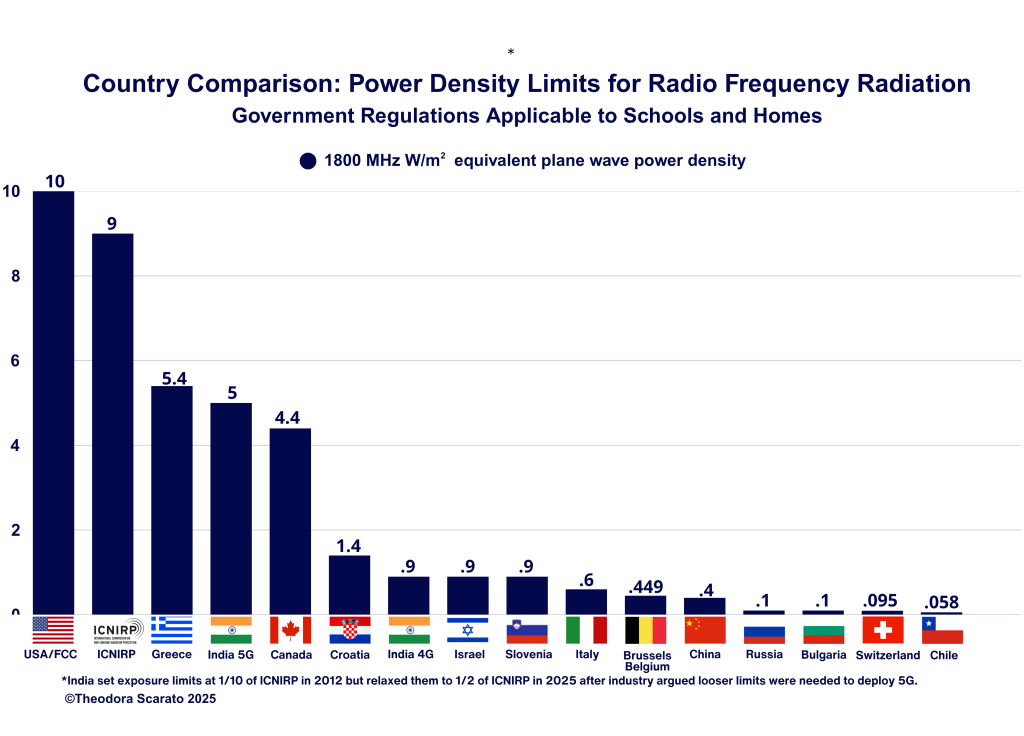
The U.S. is among the countries that allow for the highest levels of cell tower radiofrequency (RF) radiation in the environment. The graph below shows the selected countries regulations regarding public exposure limits for 1800 W/m2 equivalent plane wave density RF radiation, applicable to schools and/or homes. Many countries have limits that apply to places of “sensitive use” such as apartment buildings, schools, hospitals, permanent workplaces, and children’s playgrounds. The U.S. has no specific safeguards for children or schools. In addition, in contrast to the U.S., countries have enacted various policy measures to provide oversight, transparency, and mitigate risk
Minimal Federal Agency Review of Mounting Science on Cell Tower and Wireless Radiation Health Risk
The FCC has no scientists or public health experts on staff, reportedly relying on other federal agencies for expertise in these areas, stating:
“Since the Commission is not a health and safety agency, we defer to other organizations and agencies with respect to interpreting the biological research necessary to determine what levels are safe.”
However, at this time no U.S. federal civilian agency with expertise in health or environment is actively evaluating the effects of wireless exposure. The FCC has no agency to defer to.
The Environmental Protection Agency (EPA), once tasked with establishing RFR safety standards, lost its funding for non-ionizing radiation work in the mid-1990s. When asked in 2020 about the EPA’s activities, Lee Ann B. Veal, then Director of the EPA’s Radiation Protection Division, stated, “EPA does not have a funded mandate for radiofrequency matters, nor do we have a dedicated subject matter expert in radiofrequency exposure.
The National Institute for Occupational Safety and Health (NIOSH) and the Occupational Safety and Health Administration (OSHA) no longer maintain research programs on electromagnetic field exposure. On July 1, 2015, William Perry, the Director of OSHA’s Directorate of Standards and Guidance, when asked about the agencies related to the FCC’s regulations, wrote that “RF emissions are not on OSHA’s active regulatory agenda, so we have not conducted a comprehensive literature review or risk assessment on RF hazards.”
The Food and Drug Administration (FDA) does not conduct original research, and its one well-critised literature review from 2018 was narrow in scope, focused solely on cancer and cell phones, notably dismissing the cancer findings of the $ 30M animal study it requested be conducted.
A 2014 U.S. Department of the Interior letter warned that FCC standards are “based on thermal heating, a criterion now nearly 30 years out of date and inapplicable today,” and highlighting the need for U.S. research on radiation impacts to migratory birds and other species. Yet they have performed no reviews.
This lack of interagency engagement has created a vacuum where no entity is responsible for integrating the growing scientific data into public policy. The absence of an active federal review structure is one of the most fundamental gaps in U.S. wireless governance.
No Consideration for Wildlife or Ecosystem Impacts
U.S. wireless exposure regulations were designed solely for human protection and do not address effects on wildlife or ecosystems. A major review of over 1,2000 studies documented a broad range of impacts to birds, bats, insects, and mammals at exposure levels far below human safety limits. Pollinators, such as bees, are uniquely sensitive due to their smaller size, which results in significantly higher exposures.
Growing Science on Health Effects
A 2023 systematic review and meta-analysis of studies on the biological effects of non-ionizing EMFs to insects of non-ionizing electromagnetic fields was published in Reviews on Environmental Health found the “vast majority of studies found effects, generally harmful ones” with adverse effects such as impacts to reproduction and immune health occurring at legally allowed exposure levels.
“Based on an assessment of the overall study situation on insects, we must warn against a careless deployment of further mobile telephony infrastructure, as harmful effects on insect populations would be likely, especially if interactions with other noxious agents are taken into account (including high-voltage power lines and artificial lighting). This might lead to further declines of already dwindling populations of pollinators, and would thereby entail costs for humanity.”
Further, compliance tests for cell towers focus only on ground-level human exposure. They do not evaluate radiation levels in the airspace where birds fly, tree limbs grow, and bird nests exist. The DC Circuit Court concluded in 2021 that the FCC had “completely failed” to address substantive evidence of environmental harm. Flora and fauna are entirely unprotected under its current guidelines.
A large and growing body of peer-reviewed research now reports biological effects at exposure levels far below FCC limits, including cancer , DNA and genetic damage, endocrine disruption , and impacts to the reproductive system and brain development . Chronic exposure has also been linked to cellular stress responses and increased oxidative stress, which can contribute to chronic disease. Long-term animal studies from the U.S. National Toxicology Program and the Ramazzini Institute in Italy have reported increased rates of brain and heart tumors at exposure levels comparable to cell phones and cell towers. A review on people living near cell towers found that the majority of studies found effects from cancer, to radiation sickness symptoms, to biochemical changes.
A review of low intensity studies found that biological effects could occur at a median specific absorption rate (SAR) of 0.0165 W/kg, much lower than the FCC’s limits of 1.6 W/kg (cell phone and wireless device local tissue limit) and 0.08 W/kg (averaged whole body limit). Further, FCC limits are often stated to have a 50 times safety factor, which the current scientific evidence does not support. The review, published in the peer-reviewed journal Electromagnetic Biology and Medicine, states:
“RFR effects have been observed at low intensities (< 0.4 W/kg) – a list of which is included in Supplement 1 – far below the guidelines. This points to both the nonlinearity of how living systems couple with nonionizing radiation as well as the inadequacy of acute thresholds. The studies encompass many different biological effects to myriad systems, including: apoptosis induction, adrenal gland activity, blood–brain barrier permeability, brain transmitter levels, calcium concentration in heart muscle, calcium efflux, calcium movement in cells, cell growth, cognitive functions, cellular damage in liver, decreased cell proliferation, embryonic development, endocrine changes, enolase activity, genetic effects, hippocampal neuronal damage, immunological functions, kidney development, memory functions, latency of muscular contraction, membrane chemistry, nerve cell damage, metabolic changes, neural electrical activity, oxidative stress, plant growth, prion level, protein changes, renal injury, serum testosterone concentration, heat-shock protein induction, testis morphology, testosterone synthesis, thymidine incorporation, and ultrastructural alteration in cell cytoplasm. In fact, there are not many physiological functions in humans, animals, or plants that are not affected by low-level RFR.”
Regulatory Capture and Industry Influence
Over the past several decades, the FCC is deeply intertwined with the telecommunications industry. Many former FCC commissioners and legal counsels have moved directly into wireless industry leadership roles, and vice versa. As detailed in the Harvard Press book “Captured Agency: How the Federal Communications Commission is Dominated by the Industries it Presumably Regulates,” written by investigative journalist Norm Alster, this revolving door is evidence of regulatory capture.
The investigation “Captured Agency” describes:
- A revolving door between regulators and the wireless industry
- Heavy lobbying and funding through “nonprofit” fronts
- Industry influence over Congress and public relations
- Reliance on discredited, industry-funded scientists
- Misleading claims of “scientific consensus”
- Cuts to independent health research
- Dismissal of credible experts raising concerns
- Push for minimal regulation and refusal to review health evidence
- Aggressive intimidation and lawsuits against researchers
Now, a decade since the investigation was written, the situation continues on. The current FCC Chair, Brendan Carr, previously worked as an attorney representing the wireless industry, including in a major case in which the City of San Francisco passed its “Cell Phone Right-to-Know” ordinance in 2009. The industry had sued, claiming the law violated companies’ free speech rights. The ordinance, passed unanimously, was ultimately not implemented. Today, as FCC Chair, Brendan Carr is pushing forward rules to fast-track cell towers across the nation.
Published analyses also indicate that the source of funding can significantly shape the reported outcomes when it comes to non-ionizing EMF bioeffects research. Studies supported by industry are consistently less likely to identify adverse health effects, while independently funded or government-sponsored investigations more often report biological impacts. Comprehensive reviews have found that higher-quality, independently funded research more frequently demonstrates statistically significant associations between long-term mobile phone use and brain tumor risk, in contrast to industry-funded studies that generally find no such links. The same patterns have been found in studies in powerlines and magnetic field exposure. Elevated risks of childhood leukemia from powerline EMFs are less often found in electric industry-sponsored work. Analyses of millimeter-wave radiation studies funded by industry also report less biological effects compared to those supported by government or academic institutions.

Image: Figure 2. The relative proportion of “Effects” and “No Effects” outcomes from studies according to the funding source from McCredden, J. E., Weller, S., & Leach, V. (2023). The assumption of safety is being used to justify the rollout of 5G technologies. Frontiers in public health, 11, 1058454. See also the Oceania Radiofrequency Scientific Advisory Association Inc. (ORSAA).
Summary of Key Recommendations
- Reinstate a comprehensive national EMF bioeffects research program across federal agencies, with ongoing scientific review and interagency coordination.
- Update FCC human exposure limits to protect against non-heating and long-term exposure, using current science and safety margins protective of children and vulnerable populations.
- Establish national EMF monitoring and surveillance programs, prioritizing schools, homes, and environmentally sensitive areas, with publicly accessible data.
- Require rigorous premarket safety testing for all new wireless technologies, including human, wildlife, and cumulative exposure impacts.
- Modernize compliance testing and enforcement to reflect real-world use, including body contact, multiple devices, and routine audits of networks and cell towers.
- Create a national registry of wireless infrastructure, including cell towers, antennas, and 4G/5G installations, with transparent permitting and RF radiation compliance data.
- Implement clear consumer labeling and public health guidance on wireless radiation exposure and practical steps to reduce exposure.
- Prioritize exposure reduction in homes and schools, including wired alternatives, limits on cell towers and infrastructure near schools and daycares, and mitigation measures for children.
- Establish a robust occupational RF/EMF safety program with exposure monitoring, medical surveillance, training, and worker protections.
- Develop science-based protections for wildlife and ecosystems, including updated NEPA reviews, low-EMF zones, and monitoring in ecological areas.
The current U.S. approach to regulating radiofrequency radiation is outdated and insufficient. The FCC’s 1996 standards were never designed to address the realities of continuous, multifrequency, low-intensity exposure that now defines daily life. With no active federal review of emerging science, no monitoring of environmental levels, and no post-market oversight, the United States lacks an adequate system for ensuring the safety of wireless technologies.
Scientific References For APHA Presentation
1. International Commission on the Biological Effects of Electromagnetic Fields (ICBE-EMF), Belyaev I, Blackman C, et al. Scientific evidence invalidates health assumptions underlying the FCC and ICNIRP exposure limit determinations for radiofrequency radiation: implications for 5G. Environ Health. 2022;21(1). doi:10.1186/s12940-022-00900-9
2. Cook HJ, Steneck NH, Vander AJ, Kane GL. Early research on the biological effects of microwave radiation: 1940–1960. Annals of Science. 1980;37(3):323-351. doi:10.1080/00033798000200271
3. Steneck NH, Cook HJ, Vander AJ, Kane GL. The Origins of U.S. Safety Standards for Microwave Radiation. Science. 1980;208(4449):1230-1237. doi:10.1126/science.6990492
4. Bandara P, Carpenter DO. Planetary electromagnetic pollution: it is time to assess its impact. The Lancet Planetary Health. 2018;2(12):e512-e514. doi:10.1016/S2542-5196(18)30221-3
5. Miller AB, Morgan LL, Udasin I, Davis DL. Cancer epidemiology update, following the 2011 IARC evaluation of radiofrequency electromagnetic fields (Monograph 102). Environmental Research. 2018;167:673-683. doi:10.1016/j.envres.2018.06.043
6. Peleg M, Berry EM, Deitch M, Nativ O, Richter E. On radar and radio exposure and cancer in the military setting. Environmental Research. 2023;216:114610. doi:10.1016/j.envres.2022.114610
7. Belpomme D, Hardell L, Belyaev I, Burgio E, Carpenter DO. Thermal and non-thermal health effects of low intensity non-ionizing radiation: An international perspective. Environmental Pollution. 2018;242:643-658. doi:10.1016/j.envpol.2018.07.019
8. Hardell L, Carlberg M. Comments on the US National Toxicology Program technical reports on toxicology and carcinogenesis study in rats exposed to whole-body radiofrequency radiation at 900�MHz and in mice exposed to whole-body radiofrequency radiation at 1,900�MHz. Int J Oncol. Published online October 24, 2018. doi:10.3892/ijo.2018.4606
9. Davis D, Birnbaum L, Ben-Ishai P, et al. Wireless technologies, non-ionizing electromagnetic fields and children: Identifying and reducing health risks. Current Problems in Pediatric and Adolescent Health Care. 2023;53(2):101374. doi:10.1016/j.cppeds.2023.101374
10. Panagopoulos DJ. Mobile telephony radiation exerts genotoxic action and significantly enhances the effects of gamma radiation in human cell. gpb. 2024;43(02):103-120. doi:10.4149/gpb_2023036
11. Weller SG, McCredden JE, Leach V, Chu C, Lam AK yin. A scoping review and evidence map of radiofrequency field exposure and genotoxicity: assessing in vivo, in vitro, and epidemiological data. Front Public Health. 2025;13. doi:10.3389/fpubh.2025.1613353
12. Lai H, Levitt BB. Radiofrequency radiation-induced gene expression. Reviews on Environmental Health. Published online October 29, 2025. doi:10.1515/reveh-2025-0104
13. Perov SYu, Rubtsova NB, Belaya OV. Status of the Neuroendocrine System in Animals Chronically Exposed to Electromagnetic Fields of 5G Mobile Network Base Stations. Bull Exp Biol Med. 2022;174(2):277-279. doi:10.1007/s10517-023-05689-2
14. Alkayyali T, Ochuba O, Srivastava K, et al. An Exploration of the Effects of Radiofrequency Radiation Emitted by Mobile Phones and Extremely Low Frequency Radiation on Thyroid Hormones and Thyroid Gland Histopathology. Cureus. 2021;13(8). doi:10.7759/cureus.17329
15. Özyılmaz C, Daşdağ S, Oktay MF, et al. One-year follow-up of thyroid status in rats exposed to 2.45 Ghz radiofrequency radiation during the prenatal period. Electromagnetic Biology and Medicine. Published online October 22, 2025:1-10. doi:10.1080/15368378.2025.2577318
16. Assefa EM, Abdu SM. Histopathologic effects of mobile phone radiation exposure on the testes and sperm parameters: a systematic literature review of animal studies. Front Reprod Health. 2025;6. doi:10.3389/frph.2024.1515166
17. Yu G, Bai Z, Song C, et al. Current progress on the effect of mobile phone radiation on sperm quality: An updated systematic review and meta-analysis of human and animal studies. Environmental Pollution. 2021;282:116952. doi:10.1016/j.envpol.2021.116952
18. Bektas H, Dasdag S. The effects of radiofrequency radiation on male reproductive health and potential mechanisms. Electromagnetic Biology and Medicine. 2025;44(3):359-384. doi:10.1080/15368378.2025.2480664
19. Maluin SM, Osman K, Jaffar FHF, Ibrahim SF. Effect of Radiation Emitted by Wireless Devices on Male Reproductive Hormones: A Systematic Review. Front Physiol. 2021;12. doi:10.3389/fphys.2021.732420
20. Zhang Y, Song JY, Sun ZG. Exploring the impact of environmental factors on male reproductive health through epigenetics. Reproductive Toxicology. 2025;132:108832. doi:10.1016/j.reprotox.2025.108832
21. Jangid P, Rai U, Sharma RS, Singh R. The role of non-ionizing electromagnetic radiation on female fertility: A review. International Journal of Environmental Health Research. 2023;33(4):358-373. doi:10.1080/09603123.2022.2030676
22. Bodin R, Godin L, Mougin C, et al. Altered development in rodent brain cells after 900 MHz radiofrequency exposure. NeuroToxicology. 2025;111:103312. doi:10.1016/j.neuro.2025.103312
23. Kaplan S, Deniz OG, Önger ME, et al. Electromagnetic field and brain development. Journal of Chemical Neuroanatomy. 2016;75(Pt B):52-61. doi:10.1016/j.jchemneu.2015.11.005
24. Gulati S, Mosgoeller W, Moldan D, et al. Evaluation of oxidative stress and genetic instability among residents near mobile phone base stations in Germany. Ecotoxicology and Environmental Safety. 2024;279:116486. doi:10.1016/j.ecoenv.2024.116486
25. Schuermann D, Mevissen M. Manmade Electromagnetic Fields and Oxidative Stress—Biological Effects and Consequences for Health. IJMS. 2021;22(7):3772. doi:10.3390/ijms22073772
26. Yakymenko I, Burlaka A, Tsybulin I, et al. Oxidative and mutagenic effects of low intensity GSM 1800 MHz microwave radiation. Exp Oncol. 2018;40(4):282-287.
27. Melnick RL. Commentary on the utility of the National Toxicology Program study on cell phone radiofrequency radiation data for assessing human health risks despite unfounded criticisms aimed at minimizing the findings of adverse health effects. Environmental Research. 2019;168:1-6. doi:10.1016/j.envres.2018.09.010
28. Cell Phone Radio Frequency Radiation. National Toxicology Program. Accessed September 23, 2025. https://ntp.niehs.nih.gov/research/topics/cellphones
29. Falcioni L, Bua L, Tibaldi E, et al. Report of final results regarding brain and heart tumors in Sprague-Dawley rats exposed from prenatal life until natural death to mobile phone radiofrequency field representative of a 1.8 GHz GSM base station environmental emission. Environmental Research. 2018;165:496-503. doi:10.1016/j.envres.2018.01.037
30. Balmori A. Evidence for a health risk by RF on humans living around mobile phone base stations: From radiofrequency sickness to cancer. Environmental Research. 2022;214:113851. doi:10.1016/j.envres.2022.113851
31. Lai H, Levitt BB. The roles of intensity, exposure duration, and modulation on the biological effects of radiofrequency radiation and exposure guidelines. Electromagnetic Biology and Medicine. 2022;41(2):230-255. doi:10.1080/15368378.2022.2065683
32. European Parliament. Directorate General for Parliamentary Research Services. Health Impact of 5G: Current State of Knowledge of 5G Related Carcinogenic and Reproductive/Developmental Hazards as They Emerge from Epidemiological Studies and in Vivo Experimental Studies. Publications Office; 2021. Accessed July 29, 2025. https://data.europa.eu/doi/10.2861/657478
33. Elizabeth Kelley, Henry Lai, Marin Blank, Joel Moskowitz, Magda Havas. International Appeal: Scientists call for protection from non-ionizing electromagnetic field exposure. European Journal of Oncology. 2015;20. https://mattioli1885journals.com/index.php/EJOEH/article/view/4971
34. Scientific Appeals on Wireless and EMF Health Effects. Environmental Health Sciences. Accessed July 29, 2025. https://ehsciences.org/scientific-appeals-on-wireless-and-emf-health-effects/
35. Lin JC. Incongruities in recently revised radiofrequency exposure guidelines and standards. Environmental Research. 2023;222:115369. doi:10.1016/j.envres.2023.115369
36. Lin JC. Health and safety practices and policies concerning human exposure to RF/microwave radiation. Front Public Health. 2025;13. doi:10.3389/fpubh.2025.1619781
37. McCredden JE, Cook N, Weller S, Leach V. Wireless technology is an environmental stressor requiring new understanding and approaches in health care. Front Public Health. 2022;10. doi:10.3389/fpubh.2022.986315
38. McCredden JE, Weller S, Leach V. The assumption of safety is being used to justify the rollout of 5G technologies. Front Public Health. 2023;11. doi:10.3389/fpubh.2023.1058454
39. Birnbaum LS, Taylor HS, Baldwin H, Ben-Ishai P, Davis D. RE: Cellular Telephone Use and the Risk of Brain Tumors: Update of the UK Million Women Study. JNCI: Journal of the National Cancer Institute. 2022;114(11):1551-1552. doi:10.1093/jnci/djac110
40. Environmental Health Trust et al. v. Federal Communications Commission.(United States Court of Appeals for the District of Columbia Circuit 2021). Accessed July 27, 2025. https://www.fcc.gov/document/dc-circuit-decision-environmental-health-trust-v-fcc
41. Veal LAB. Letter with specific Questions Related to the FDA review and to the EPA, CDC, NIOSH and FDA Jurisdiction on EMFs. Published online July 8, 2020. Accessed July 7, 2025. https://ehsciences.org/wp-content/uploads/2025/05/2023-2020-EPA-RF-Radiation-Scarato.pdf
42. Veal LAB. Answering questions regarding the EPA’s webpage and EMF information. Published online May 7, 2023. Accessed July 25, 2025. https://ehsciences.org/wp-content/uploads/2025/05/2023-2020-EPA-RF-Radiation-Scarato.pdf
43. Perry W. OSHA Comments on the FCC’s Notice of Inquiry regarding Policy and Exposure limits for Radiofrequency Emissions. Published online July 1, 2015. Accessed July 27, 2025. https://www.fcc.gov/ecfs/document/10612045456038/1
44. Food and Drug Administration. Nominations from FDA’s Center for Devices and Radiological Health.; 1999. Accessed May 27, 2025. https://ntp.niehs.nih.gov/sites/default/files/2024-10/wireless051999_508.pdf
45. Statement from Jeffrey Shuren, M.D., J.D., director of the FDA’s Center for Devices and Radiological Health on the recent National Toxicology Program draft report on radiofrequency energy exposure. Food and Drug Administration. February 2, 2018. Accessed July 27, 2025. https://www.fda.gov/news-events/press-announcements/statement-jeffrey-shuren-md-jd-director-fdas-center-devices-and-radiological-health-recent-national
46. Panagopoulos DJ, Johansson O, Carlo GL. Evaluation of Specific Absorption Rate as a Dosimetric Quantity for Electromagnetic Fields Bioeffects. Cordes N, ed. PLoS ONE. 2013;8(6):e62663. doi:10.1371/journal.pone.0062663
47. Gandhi OP, Morgan LL, De Salles AA, Han YY, Herberman RB, Davis DL. Exposure Limits: The underestimation of absorbed cell phone radiation, especially in children. Electromagnetic Biology and Medicine. 2012;31(1):34-51. doi:10.3109/15368378.2011.622827
48. Gandhi OP. Yes the Children Are More Exposed to Radiofrequency Energy From Mobile Telephones Than Adults. IEEE Access. 2015;3:985-988. doi:10.1109/ACCESS.2015.2438782
49. American Academy of Pediatrics. Letter in Support of the Cell Phone Right to Know to The Honorable Dennis Kucinich. Published online December 12, 2012. https://ehsciences.org/wp-content/uploads/2025/06/aap_support_letter_cell_phone_right_to_know_act-2012.pdf
50. Fernández C, De Salles AA, Sears ME, Morris RD, Davis DL. Absorption of wireless radiation in the child versus adult brain and eye from cell phone conversation or virtual reality. Environmental Research. 2018;167:694-699. doi:10.1016/j.envres.2018.05.013
51. Gandhi OP. Microwave Emissions From Cell Phones Exceed Safety Limits in Europe and the US When Touching the Body. IEEE Access. 2019;7:47050-47052. doi:10.1109/access.2019.2906017
52. Federal Communications Commission. FOIA No. 2023-000281 and 000325 2mm SAR Tests All Records. Published online September 29, 2023. https://ehsciences.org/wp-content/uploads/2025/09/FCC-FOIA-Control-No.-2023-000281-and-000325-All-records-Theodora-Scarato-2-mm-SAR-Test-.pdf
53. I. Yahya S, A. Khalil Y. Numerical Computation of the Combined Specific Absorption Rates Induced in Human Head due to Multiple Independent Sources. ijea. 2015;5(2):73-79. doi:10.5923/j.ijea.20150502.01
54. Liste des téléphones portables dangereux retirés ou mis à jour. Phonegate. June 13, 2025. Accessed July 27, 2025. https://phonegatealert.org/france-liste-portables-dangereux/
55. Levitt BB, Lai HC, Manville AM. Effects of non-ionizing electromagnetic fields on flora and fauna, part 1. Rising ambient EMF levels in the environment. Reviews on Environmental Health. 2022;37(1):81-122. doi:10.1515/reveh-2021-0026
56. Levitt BB, Lai HC, Manville AM. Effects of non-ionizing electromagnetic fields on flora and fauna, Part 2 impacts: how species interact with natural and man-made EMF. Reviews on Environmental Health. 2022;37(3):327-406. doi:10.1515/reveh-2021-0050
57. Levitt BB, Lai HC, Manville AM. Effects of non-ionizing electromagnetic fields on flora and fauna, Part 3. Exposure standards, public policy, laws, and future directions. Reviews on Environmental Health. 2022;37(4):531-558. doi:10.1515/reveh-2021-0083
58. Levitt BB, Lai HC, Manville AM. Low-level EMF effects on wildlife and plants: What research tells us about an ecosystem approach. Frontiers in Public Health. 2022;10. Accessed December 13, 2022. https://www.frontiersin.org/articles/10.3389/fpubh.2022.1000840
59. Thielens A, Bell D, Mortimore DB, Greco MK, Martens L, Joseph W. Exposure of Insects to Radio-Frequency Electromagnetic Fields from 2 to 120 GHz. Sci Rep. 2018;8(1):3924. doi:10.1038/s41598-018-22271-3
60. Froidevaux JSP, Recuero Virto L, Czerwiński M, Thielens A, Park KJ. Addressing Wildlife Exposure to Radiofrequency Electromagnetic Fields: Time for Action. Environ Sci Technol Lett. 2024;11(1):3-4. doi:10.1021/acs.estlett.3c00795
61. Thill A, Cammaerts MC, Balmori A. Biological effects of electromagnetic fields on insects: a systematic review and meta-analysis. Reviews on Environmental Health. 2024;39(4):853-869. doi:10.1515/reveh-2023-0072
62. Jeladze V, Thielens A, Nozadze T, Korkotadze G, Partsvania B, Zaridze R. Estimation of the Specific Absorption Rate for a Honey bee Exposed to Radiofrequency Electromagnetic Fields from 2.5 to 100 GHz. In: 2023 IEEE XXVIII International Seminar/Workshop on Direct and Inverse Problems of Electromagnetic and Acoustic Wave Theory (DIPED). Vol 1. 2023:180-185. doi:10.1109/DIPED59408.2023.10269454
63. Odemer R, Odemer F. Effects of radiofrequency electromagnetic radiation (RF-EMF) on honey bee queen development and mating success. Science of The Total Environment. 2019;661:553-562. doi:10.1016/j.scitotenv.2019.01.154
64. Willie Taylor. Department of Interior Letter and Attachments on FirstNet. Published online February 7, 2014. https://www.ntia.doc.gov/files/ntia/us_doi_comments.pdf
65. Norm Alster. Captured Agency: How the Federal Communications Commission Is Dominated by the Industries It Presumably Regulates. Harvard University Center for Ethics; 2015. https://www.ethics.harvard.edu/publications/captured-agency-how-federal-communications-commission-dominated
66. Huss A, Egger M, Hug K, Huwiler-Müntener K, Röösli M. Source of Funding and Results of Studies of Health Effects of Mobile Phone Use: Systematic Review of Experimental Studies. Environ Health Perspect. 2007;115(1):1-4. doi:10.1289/ehp.9149
67. Van Nierop LE, Röösli M, Egger M, Huss A. Source of funding in experimental studies of mobile phone use on health: Update of systematic review. Comptes Rendus Physique. 2010;11(9-10):622-627. doi:10.1016/j.crhy.2010.10.002
68. Prasad M, Kathuria P, Nair P, Kumar A, Prasad K. Mobile phone use and risk of brain tumours: a systematic review of association between study quality, source of funding, and research outcomes. Neurol Sci. 2017;38(5):797-810. doi:10.1007/s10072-017-2850-8
69. Carpenter DO. Extremely low frequency electromagnetic fields and cancer: How source of funding affects results. Environmental Research. 2019;178:108688. doi:10.1016/j.envres.2019.108688
70. Telecommunications Act of 1996. Vol 609.; 2018. https://www.govinfo.gov/content/pkg/COMPS-959/uslm/COMPS-959.xml
71. Summary of H.R. 6358 (112th): Cell Phone Right to Know Act. GovTrack.us. August 3, 2012. Accessed July 1, 2025. https://www.govtrack.us/congress/bills/112/hr6358/summary
72. National Cancer Institute Letter. New Hampshire State Report on 5G Health and Environment. New Hampshire Commission https://gc.nh.gov/statstudcomm/committees/1474/reports/5G%20final%20report.pdf