
The FCC has not complied with the 2021 federal court order to explain how its radiation guidelines for cell towers and cell phones adequately protect the public and the environment from harm. Freedom of Information requests reveal the FCC withheld cell phone test data measuring high radiation from several court filings. Now the FCC is refusing to release its Apple iPhone 12 radiation test results.
PRESS RELEASE
Washington, D.C. — December 15, 2025 — Environmental Health Sciences (EHS), a science-based nonprofit organization, submitted a detailed set of questions and supporting evidence to the U.S. Senate Committee on Commerce, Science, and Transportation ahead of its Federal Communications Commission (FCC) oversight hearing, urging Senators to confront what it describes as serious failures in transparency, oversight, and enforcement related to wireless radiation, public health and the environment.
“The American public cannot make informed decisions about wireless technology when safety data are hidden, complaints are ignored, and oversight is virtually nonexistent. Transparency and accountability are not optional; they are fundamental to democracy,” stated Theodora Scarato, Director of the Wireless and EMF Program at Environmental Health Sciences.
In its submission, EHS not only called on Senators to question how the FCC can continue to fast-track cell towers while failing to comply with the 2021 federal court mandate but also called for full transparency related to its cell phone radiation tests that documented radiation levels exceeding FCC radiation limits when tested in body-contact positions, such as in a pocket.
The letter cites evidence obtained through Freedom of Information Act requests showing that the FCC has repeatedly withheld cell phone radiation test results from the public, the courts, and policymakers. Theodora Scarato, Director of the Environmental Health Sciences Wireless and EMF Program, states that her Freedom of Information Act requests also reveal the FCC has refused to release the results of its radiation testing of the Apple iPhone 12 and that the lacks a robust cell phone radiation surveillance program to ensure compliance, instead relying on what is tantamount to an honor system.
Scarato further raises that no federal health or environmental agency is actively conducting comprehensive oversight of cell tower radiation exposures, that the FCC lacks a national RF measurement and monitoring program, and that the agency relies largely on industry self-certification rather than independent compliance verification.
Scarato highlights the hundreds of scientists that recommend public exposure be reduced due to mounting scientific evidence of harmful effects. The International Commission on the Biological Effects of Electromagnetic Fields (ICBE-EMF), an international consortium of physicians and scientists also sent a letter to Congress this week stating, “The FCC’s exposure limits, unchanged since 1996, are not science-based and do not protect the public. They ignore decades of peer-reviewed research showing biological harm at levels far below those that cause heating.”
US regulations, unchanged since they were set in 1996, allow wireless radiation levels in the environment far higher than many other countries. Scarato documents how
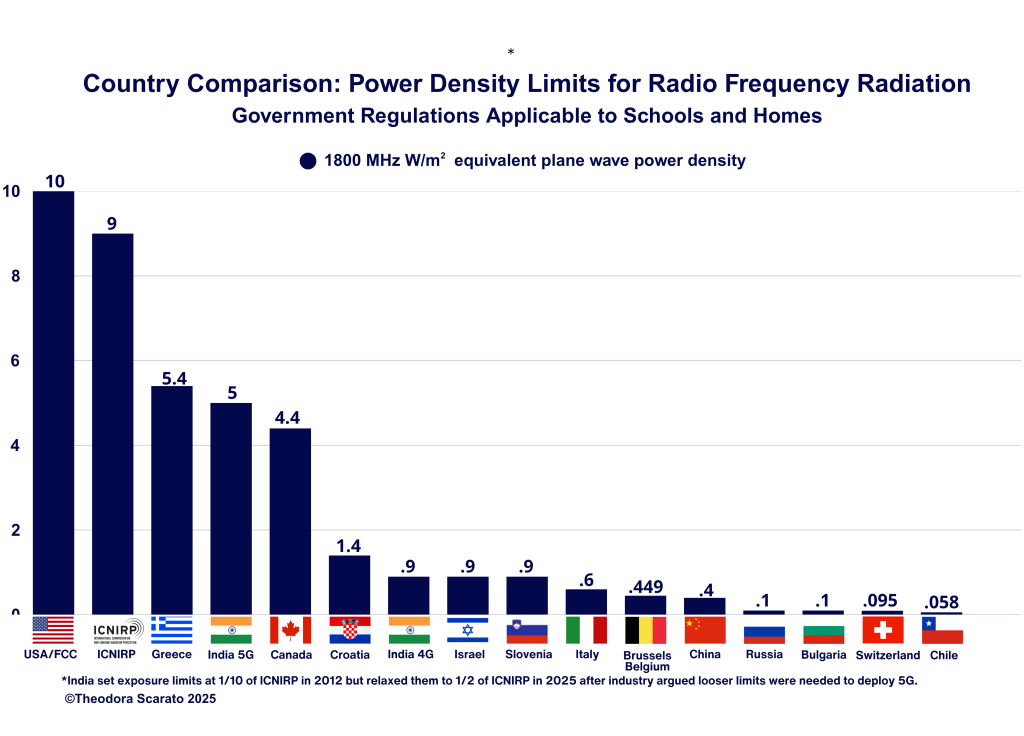
Read the full letter by Environmental Health Sciences to the Senate here.
The letter text is also posted online at this link.
Key Questions on Cell Tower and Wireless Radiation Oversight and Health Risk
Below are key specific questions we ask the Committee to raise with the FCC. This document includes background information with scientific references and more detailed questions.
- How can the FCC fast-track cell towers when it has not responded to the 2021 D.C. Circuit Court mandate requiring the agency to explain how its cell tower and cell phone radiofrequency radiation exposure limits are adequately protective in light of mounting scientific evidence of harm.
- How can the FCC provide public assurances of safety while no federal health or environmental agency is actively conducting comprehensive oversight of cell tower radiofrequency radiation exposures and when there is no premarket safety testing of wireless technologies nor post-market health surveillance?
- Why did the FCC withhold its own laboratory test results, finding cell phone radiation exposure levels exceeding FCC radiation limits when phones were tested in body positions contact-like- like in a pants pocket- from the public?
- Why did the FCC omit its cell phone radiation test results finding RF radiation that exceeded FCC limits from its court filings.
- Why did the FCC omit its cell phone radiation test results, finding RF radiation that exceeded FCC limits, from its open rulemaking on RF radiation limits and rules?
- Why is the FCC withholding its Apple iPhone 12 RF radiation measurement data?
- How can the FCC fast-track cell towers yet it lacks a national cell tower and wireless radiation measurement and monitoring program?
- How can the FCC fast-track cell towers, yet it lacks adequate oversight, compliance, and enforcement mechanisms for cell towers and wireless facilities?
- How can the FCC fast-track cell towers and wireless technologies, yet it lacks a robust oversight and enforcement program to protect workers from occupational radiofrequency radiation exposures?
- Why is the FCC narrowing National Environmental Policy Act protections despite the fact that its rules omit protections for birds, bees, and trees, and that substantial science indicates ecological risks?
- How can the FCC preempt health and environmental issues via Section 704 of the Telecommunications Act, despite continued reliance on outdated, and obsolete FCC exposure limits?
- What is the FCC doing to compete on safety and promote already available wireless radiation exposure-reducing technologies?
Excerpt from the Letter: The FCC Provides Misleading Assurances of Safety While Lacking Active Federal Health Oversight of Cell Tower Radiation
The wireless industry has repeatedly invoked FCC authority and its assurances of safety despite the reality that federal health and environmental agencies are not reviewing the totality of the scientific evidence to ensure public health and environmental protection. There is no FCC required premarket safety testing of wireless technologies for health effects, nor post-market health surveillance. New technologies are given the green light so long as RF emissions meet 1996 limits, despite such technologies and frequencies not even being in existence at that time.
In a letter opposing proposed wireless safety bills in Massachusetts, CTIA asserted that “the FCC’s oversight of these issues was confirmed in October 2018 by FCC Commissioner Carr,” quoting his statement that “the FCC, as well as other agencies that are experts in health and safety issues, are always looking very closely at these issues, staying up to date on the latest science… and have reached the determination that these are safe.” CTIA further claimed that “the consensus among health experts is that the weight of scientific evidence shows no known adverse health effects to humans from exposure to wireless antennas or devices.”
Neither of these statements is accurate, yet the FCC has taken no action to correct or disavow these representations.
In EHT et al. v. FCC, the D.C. Circuit highlighted how the record showed that federal health and safety agencies did not provide any substantive, independent evaluation of the FCC’s radiofrequency exposure limits or affirm their adequacy, despite the FCC’s repeated claims of interagency consensus. The Environmental Protection Agency abandoned non-ionizing radiation research decades ago; OSHA and NIOSH have no active RF health research or surveillance programs; the National Cancer Institute does not conduct risk assessments or make safety determinations ; the CDC has repeatedly funded industry consultants to draft its webpages ; and the FDA has only shown limited review to narrow questions about cell phones while disclaiming jurisdiction over cell tower emissions. Despite the rapid expansion of wireless infrastructure and near-universal exposure to wireless (RF) radiation, in practice, no federal agency is currently conducting comprehensive, ongoing oversight to evaluate real-world cell tower radiofrequency radiation exposures or associated long-term health risks.
Read the full letter by Environmental Health Sciences to the Senate here.
About Environmental Health Sciences
Environmental Health Sciences is a non-profit environmental health organization with a Wireless and EMF Program advancing scientific research on cell tower radiation health effects, wireless exposure, cell phone safety, and EMF health risks.