
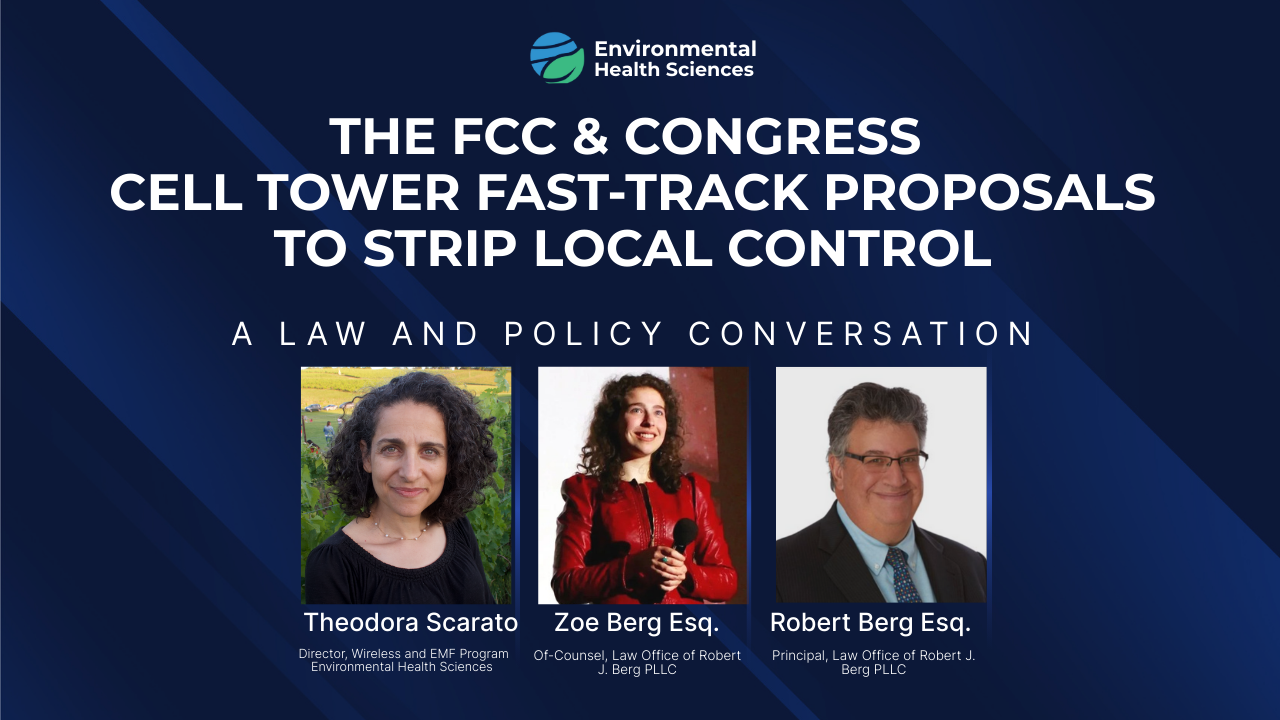
Video from the December 8, 2025 Webinar and Resources
The FCC has released a sweeping new proposed rulemaking – WT Docket No. 25-276 – which is intended to strip local control over the siting of cell towers and wireless telecommunications equipment. At the same time, Congress is considering H.R. 2289, a bill that would similarly strip local control and exempt numerous wireless telecommunications facilities from environmental and historic preservation reviews. This deregulatory effort comes despite the FCC’s failure to comply with the D.C. Circuit’s 2021 EHT v. FCC court order and an ever-growing body of peer-reviewed scientific evidence linking wireless radiation exposure to serious adverse health impacts.
This law and policy webinar from the Wireless and EMF Program of Environmental Health Sciences features leading experts in the field of technology safety discussing the federal proposals and the urgent need to preserve local control to ensure public health protection. This webpage includes resources for the public to take action.
Presenters:
Theodora Scarato, MSW
Director of the Wireless & EMF Program at Environmental Health Sciences. She is a leading expert in wireless-safety policy. She has published several papers on wireless, health, and environment and was a lead in the landmark federal case that ordered the U.S. government to justify its 1996 cell tower radiation limits. More about Theodora Scarato.
Robert Berg, Esq.
Principal, Law Office of Robert J. Berg PLLC
Zoe Berg, Esq.
Of-Counsel, Law Office of Robert J. Berg PLLC
Robert and Zoe are telecommunications lawyers and staunch advocates for pubic health and preserving state and local authority over the siting of wireless telecommunications infrastructure. More at Robertjberglaw.com
Deadlines: The public and local governments only have until New Year’s Eve to submit comments to the FCC, with an additional 15 days for reply comments. For H.R. 2289, the bill can come to the floor for a full vote by the House at a TBA time and date.
Take action by writing your local lawmaker. Below is an action alert for your federal and state reps; however we urge everyone to also contact your local city and county and town officials.
Webinar Resources
On this page, you can find more information on what the proposed rules mean, how the federal rule-making process works, and how everyone, from elected officials to the public, can provide input into these proceedings. Additional resources, court cases, how to find your elected officials, and fact sheets are listed at the bottom of this page.
FCC WT Docket No. 25-276
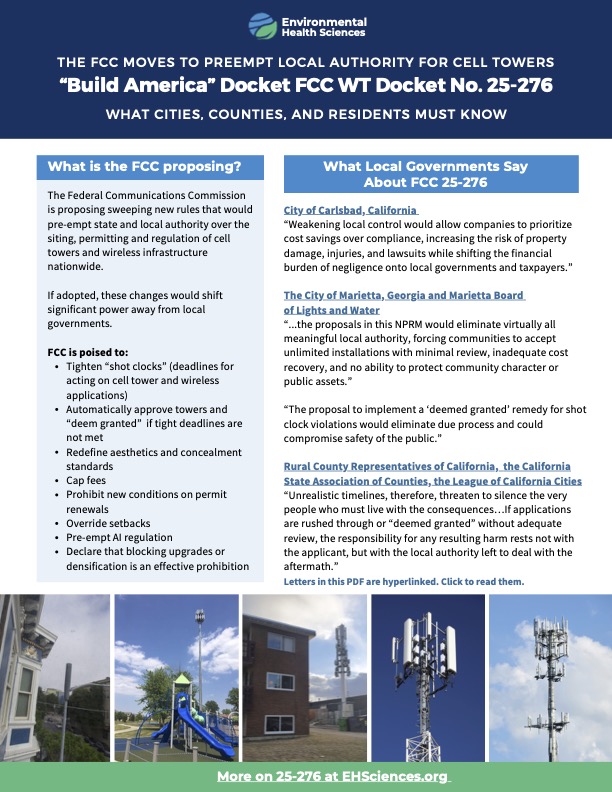
The U.S. Federal Communications Commission (FCC) is proposing new rules to speedup the approval of cell towers and wireless equipment in neighborhoods across the country. In the FCC’s Notice of Proposed Rulemaking in Docket No. 25-276, entitled Build America: Eliminating Barriers to Wireless Deployments, the FCC is proposing sweeping new rules that could override local authority and undermine community control over where and how cell towers, small cells, and wireless antennas are built.
If passed, new FCC rules would:
- Fast-track Cell Towers: Automatically approving cell towers near homes and schools even with strong community opposition due to strict timelines.
- Strip Local Control: Limiting the power of city, state, and county governments to have thoughtful and responsible ordinances, zoning, fees, and permitting rules.
- Bypass Public Input: Excluding the voices of those most affected – the people living beside the cell towers.
How Can You Get Involved?
Once the FCC proposal is published in the Federal Register, the public and elected officials have 30 days to file comments to the FCC and then 15 days more to reply to comments. Comments are due December 31, 2025. Reply Comments are due January 15, 2026.
We urge everyone to submit individual comments to the FCC. Thousands of comments need to be on the record.
Note: Use our letter writing tool for federal and state officials, but these letters do not go to your local officials. You still need to contact your local officials (Mayor, Councilmembers etc..). We recommend Common Cause’s “Find Your Representative” tool. This resource provides a complete list of your federal, state, and local representatives along with their contact information.
Take Action:
Congressional Bill H.R. 2289
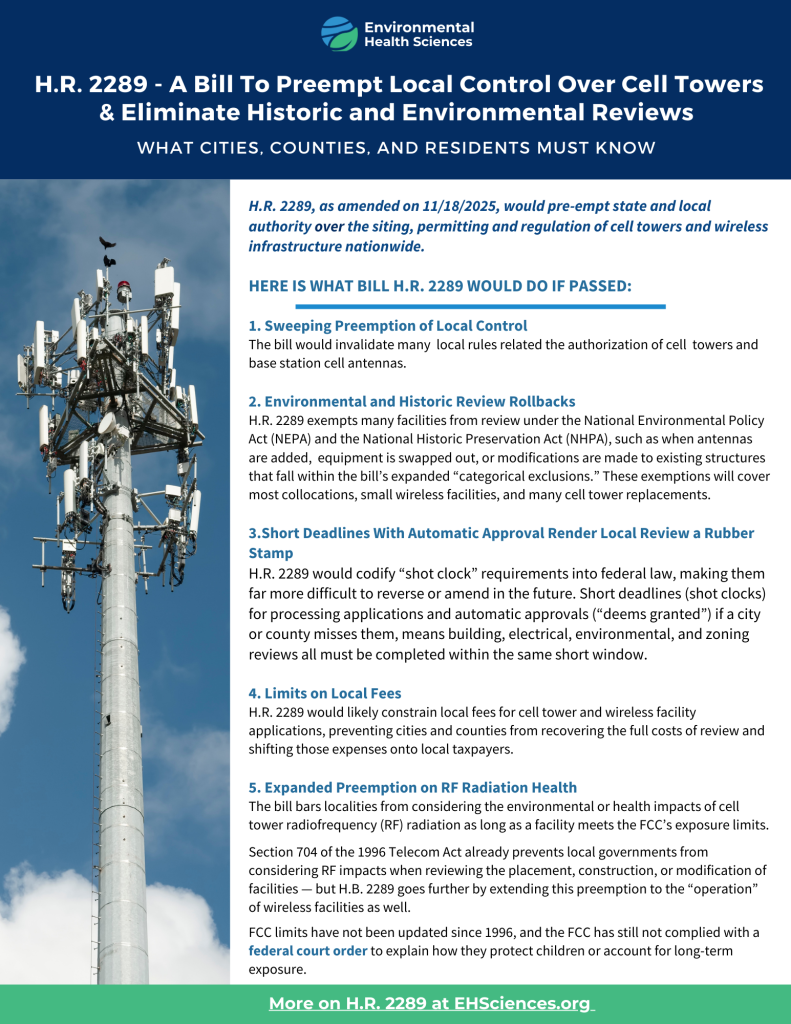
A new bill introduced in the U.S. Congress, H.R. 2289, would dramatically reduce the ability of cities and counties to properly oversee wireless telecommunications while granting sweeping advantages to industry. The bill rewrites federal law to override and basically steamroll local authority by limiting fees, tightening shotclocks, and removing reviews under the National Environmental Policy Act and the National Historic Preservation Act for modifying cell towers and wireless sites.
How Can You Get Involved?
Policymakers must stop H.R. 2289 and reject bills that further weaken local authority. The public must demand transparency and accountability before Congress rewrites national wireless policy. Residents should contact their elected officials and speak out locally on the need for environmental, health, and safety protections.
Take Action:
Important: Additional Congressional Bills Will Strip Local Control
In addition to H.R. 2289, the House Committee advanced several other bills HR 1343, 1588, 1665, 1681, 1731, and 6046. The National Call for Safe Technology has been tracking these bills in addition to H.R. 2298. We recommend sending a letter via their action alert and staying connected with the organization as well. Another useful website is which has a website 25-276.org from Grassroots Communications with key information on the FCC proposal.
Policy Fact Sheets
Factsheet on H.R. 2289 and Factsheet on the FCC 25-276
The Hearings
December 17, 2025: The full Senate Committee on Commerce, Science, and Transportation Committee will convene for a hearing on December 17th to conduct oversight of the Federal Communications Commission. (Press Release). Contact the Committee members and request that they ask the FCC why it is fast-tracking cell towers, but has not responded to the federal court mandate to explain how its cell tower radiation is safe. What is the Timetable for the response?
Resources Discussed in the Webinar
Property Value Devaluation Resources: Environmental Health Sciences has a factsheet on impacts to property values that links to published papers as well as realtor letters. Read more.
The DC Circuit Case on the FCC’s Wireless Radiation Limits: A landmark federal court case where the FCC’s decision to maintain its 1996 cell tower and wireless radiation limits was determined to be “arbitrary and capricious” as the FCC had ignored numerous issues raised in the record regarding health effects of cell towers, cell phones, and wireless radiation. The court issued a mandate that the FCC show proper examination of evidence on its record related to non-cancer health effects (such as impacts to reproduction, brain development, and the immune system), long-term exposure, children’s vulnerability, and environmental impacts. The court also mandated the FCC explain how its compliance test procedures were adequate. In short, the FCC was ordered to show how its 1996 wireless radiation safety limits were protective in light of recent technology and over two decades of published research studies since the limits were set. Read more.
Montgomery County vs. the FCC: In 2019, Montgomery County became the only jurisdiction in the nation to directly challenge the FCC on radiofrequency (RF) health and safety, arguing that the federal government was advancing a “5G First, Safety Second” agenda—rolling out thousands of antennas while refusing to evaluate whether its 1996 radiation exposure limits protect human health in today’s wireless environment. Read more.
About Us: Environmental Health Sciences is a non-profit organization. Our Wireless and EMF Program, directed by policy expert Theodora Scarato, advances independent, high-quality scientific research on cell tower radiation health effects, wireless exposure, cell phone safety, and EMF health risks. We work to ensure that strong, evidence-based science informs meaningful policies that reduce risk and protect communities, children, and the environment.