

Documents from FOIA requests by Theodora Scarato reveal that in 2014, the U.S. Centers for Disease Control and Prevention (CDC) hired Kenneth Foster, PhD—a wireless industry consultant and Professor of Bioengineering at the University of Pennsylvania —to serve as a subject matter expert in drafting new CDC website pages on the health risk of wireless wearables, power lines, smart meters, Wi-Fi, and electromagnetic hypersensitivity (EHS).
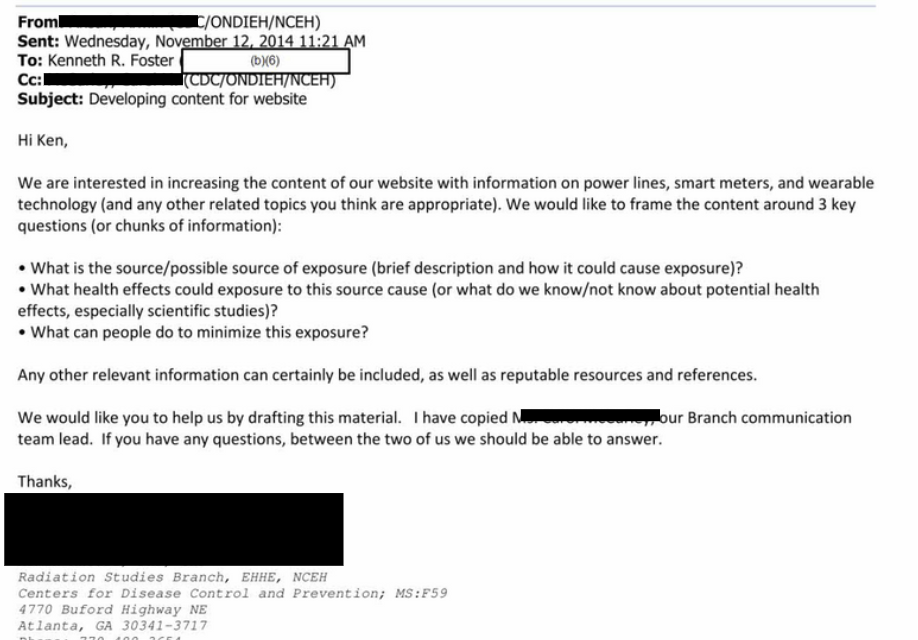
Theodora Scarato began a multi-year investigation into the CDC website pages following the agency’s 2014 removal of earlier posted precautionary advice on reducing cell-phone radiation exposure. FOIA records show that the CDC hired Foster through an hourly consulting contract.

It remains unknown whether the CDC conducted a conflict-of-interest review prior to hiring him, despite CDC policy requiring that content experts disclose financial relationships with manufacturers or commercial supporters. Scarato repeatedly contacted the CDC, but her questions regarding vetting contractors for conflicts of interest were never answered.
CDC Published Website Information on Wireless Health Risk
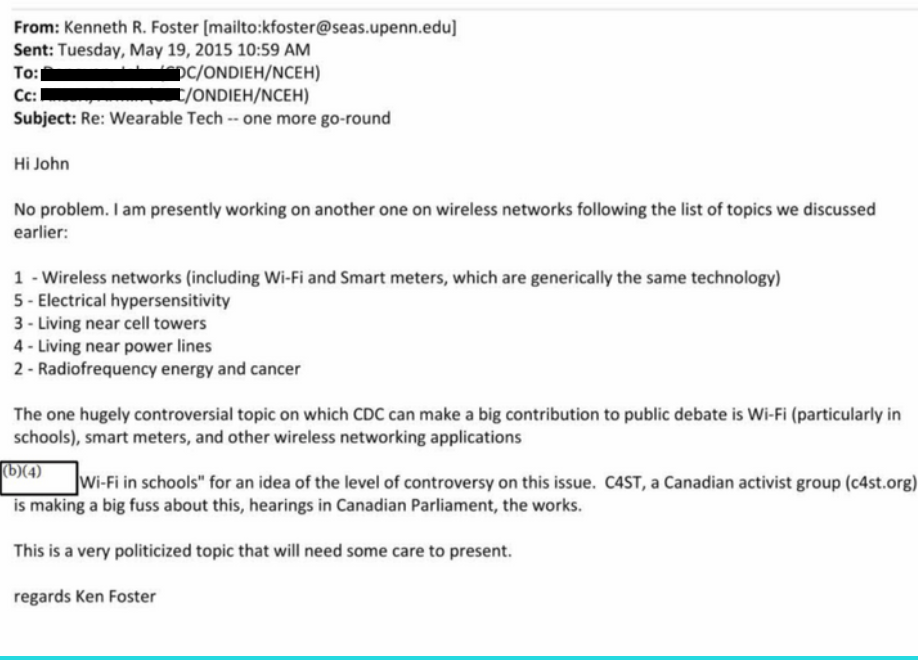
The CDC webpages that Foster was involved in and remain online are:
- Wearable Computers and Wearable Technology (Examples of edited drafts)
- The Electromagnetic Spectrum: Non-Ionizing Radiation
Additional CDC draft webpages that Foster helped create—but which were never finalized—include CDC website pages on:
Like the two published webpages that involved Ken Foster, the unpublished drafts uncovered in Scarato FOIA requests reflect industry-aligned messaging, emphasizing that harm from wireless radiation is “not proven” and that EHS is “not a proven condition caused by electromagnetic fields.” This language closely mirrors the wireless industry talking points that cell phone and wireless radiation is “safe” despite substantial peer-reviewed, published scientific research reporting harmful effects, especially for children. Foster worked with the CDC for several months, often cautioning the CDC about how to handle the topic.
Kenneth Foster’s Longstanding Wireless Industry Ties
Kenneth Foster has authored numerous studies on 5G and wireless radiation, with many funded by wireless and electric-power industry organizations such as the Wi-Fi Alliance, the Mobile Manufacturers Forum (MMF), the Electric Power Research Institute (EPRI), and the GSMA, which represents mobile network operators worldwide. As an example, Foster’s paper Transient Thermal Responses of Skin to Pulsed Millimeter Waves (2020) states, “The work of Kenneth Foster, Martin Ziskin and Quirino Balzano was supported in part by the Mobile and Wireless Forum.” Foster has also served as an expert witness in legal cases involving wireless, non-ionizing EMF radiation and health, where he claims no proof of harm exists.
Foster has also been repeatedly hired as a “safety consultant” for industry in smart-meter, cell-tower, and high-voltage-power-line situations. He lists clients including Motorola, Bell Atlantic Mobile, Comcast Metrophone, Sprint Spectrum, Omnipoint Cellular Communications, and EPRI (See page 220 of this document from a legal case). Public records show that he has testified as an industry safety expert for companies such as T-Mobile, Towers of PA, and AT&T.
How Foster’s Industry Funded Research was Used By the Industry To Show Safety
For nearly decades, Kenneth Foster has repeatedly published industry-funded papers downplaying wireless-radiation risks, and the wireless industry has then used those same papers in glossy brochures, PR campaigns, and “risk communication” materials to promote a narrative of safety. Each time Foster publishes a study funded by groups like the Wi-Fi Alliance, the Mobile Manufacturers Forum, EPRI, or GSMA, the sponsoring organizations quickly cite his work in brochures, FAQs, PowerPoints, and public messaging that reassure consumers there is “no health threat” — even when the studies involve limited samples or methodological gaps. Despite this close relationship, Foster has publicly minimized his industry ties while his research continues to be central to the wireless industry’s safety messaging worldwide.
His paper entitled Wi-Fi and Health: Review of Current Status of Research claims to “examine the current state of research on possible biological effects/health effects of RF energy emitted by Wi-Fi.”
It also states:
“Acknowledgments: This work was funded by the Wi-Fi Alliance, Washington, DC, and Mobile Manufacturers Forum, Brussels, Belgium.”
See more statements on Foster’s papers regarding his financial support from wireless companies.


Here are examples of how the wireless industry funded papers by Foster are frequently used by wireless-industry public relations organizations as “proof of safety” in their health and safety brochures—creating a circular system in which industry-funded studies serve as the evidence base for industry-produced safety assurances.
Wi-Fi and Health
In 2007, the Wi-Fi Alliance released a glossy “WiFi and Health Safety” brochure built around Foster’s Wi-Fi Alliance funded paper, claiming there was “no evidence” of health risks and sponsored by the Mobile Manufacturers Forum. That same year, the Wi-Fi Alliance also issued a one-page FAQ sheet centered on Foster’s study—framing it as one of the largest Wi-Fi exposure investigations while omitting key methodological limits. They also incorporated his work into an internal “Risk Communications” PowerPoint that outlined a PR strategy to showcase the safety of their product.
In 2013, Foster co-authored a review on Wi-Fi and health with long-time industry consultant John Moulder, funded by the Wi-Fi Alliance and the Mobile Manufacturers Forum, concluding exposures were “far below limits.” His 2007 and 2013 industry funded papers on Wi-Fi were then featured in an updated Wi-Fi safety brochure from the Wi-Fi Alliance, MMF, and GSMA, which claimed Wi-Fi signals fall “well below” exposure limits and was distributed internationally as proof of safety.
Smartmeters
Also in 2013, Foster co-authored an EPRI funded paper on Smartmeters with consultant Richard Tell based on measurements from only two houses, which concluded exposures were “very far below” limits. In 2015, GSMA, one of the most powerful trade associations in the world representing wireless companies, published a smart-meter safety brochure that again relied on all three Foster papers to promote compliance with RF exposure standards.
Millimeter Waves
Recent examples of Foster’s industry-funded work include Transient Thermal Responses of Skin to Pulsed Millimeter Waves (2020), supported in part by the Mobile and Wireless Forum. He is also co-author of several papers the Mobile Manufacturers Forum showcased in its 2018 report Twenty Years of Research, including:
- Thermal Response of Human Skin to Microwave Energy: A Critical Review (2016)
- Thermal Response to Tissue RF Exposure… (2016)
- Thermal Modeling for the Next Generation of RF Exposure Limits (2017)
- Tissue Models for RF Exposure Evaluation… (2018)
- Are Children More Exposed to RF Energy from Mobile Phones than Adults? (2014)
Foster’s work focuses heavily on measuring RF exposure and comparing it to FCC or ICNIRP limits—limits widely criticized for failing to account for long-term, low-level, or non-thermal biological effects in humans, wildlife, and plants.
FOIA Documents Show Significant Changes to the CDC Wearables Page After Foster’s Involvement
The CDC initially drafted a webpage that described potential RF exposure from wearable technology and included sections on health effects and how the public could minimize exposure.
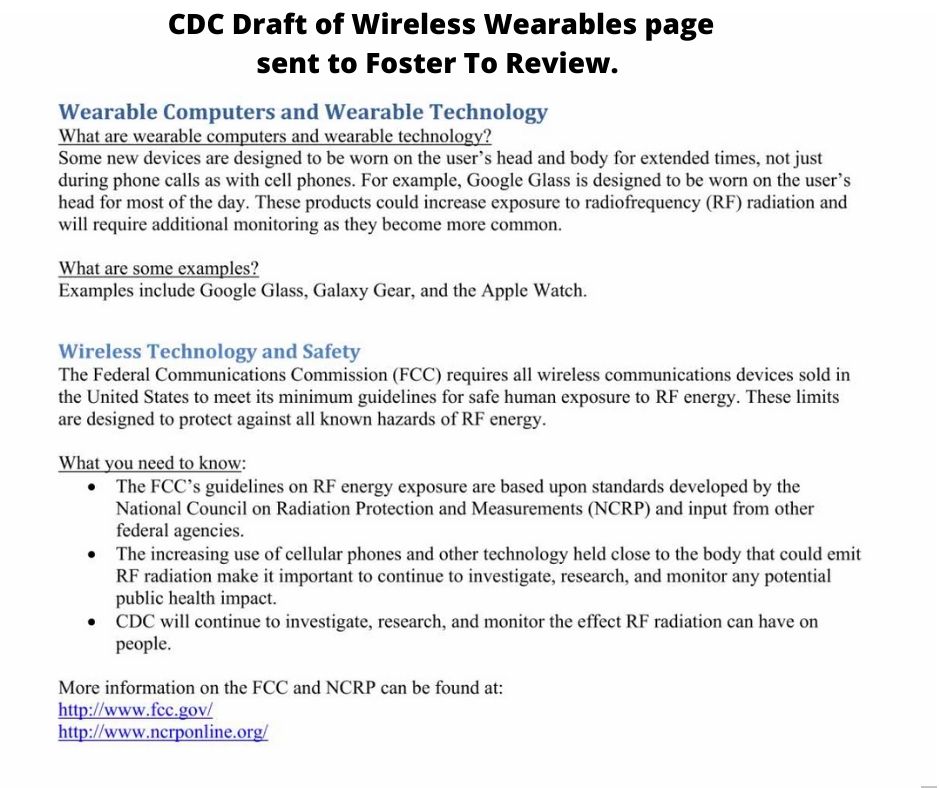
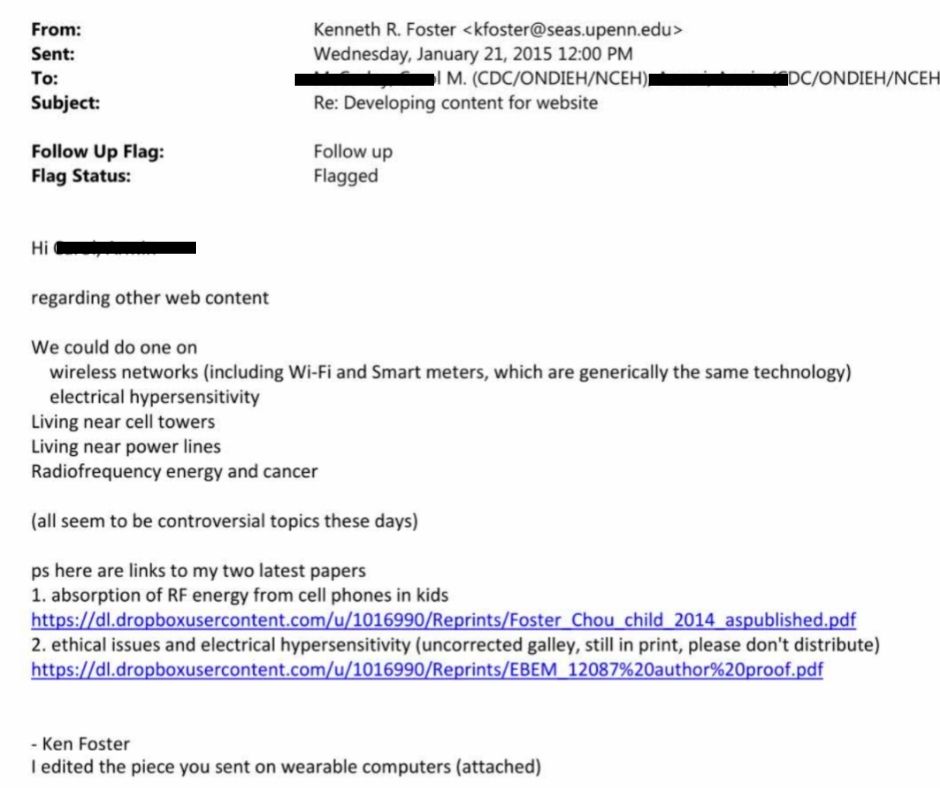
On November 20, 2014, CDC staff emailed Foster the draft, which clearly stated that wearables would increase a user’s RF exposure. On January 21, 2015, Foster sent the CDC detailed revisions. FOIA documents include examples of his proposed wording.
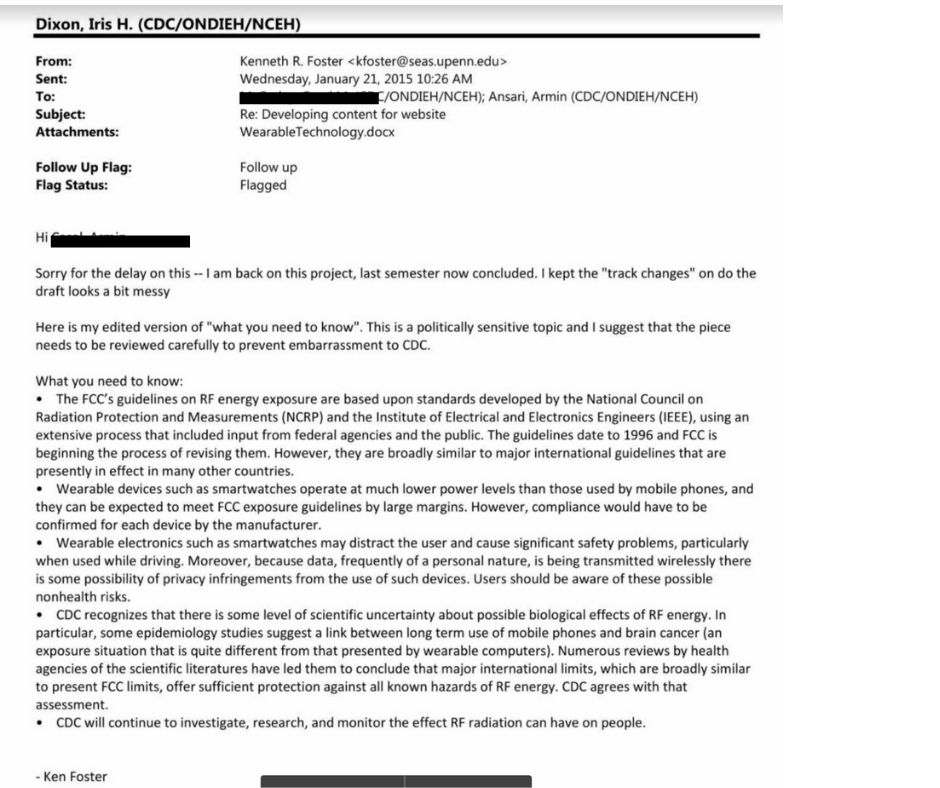
The Final Result: Wireless Health Effects Removed, Exposure Minimized
A review of of emails between Foster and CDC staff finds that:
- All references to increased RF exposure were removed.
- The term “increase” was replaced with terms such as “low,” “small,” “short,” and “reduced.”
- The word “low” appears five times on the final webpage.
- No health effects are mentioned whatsoever.
- No information on how to minimize exposure is provided.
The final CDC webpage states:
“RF transmitters in wearable devices operate at extremely low power levels… wearable devices expose the user to very small levels of RF radiation over time.” The only “safety concern” mentioned is that wearables may be distracting.
While the page links to a CDC non-ionizing radiation overview, that page also provides no information on possible health effects. Thus, the final CDC webpage on wearables reads more like promotional material than a public-health information as was initially drafted by the CDC.
Foster Resisted Sharing Google Glass Radiation Data With Public
FOIA emails show that CDC staff and Kenneth Foster discussed the “high SAR values for Google Glass” while finalizing CDC website content. When a CDC staff member suggested sharing this information—“We maybe should include a link to that info”—Foster advised against it, calling the issue “too complicated.” He urged the CDC to simply state that wearables “operate at low power levels and meet FCC limits,” rather than provide actual SAR data.
Staff had pulled the Google Glass FCC test reports because exposures were relatively higher, and one official argued that adding links would “make it more readable” for the public. Foster pushed back, repeatedly referencing “activists” who might use the information to “discredit CDC,” and recommended softening the language to say RF exposures are “generally” far below FCC limits.
He also noted that Google’s FCC filing predated rule changes allowing higher radiation levels into the ear, calling this “a complicated story for laypeople, but easy for the activists to spin.”


CDC Staff Received Industry-Funded Papers on Wireless and Health Effects from Foster
On February 14, 2015, Foster emailed CDC staff two of his latest papers, including a study on children’s RF exposure. The CDC may not have been aware that the paper was funded by the Mobile Manufacturers Forum and co-authored with C.K. Chou, who was then Chief EME Scientist at Motorola Solutions.
Independent scientists later published a peer-reviewed critique of this very paper in IEEE Access, describing “glaring internal inconsistencies and systematic errors,” and calling for Foster’s paper to be retracted.
Foster has publicly dismissed concerns about wearables as “ludicrous” and argued that research into potential health risks “isn’t necessary.”
Between August 2014 and December 2014, Scarato’s FOIAs show the CDC text on children and cell phone risk was entirely deleted. FOIA documents have redacted sections, and it is unknown why or how this happened.
Foster’s Long-Standing Bias Against Wireless RF Radiation Safety Research
This is not new. Nearly 30 years ago, in a 1987 Nature commentary, Foster argued for halting research into microwave radiation and health, calling such research a “dead end.” His stance has remained largely unchanged since then.