
Electromagnetic fields (EMFs) are invisible energized waves.
A power line carrying electrical current naturally generates a fluctuating magnetic field around it. Because standard electrical equipment and power lines operate at 50 Hz in Europe or 60 Hz in North America, they create electromagnetic fields that fall within the Extremely Low Frequency (ELF) band of the electromagnetic spectrum.
ELF fields and their associated magnetic fields are generated by all electrical grid equipment. This type of exposure is often referred to as ELF-EMF, magnetic fields, or simply EMF.
Health Risks Linked to EMF Exposure:
- Childhood leukemia
- Brain and breast cancers
- Miscarriage
- ADHD, asthma, and obesity in prenatally-exposed children
- Cognitive decline and neurological impacts
Jumplinks:
- Sources of Exposure
- The Science on Health Risks of ELF and Magnetic Fields
- Exposure at School
- How to Protect Your Health
- Policy Issues and Expert Recommendations
- Global Policies to Minimize ELF-EMF Exposure in Sensitive Areas
- Scientific Research Studies
Sources of EMF Exposure
ELF magnetic fields are emitted by a wide range of everyday sources, both inside and outside the home.
- Power lines and electrical grid infrastructure: High-voltage transmission lines, distribution powerlines, transformers, data centers and electrical substations generate continuous exposure.
- Household electrical wiring: Utility meters, wiring in walls, and circuit breakers can produce fields that affect nearby living spaces, particularly when circuits carry heavy loads.
- Everyday appliances: Many common household devices emit ELF magnetic fields during use, including refrigerators, microwaves, electric ovens, and space heaters.
- Electronics, particularly when charging: Laptops, cell phones, and tablets can create localized magnetic field exposure near the charging cords and device.
Chronic exposure—such as living, attending school, or working near power lines, or working in industries with high exposures—is considered the greatest concern by many researchers, because it exposes the body continuously, and exposure accumulates over time.
Residential EMF exposure is rising not only because of our increasing use of electronic devices, but also due to the rapid expansion of energy-intensive data centers that demand new high-voltage transmission lines, increasingly being built near homes and schools. This makes EMF exposure an overlooked but significant health risk tied to data center development.
Science on Health Risks of EMF, ELF and Magnetic Fields
The World Health Organization International Agency for Research on Cancer classified ELF-EMF magnetic fields as a “possible” human carcinogen in 2001, based largely on evidence linking power line exposure to childhood leukemia. In addition, some studies report associations with adult cancers, miscarriage, sleep disruption, and other health effects. Many countries have protective policies in place to reduce power line EMF exposures.
EMF from Powerlines, Childhood Leukemia, and Cancer
“This study presents the epidemiological evidence of childhood cancer risk on exposure to ELF-MFs, which implies that we can confirm the risk of childhood leukemia among pediatric cancers followed exposure to ELF-MFs, which is associated with a higher risk than what was previously known.”
- A 2022 systematic review by Brabant et al. in Reviews on Environmental Health found that long-term exposure to magnetic fields above 0.4 µT (4 milligauss) was associated with increased risk of childhood leukemia, particularly acute lymphoblastic leukemia.
- A 2021 meta-analysis of 33 studies concluded a significant association between powerline ELF exposure and childhood leukemia, with possible dose-response effects.
- A study of children in Mexico City by Correa‐Correa et al. 2025 found children exposed 4 milligauss (ELF-EMF) in their homes had a significantly increased risk of central nervous system tumors. Prolonged tablet use also increased CNST risk, especially in children aged 6–10. Residential ELF-MF exposure was measured over 24 h.
- A study by Lowenthal et al. (2007), published in the Internal Medicine Journal, found that people who lived within 300 meters of high-voltage power lines during childhood had significantly elevated risks of lymphoproliferative and myeloproliferative disorders, including approximately threefold higher risk during the first 15 years of life and up to fivefold higher risk with exposure in early childhood.
Industry funding can significantly impact EMF health effect study results, as electric power companies have substantial financial interests
David Carpenter, MD, Director of the Institute for Health and the Environment at the University at Albany, published a review of the research showing that the source of funding affects study findings.
“The evidence that magnetic fields increase the risk of cancer is neither inconsistent nor inconclusive. Furthermore, adults are also at risk, not just children, and there is strong evidence for cancers in addition to leukemia, particularly brain and breast cancer.”
EMF, Brain Tumors, and Other Cancers
- A 2020 study in Environmental Research linked residential proximity to power lines with an increased risk of brain tumors.
- A 2022 study published in Occupational and Environmental Medicine linked childhood ELF-EMF exposure to adult melanoma.
- Animal studies such as those conducted by the Ramazzini Institute, found that long-term ELF-EMF exposure combined with other carcinogens increased tumor incidence in rats.
EMF, Pregnancy, and Developmental Effects
Kaiser Permanente studies reported that prenatal ELF-EMF exposure was associated with increased miscarriage risk as well as ADHD, obesity, and asthma. A 2020 systematic review concluded that ELF-EMF exposure during early pregnancy is linked to higher first-trimester miscarriage risk. Numerous animal studies report reproductive impacts as well and a 2026 review published in Frontiers in Physiology stated, “to sum up, the current available evidences indicate that the ELF-EMF exposure induces significant biological effects in the myometrium and the endometrium.”
Sperm Damage
Early research by Dr. De Kun Li (2010) found that higher daily exposure to magnetic fields (MFs) at 1.6 mG was associated with a two-fold increased risk of poor sperm quality (abnormal motility and morphology). This study, published in Reproductive Toxicology, suggests a dose-response relationship, with increased exposure duration posing a higher risk to semen quality. Men who were exposed for more than six hours a day were three-to-four times more likely to have decreased fertility.
Watch Dr. De-Kun Li of Kaiser Permanente present his studies in the video below.
Powerline EMF, Alzheimer’s Disease, and Cognitive Effects
Studies have found higher rates of Alzheimer’s disease and other types of dementia close to high voltage powerlines.
A National Institute on Aging, National Institutes of Health supported study of high occupational ELF-EMF exposure reported associations with cognitive dysfunction and dementia, likely due to amyloid beta accumulation and reduced melatonin.
“The results of this study indicate that working in an occupation with high or M/H MF exposure may increase the risk of severe cognitive dysfunction. Smoking and older age may increase the deleterious effect of MF exposure.”
As another example, a large 18-year nationwide cohort study published in Environment International (2026) found effects beginning around 0.5 mG ( milligauss), with stronger associations observed in the 1–3 mG range, a range commonly found in homes close to electrical grid infrastructure.
The Majority of Research Studies Show Effects from EMF Exposure
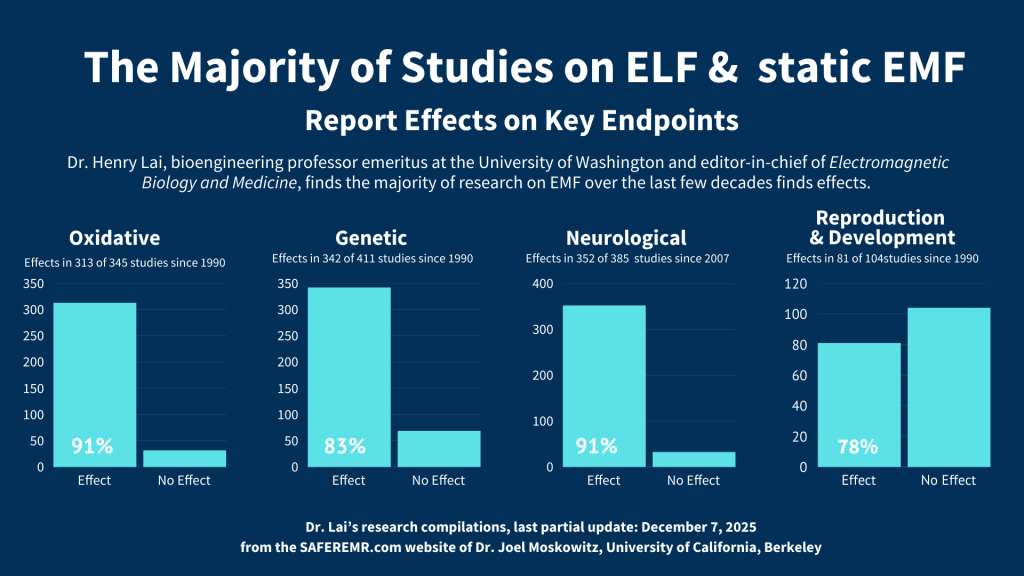
Dr. Henry Lai, Professor Emeritus at the University of Washington, Editor Emeritus of the journal, Electromagnetic Biology and Medicine, and an emeritus member of the International Commission on the Biological Effects of EMF, has compiled summaries of the research on the biological effects of exposure to radio frequency (RFR) and extremely low frequency (ELF) and static electromagnetic fields (EMF). His set of abstracts, which covers the period from 1990 through November 2025 constitutes a comprehensive collection of the peer-reviewed research.
Dr. Lai reports that the preponderance of research has found that exposure to RFR or ELF EMF produces oxidative effects or free radicals, and damages DNA. This information is posted on Dr. Joel Moskowitz website SaferEMR.com.
Summary of Results for ELF (Last major update: December 7, 2025)
91% (n=313) of 345 ELF/static EMF oxidative effects (or free radical) studies published since 1990 reported significant effects.
83% (n=342) of 411 ELF/static EMF genetic effects studies published since 1990 reported significant effects , including 92% (n=219) of 239 studies of gene expression.
91% (n=352) of 385 ELF/static EMF neurological studies published since 2007 reported significant effects.
78% (n=81) of 104 ELF/static EMF reproduction and development studies published since 1990 reported significant effects.
IEEE and ICNIRP Limits Fail To Protect
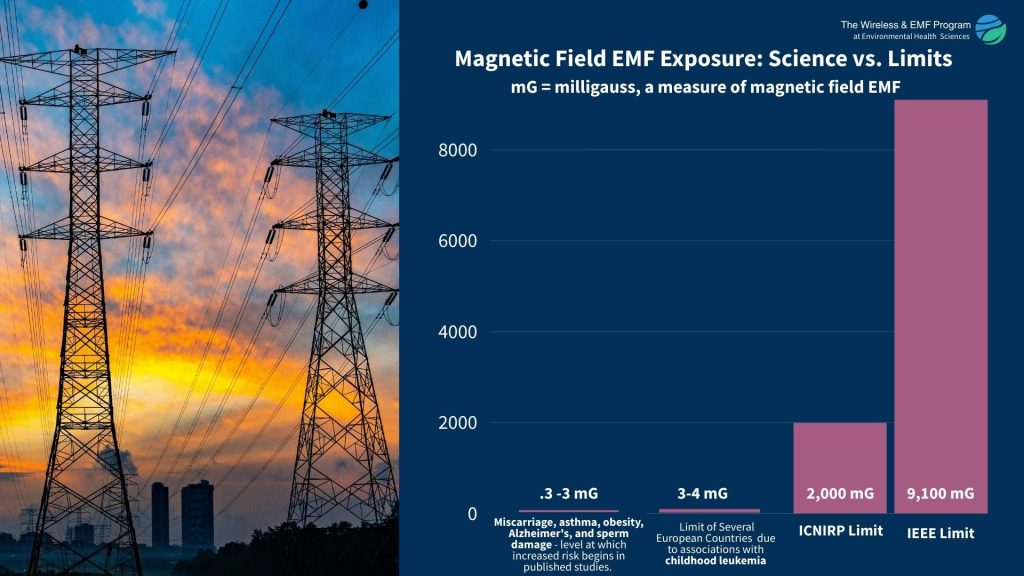
Companies will often say the EMF from their power lines, substations, or AI data centers is within “safe” limits. not so. The industry and international guidelines of the IEEE and ICNIRP primarily address short-term, acute effects (such as nerve stimulation), not long-term EMF exposure health effects. They are set far above the EMF levels associated with childhood cancer in long-term epidemiological studies. In 2002, the WHO’s International Agency for Research on Cancer (IARC) determined that ELF-EMF magnetic fields are “possibly carcinogenic” to humans due to this research.
The US does not have federal safety limits, as the EPA was defunded decades ago from developing proper safety limits. The often cited ICNIRP and IEEE exposure limits for fields at 60 Hz are 2,000–9,000 milligauss. However, the levels at which epidemiologic studies have reported associations with childhood leukemia are at 3–4 milligauss, thousands of times lower. People living in homes very close to powerlines can be exposed to 3-4 milligauss due to the proximity, and it is perfectly legal. No laws have been broken, yet no laws exist.
EMF Exposure at School
While many countries have safeguards in place for schools, the United States has no special federal protections to reduce exposures on school grounds. In California, new schools must maintain minimum distances from transmission line right-of-ways, as nearby power lines can increase ELF‑EMF exposure.
Even if a school is not near a powerline, the EMF exposure can be significant. A 2020 study found that exposure in classrooms was mainly from electrical appliances, wiring, and electrical equipment, and the scientists concluded that, “it is important to design safe and appropriate environments for digital learning in schools, such as proper seating arrangements, to avoid ELF-MFs exposure to students as much as possible.”
EMF Impacts to Wildlife and Nature
EMFs have been shown to affect non-human species at levels well below IEEE and ICNIRP limits.
Over 1,200 research studies on wildlife, flora, and fauna impacts summarized by Levitt et al. (2021) in Reviews on Environmental Health report a broad range of impacts, including altered behavior, endocrine disruption, milk production changes, and prolonged estrous cycles in cattle near electrical infrastructure
“ ELF-EMF found contradictory evidence affecting milk production, fat content, hormone imbalances and important changes in other physiological parameters. Cows have also been found sensitive to stray voltage and transient harmonics with problematic milk production, health, reproduction and behavioral effects.”
-Levitt et al 2021, Effects of non-ionizing electromagnetic fields on flora and fauna, Part 2 impacts: how species interact with natural and man-made EMF.
A 2023 review on non-ionizing EMF impacts to insects, including bees, documented decreased reproductive capacity, altered behavior, oxidative stress, DNA damage, and impaired development as well as navigation and orientation disruption.
Policy Issues and Expert Recommendations on EMF
In 2019, the French Agency for Food, Environmental and Occupational Health & Safety (ANSES) published its Report on the Health Effects of Exposure to Low-Frequency Electromagnetic Fields, reaffirming scientific evidence linking childhood leukemia to exposure and calling for minimizing exposure in sensitive areas such as schools, hospitals, and for pregnant women. ANSES updated its 2010 recommendations, emphasizing that new schools and hospitals should avoid proximity to power lines, occupational exposure should be better controlled (especially for pregnant women), manufacturers should measure and disclose ELF-EMF emissions, and regulations should extend beyond transmission lines to cover all significant sources of exposure.
Theodora Scarato MSW, Director of the Wireless and EMF Program at Environmental Health Sciences documented much of the science and policy information presented on this webpage in a section of her chapter “Escalating Non-Ionizing Electromagnetic Fields from Telecommunications and Electricity: Comparing and Contrasting U.S. and International Policies and Approaches to Protecting Public and Environmental Health,” published in the book The Impact of Anthropogenic Activities on the Natural Environment and Societies during the Contemporary Period, edited by Carolina Leticia Zilli Vieira (CRC Press, 2026).
Failed U.S. Policy on EMF
The U.S. once had a strong EPA research program, but it was defunded. Thus, the U.S. does not have a federal limit for exposure to ELF or magnetic fields.
A major 2002 California State Health and Human Services report “An Evaluation of the Possible Risks From Electric and Magnetic Fields (EMFs) From Power Lines, Internal Wiring, Electrical Occupations and Appliances” concluded that EMFs may increase risks of childhood leukemia, brain cancer, ALS, and miscarriage. There have even been out-of-court settlements for EMF exposure, such as one in Massachusetts where high magnetic fields in a child’s bedroom were linked to leukemia. However, on contrast to numerous other countries, the U.S. has no ongoing activities to create federal safety limits or ensure public health protection.
Global Policies to Minimize ELF-EMF Exposure in Sensitive Areas
Watch a presentation regarding the Netherlands ‘ government’s decision to reduce magnetic field exposure to the public, especially for children, by buying out homes under high voltage powerlines and transformer stations (electrical substations in the USA).
- The Netherlands: Since 2005, policies have been in place to reduce ELF-EMF in homes, schools, and kindergartens. In 2013, houses under 380–220 kV lines were bought out because of the ELF exposure. A 2018 Health Council report reaffirmed links to cancer and recommended reducing ELF-EMF.
- United Kingdom: Government promotes a precautionary policy to reduce EMF including optimum phasing for high-voltage overhead power lines, a series of engineering measures designed to reduce net currents, and encourages substations be sited away from homes. For low-voltage distribution networks (132 kV and below), the precautionary best practice measures to reduce EMF are set out in Engineering Recommendation G92 published by the Energy Networks Association.
- Germany: A 2013 Ordinance requires all feasible measures to minimize ELF-EMF exposure. 220 kV lines cannot be erected over buildings intended for long-term human occupancy.
- Israel: The maximum permissible ELF-EMF exposure in schools and residences is 4 mG per recommendations of the Ministry of Environment and the Ministry of Health.
- French Polynesia: The government-run public awareness campaign advises maintaining at least 1–1.5 meters from induction stoves and other EMF-generating appliances.
- France: Ministerial guidance discourages new hospitals, maternity wards, and childcare facilities near power lines, cables, and transformers where fields exceed 1 µT. The grid operator must monitor EMF emissions near power lines, and citizens can request measurements via local authorities.
- Slovenia: ELF limits are set at 10% of the EU reference value for new or modified installations near residences, schools, kindergartens, hospitals, playgrounds, parks, and public buildings.
- Denmark: Utilities must measure magnetic fields at new installations; annual averages should not exceed 4 mG, and no kindergartens or new buildings may be built near high-voltage lines.
- Switzerland: The Non-Ionizing Radiation Protection Act establishes precautionary EMF exposure limits for new installations.The country also measures, monitors and reports EMF levels.
- Croatia: Reduced ELF-EMF limits apply to sensitive areas, including homes, offices, schools, playgrounds, kindergartens, maternity wards, hospitals, and care facilities.
- Luxembourg: Ministerial recommendation prohibits new living spaces within 20 meters of 65 kV lines and 30 meters of 100–220 kV lines.
- Finland: The radiation authority STUK advises avoiding permanent residences where magnetic flux density continuously exceeds ~0.4 µT.
- Norway: A 0.4 µT “investigation level” applies to new homes, schools, kindergartens, and power lines; if exceeded, exposure-reduction measures are evaluated and implemented if reasonable.
- Italy: The 2017 Environment Ministry Decree recommends minimizing indoor ELF-EMF exposure; a precautionary “attention value” applies to 24-hour median exposure in homes, schools, playgrounds, and other spaces where people spend over 4 hours.
- Belgium: In Flanders, new power lines should be avoided near schools and childcare centers, and exposure over homes should be minimized. Year-averaged exposure near new schools and childcare centers should not exceed 4 mG. In Brussels, transformers near areas where children under 15 may be present must maintain a 24-hour average below 4 mG.
- Toronto, Canada: In 2008, the Toronto city council adopted a prudent avoidance policy to minimise EMF exposure, particularly for young children. Any recreation or parkland, residential, school or day nurseries newly planned or amended, which are adjacent to power line corridors, must adopt low or no cost measures to minimize exposures to electromagnetic fields. Furthermore, a health impact assessment is required to minimise any increase to yearly average exposures when new or upgraded high-voltage transmission lines are proposed within the city.
From the United Kingdom- Guidelines for best practice in relation to electric and magnetic fields (EMFs) in the design and management of low voltage distribution networks, Engineering Recommendation G92 Issue 2 2018
“4.1 Siting “DNOs should make reasonably practicable efforts not to site new final-distribution substations directly against living areas of homes etc (this is intended to cover homes, other residential properties, schools, libraries, and other public spaces with similar levels of occupancy).”
How to Protect Your Health
Extremely low frequency electromagnetic fields (ELF-EMF) from household electronics and electrical appliances weaken quickly as you move away from the source. At about one foot, the field strength is typically much lower, and by two to three feet, it drops sharply. Experts are most concerned about long-term or nightly exposure while sleeping.
Easy First Steps:
- Charge devices away from where you sleep. Keep phones, tablets, and laptops off the nightstand. Charge them during the day and in another room.
- Unplug after charging. EMFs are strongest when devices are plugged in and charging. Use battery power whenever possible.
- Keep the bedroom clear. Reduce electronic clutter — no routers, TVs, or charging stations near the bed. Swap out corded alarm clocks and radios for battery-powered models.
- Avoid sleeping against walls with wiring or large appliances. Keep beds and cribs away from walls with electrical panels, meters, or major appliances on the other side.
Reducing Long-Term and Nightly EMF Exposure
- Unplug unused devices. Use power strips with switches to easily turn off multiple items when not in use.
- Skip plugged-in heating products. Unplug electric blankets, heating pads, and water beds before sleeping — turning them off isn’t enough to stop EMFs.
- Install a master “kill switch.” A kill switch can safely turn off power to bedroom circuits at night, reducing wiring-related EMFs without daily breaker use.
Check your home’s magnetic fields. Use a simple magnetic field meter to spot high-EMF areas. Unusually high readings may indicate wiring or grounding issues a licensed electrician can fix.
The Importance of Knowing Your EMF Exposure
Measuring ELF-EMF levels is especially important for homes near power lines, substations, or heavy electrical equipment. A simple magnetic field meter can help identify high-exposure areas in your home so you can move beds, cribs, or workspaces farther from wiring, unplug unused devices, and use battery-powered electronics when possible. Testing is particularly valuable for households with children or pregnant women, as even modest reductions in exposure may help lower health risks.
What If I Live Near a Power Line?
Homes close to high-voltage power lines or substations can experience elevated ELF magnetic field levels indoors. The strength of these fields depends on how much electricity the lines carry, their height, their distance from your home, and local wiring conditions.
If you live near a high voltage power line:
- Measure field levels indoors and outdoors. A simple magnetic field meter can show whether EMF levels in your home are higher than typical background readings.
- Rearrange living spaces. Place beds, play areas, and home offices in rooms farther from the side of the home facing the power line, if possible.
If measurements show persistently high levels, contact your local utility or an EMF specialist for further testing and mitigation advice. Most utility companies will come out for free to measure levels. Even small adjustments—such as relocating sleeping or sitting areas—can meaningfully reduce long-term exposure depending on the source of the EMF. However, proper measurements are the only way to know the exposure.
Magnetic Fields From Net Currents
When it comes to EMF from power lines, it’s not just about how much electricity they carry. Magnetic fields depend on how current flows out and returns. When outgoing and return currents are equal, opposite, and close together, their magnetic fields largely cancel, resulting in much lower external fields.. However, because modern distribution systems are earthed (grounded) at multiple points, some return current can flow through the ground or other conductive paths instead of the neutral wire. This can create small imbalances, known as “net currents,” which are often the main source of background magnetic fields in buildings.
Wiring Issues Inside the Home Can Create High Magnetic Field EMF
Certain wiring problems inside a home can also produce elevated magnetic fields. These tend to be localized to one area of the home, rather than affecting the whole property as is usually the case when the source is outside (i.e a powerline or substation). If you take measurements and find unusually high magnetic field readings in your home, the issue can often be identified and corrected by a qualified electrician, who will inspect the wiring, repair any faults, and ensure the system is properly balanced and compliant with electrical safety standards.
Examples include:
- Faulty ring main: Phase current flows one way round ring, neutral current the other way
- Two-way switching of lights: Can result in large loops of current if the electrician took short cuts
- Accidental extra earth connections to the neutral: Through corroded insulation or a screw cutting the insulation
- Incorrect wiring: Someone wired the neutral and earth the wrong way round, or left a break in the neutral
Scientific Research Studies
Click on these drop-down links to access scientific reports and comprehensive scientific research studies on health effects of ELF and magnetic fields.
- Reports
World Health Organization International Agency For Research On Cancer. (2002).
Non-ionizing radiation, part 1: Static and extremely low-frequency (elf) electric and magnetic fields. Lyon: World Health Organization.
National Institute of Environmental Health Sciences EMF-RAPID Program (1999).
Health Effects from Exposure to Power-Line Frequency Electric and Magnetic Fields. Research Triangle Park: National Institutes of Health.
French ANSES 2019 Report
OPINION of the French Agency for Food, Environmental and Occupational Health & Safety
Overview: Health effects associated with exposure to low-frequency electromagnetic fields | Anses
Report: Health effects associated with exposure to low-frequency electromagnetic fields“In view of the data available, the Agency is reiterating its 2010 conclusions on the possible association between exposure to low-frequency electromagnetic fields and the long-term risk of childhood leukaemia. It is also restating its recommendation not to build new schools close to very-high voltage power lines. At the same time, the Agency stresses the need to better manage occupational exposure for employees who could be exposed to high levels of electromagnetic fields, particularly pregnant women.”
“the Agency is again recommending a precautionary approach that would limit the number of vulnerable people exposed to high-voltage power lines, as well as limiting exposure. To this end, it recommends not building or developing new facilities attended by vulnerable people (hospitals, schools, etc.) immediately next to very-high voltage power lines, or running new power lines over these facilities.”
National Assembly Report 2012: “The Health and Environmental Effects of Electromagnetic Fields Produced by High and Very High Voltage Power Lines”
“By 2015, your rapporteur believes it is relevant to recommend, as a precautionary measure and in view of the uncertainties of science, that parents and public authorities, in particular local elected officials, seek whenever possible at a reasonable cost not to increase the number of children aged 0 to 6 and unborn likely to be exposed to fields exceeding 0.4 µT on average .
Indeed, the population requiring attention is the unborn child, as this period may be conducive to a predisposition to leukemia, although this is not certain, and children aged 0 to 6 years, who are at risk of developing acute leukemia.”Netherlands Health Council Report
Power lines and health part I: childhood cancer“Since there are indications for a causal relationship between exposure to magnetic fields and increased risks of childhood leukaemia and brain tumours, and magnetic fields are not blocked by soil or construction materials, the Committee suggests the State Secretary from a public health perspective to consider extending the precautionary policy to underground power cables and other sources of long-term exposure to magnetic fields from the electricity grid, such as transformer stations and transformer houses.”
“According to the Committee, the risk of childhood leukaemia and brain tumours should be classified as ‘suggestive of a causal relationship’ in accordance with the EPA framework…”
“The Committee found an association between long-term exposure to a magnetic field strength higher than 0.3 to 0.4 μT and a 1.4 times higher estimated risk of childhood brain tumours (95% CI 0.8-2.7).”
In this video, scientist Eric Van Rogen explains that Dutch scientific reviews confirm an association between long-term exposure to elevated ELF magnetic fields from power lines and childhood leukemia, leading the Netherlands to adopt a precautionary policy. As part of this policy, the government has been buying up homes located directly under or extremely close to high-voltage lines so that residents—especially children—are no longer living in the highest-exposure zones.
National Institute for Public Health and the Environment.
Rianne Stam,PowerPoint on the report
CALIFORNIA EMF PROJECT REPORT
Neutra, R., DelPizzo, V., & Lee, G. (2002). An evaluation of the possible risks from electric and magnetic fields (emfs) from power lines, internal wiring, electrical occupations, and appliances. Oakland: California EMF Program.BIOINITIATIVE REPORT
Sections Specifically on ELF
2012 New Chapter: Plausible Genetic and Metabolic Mechanisms for Bioeffects of Very Weak ELF Magnetic Fields on Living Tissue – Dr. Heroux and Dr. Ying Li
ELF-EMF/Static Field Free Radical (Oxidative Damage) Abstracts (2019)
ELF-EMF Comet Assay Abstracts (2017)
ELF-EMF/Static Field Neurological Effects Abstracts (2019)
- Scientific Research
Correa-Correa V, Núñez-Enríquez JC, Mezei G, Rivera-Luna R, Peñaloza-González JG, Rivas-Carrillo SD et al Extremely Low-Frequency Magnetic Fields (ELF-MF) and Radiofrequency: Risk of Childhood CNS Tumors in a City with Elevated ELF-MF Exposure. Environ Res. 2025 Sep 14:122858. doi: 10.1016/j.envres.2025.122858. Epub ahead of print. PMID: 40957475.
Brabant C, Honvo G, Demonceau C, Tirelli E, Léonard F, Bruyère O. Effects of extremely low frequency magnetic fields on animal cancer and DNA damage: a systematic review and meta-analysis. Prog Biophys Mol Biol. 2024 Dec 31:S0079-6107(24)00116-0. doi: 10.1016/j.pbiomolbio.2024.12.005.
Henshaw, D. L. (2002). Does our electricity distribution system pose a serious risk to public health?. Medical Hypotheses, 59(1), 39-51.
Sun, J. W., Li, X. R., Gao, H. Y., Yin, J. Y., Qin, Q., Nie, S. F., & Wei, S. (2013). Electromagnetic field exposure and male breast cancer risk: a meta-analysis of 18 studies. Asian Pacific journal of cancer prevention : APJCP, 14(1), 523–528.
Brabant, C., Geerinck, A., Beaudart, C., Tirelli, E., Geuzaine, C., & Bruyère, O. (2022). Exposure to magnetic fields and childhood leukemia: A systematic review and meta-analysis of case-control and cohort studies. Reviews on Environmental Health.
Carles, C., Esquirol, Y., Turuban, M., Piel, C., Migault, L., Pouchieu, C., Bouvier, G., Fabbro-Peray, P., Lebailly, P., & Baldi, I. (2020). Residential proximity to power lines and risk of brain tumor in the general population. Environmental Research, 185, 109473.
Carpenter, D. O. (2013). Human disease resulting from exposure to electromagnetic fields. Reviews on Environmental Health, 28(4), 159–172.
Carpenter, D. O. (2019). Extremely low frequency electromagnetic fields and cancer: How source of funding affects results. Environmental Research, 178, 108688.
Erdem, O., Akay, C., Cevher, S. C., Canseven, A. G., Aydın, A., & Seyhan, N. (2018). Effects of Intermittent and Continuous Magnetic Fields on Trace Element Levels in Guinea Pigs. Biological Trace Element Research, 181(2), 265–271.
IARC. (n.d.). Non-ionizing Radiation, Part 1: Static and Extremely Low-frequency (ELF) Electric and Magnetic Fields. Retrieved September 21, 2022, from https://publications.iarc.fr/Book-And-Report-Series/Iarc-Monographs-On-The-Identification-Of-Carcinogenic-Hazards-To-Humans/Non-ionizing-Radiation-Part-1-Static-And-Extremely-Low-frequency-ELF-Electric-And-Magnetic-Fields-2002
Karimi, A., Ghadiri Moghaddam, F., & Valipour, M. (2020). Insights in the biology of extremely low-frequency magnetic fields exposure on human health. Molecular Biology Reports, 47(7), 5621–5633.
Khan, M. W., Juutilainen, J., Naarala, J., & Roivainen, P. (2022). Residential extremely low frequency magnetic fields and skin cancer. Occupational and Environmental Medicine, 79(1), 49–54.
Koeman, T., van den Brandt, P. A., Slottje, P., Schouten, L. J., Goldbohm, R. A., Kromhout, H., & Vermeulen, R. (2014). Occupational extremely low-frequency magnetic field exposure and selected cancer outcomes in a prospective Dutch cohort. Cancer Causes & Control: CCC, 25(2), 203–214.
Martínez, M. A., Úbeda, A., Martínez-Botas, J., & Trillo, M. Á. (2022). Field exposure to 50 Hz significantly affects wild‑type and unfolded p53 expression in NB69 neuroblastoma cells. Oncology Letters, 24(3), 1–9.
Malagoli C, Malavolti M, Wise LA, Balboni E, Fabbi S, Teggi S, Palazzi G, Cellini M, Poli M, Zanichelli P, Notari B, Cherubini A, Vinceti M, Filippini T. Residential exposure to magnetic fields from high-voltage power lines and risk of childhood leukemia. Environ Res. 2023 Sep 1;232
Malavolti M, Malagoli C, Wise LA, Poli M, Notari B, Taddei I, Fabbi S, Teggi S, Balboni E, Pancaldi A, Palazzi G, Vinceti M, Filippini T. Residential exposure to magnetic fields from transformer stations and risk of childhood leukemia. Environ Res. 2023 Dec 23:118043.
Seomun, G., Lee, J., & Park, J. (2021). Exposure to extremely low-frequency magnetic fields and childhood cancer: A systematic review and meta-analysis. PLOS ONE, 16(5), e0251628.
Sun, J., Tong, Y., Jia, Y., Jia, X., Wang, H., Chen, Y., Wu, J., Jin, W., Ma, Z., Cao, K., Li, X., Chen, Z., & Yang, G. (2023). Effects of extremely low frequency electromagnetic fields on the tumor cell inhibition and the possible mechanism. Scientific Reports, 13(1), Article 1.
Wang X, Ye Y, Zuo H, Li Y. Neurobiological effects and mechanisms of magnetic fields: a review from 2000 to 2023. BMC Public Health. 2024 Nov 8;24(1):3094. doi: 10.1186/s12889-024-18987-9. PMID: 39516768; PMCID: PMC11545338.